

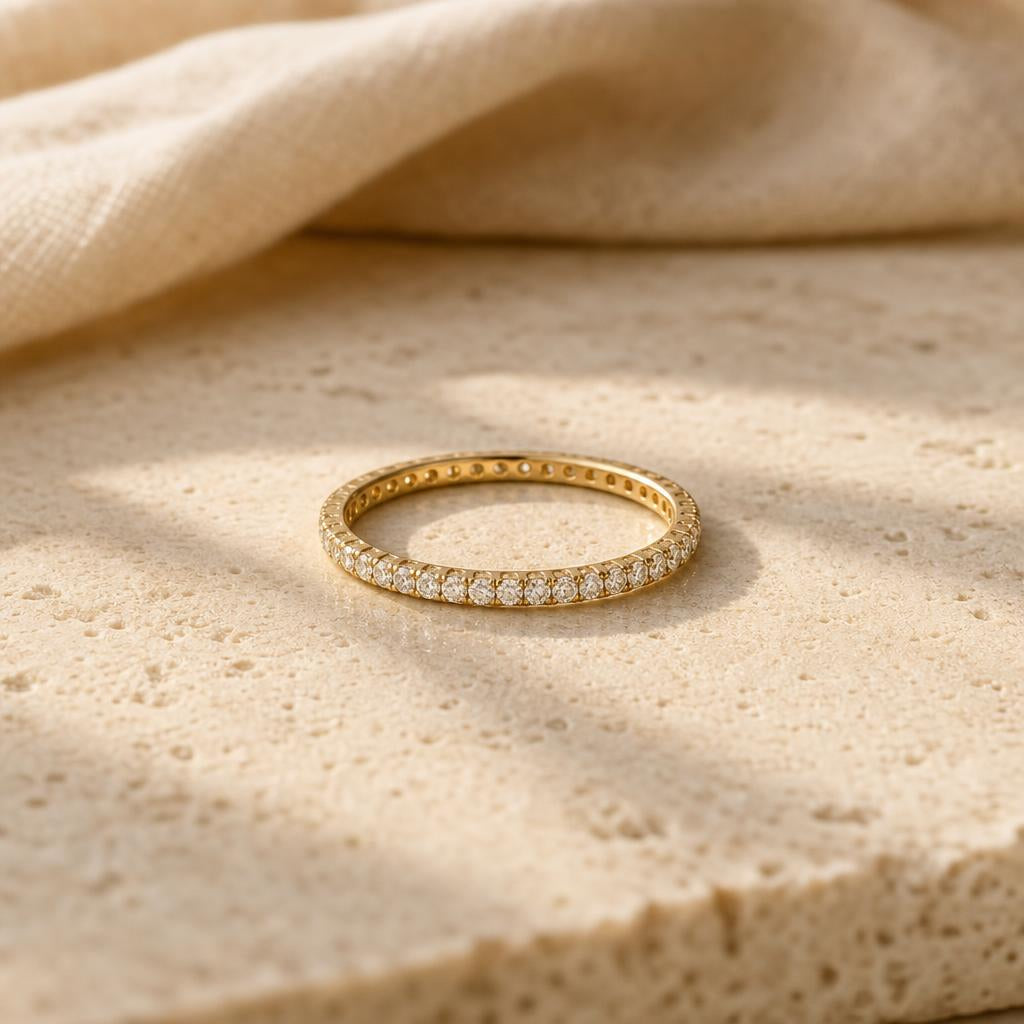
Wedding Bands You Can Wear Alone Before the Wedding: A Practical Buying Guide
There's an unwritten rule that says the wedding band waits — that it stays boxed up until the ceremony, a placeholder for a moment still months or years away. Nobody actually wrote that rule. It's just the shape ring-buying happens to take by default, and it means a lot of women spend a long stretch of engagement wearing nothing on that hand but the engagement ring itself.
That gap doesn't have to exist. A thin stacking band, worn on its own, isn't a rehearsal for the "real" ring — it's a ring doing exactly what it was built to do, months ahead of schedule. The only trick is choosing one that reads as complete by itself, so it never looks like it's waiting for reinforcements.


Why the "Wait Until the Wedding" Rule Doesn't Actually Hold Up
The rule exists because of how ring-buying is traditionally sequenced: engagement ring first, wedding band second, and the second purchase is supposed to happen close to the ceremony so the two can be sized and set together. That sequence makes sense for a band that's designed to physically interlock with a specific engagement ring — a curved band built to hug a particular setting, for instance.
It makes much less sense for a plain stacking band that isn't trying to interlock with anything. A thin eternity row, a bezel-set band, a row of marquise stones — none of these need to be measured against your engagement ring's exact contour before you buy them. They just need to fit your finger. And a ring that only needs to fit your finger can be worn the day it arrives, not the week of the wedding.
There's also a quieter argument here, and it's the more interesting one: waiting for permission to wear a full stack is its own kind of outdated rule. She's already decided what she likes. Buying it now instead of "someday" is simply the more rational move — she gets more years out of the ring, not fewer.
What Makes a Band Read as Whole, Not Half-Finished
The reason some stacking bands look incomplete alone and others don't comes down to three things: width, setting style, and how the metal tone reads against skin. Get these right and a single band looks intentional. Get them wrong and it looks like the other half is missing.
Width
A band that's too thin can disappear on the hand when it's not flanked by other pieces — it reads as an accent rather than a ring. A band that's too wide, on the other hand, can look like it's trying to do the job of a full engagement ring on its own. The sweet spot for a solo band is somewhere in the middle: substantial enough to register as a complete piece of jewelry, narrow enough to still function as a stacking piece once you're ready to add to it.
Setting Style
This is where the real difference shows up. A channel-set or bezel-set band, where each stone sits flush and protected, has a finished, self-contained look — nothing about it signals "part one of two." A shared-prong pavé row reads the same way: continuous, deliberate, complete. Settings that were designed to nest against a specific companion ring — deep curves, cut-out shanks — are the ones that look unfinished worn alone, because they were never meant to be.

Cherish Ring
A fresh take on the eternity band — each round stone is individually bezel-set, so the edge stays smooth and the whole row reads as one continuous, self-contained piece rather than a setup for something else.
Shop Cherish Ring →Metal Tone
A band worn alone gets studied more closely than one buried in a stack, so metal tone matters more here, not less. Sterling silver with rhodium plating reads clean and cool against most skin tones and pairs easily with whatever you already wear daily. Rose gold and 18k gold plating read warmer and slightly more decorative on their own — worth choosing deliberately rather than defaulting to whichever finish photographs best on someone else's hand.
The Stacking Bands Built to Work Solo — and Later, Together
Not every stacking band was designed with this dual job in mind, but a handful genuinely were. The Amore Ring takes a row of oval-cut stones and links them so the whole band catches light evenly across its width — bold enough to hold its own on a bare finger, still thin enough to sit flush once a second band joins it. The Wishbone Ring goes the opposite direction: a row of smaller round pavé stones in a slim profile that reads quiet and precise rather than sparse.
The Petal Ring is the one to reach for if a plain row feels too safe — its marquise stones are set to unfold across the band rather than sit in a flat line, so it has more visual movement than a standard eternity row without losing the continuous, finished look that makes a solo band work. The Forever Ring sits closest to a classic: a half-eternity row of round pavé stones with a clean, unfussy profile that works equally well as the only ring on your hand or as the anchor piece a future stack gets built around.

Devotion Ring
A continuous circle of baguette-cut stones, channel-set for a smooth, architectural line all the way around — one of the more structured options here, and one that reads especially deliberate worn by itself.
Shop Devotion Ring →Sizing It Now So It Still Fits Later
Worth knowing: Gemiros rings are sized in whole US sizes only, with no resizing service offered — so it's worth measuring carefully before you buy rather than sizing on instinct. If you're between sizes, sizing up slightly is generally the safer call for a band you plan to wear daily, since fingers shift with temperature, time of day, and the seasons.
Because a solo stacking band isn't waiting on a companion ring to determine its fit, there's no reason to delay sizing until closer to the wedding. Measure now, order the size that's comfortable today, and treat the ring as a permanent piece of your everyday jewelry rather than a placeholder with an expiration date.
How to Wear It Between Now and the Wedding
There's no single correct hand for a solo stacking band, which is part of what makes it such an easy piece to add early. Some women wear it on the same finger as the engagement ring, letting the two sit together as a preview of the eventual stack. Others move it to the right hand entirely, treating it as its own statement rather than a supporting piece. Either reading works — the ring doesn't need permission from the rest of your jewelry box to make sense on its own.
It also works layered against whatever you already own: a signet ring on another finger, a thin band you bought for yourself last year, nothing at all. A well-chosen solo band doesn't require an entourage to look considered.
Quick Takeaways
- A band only needs to interlock with your engagement ring if its shank was built to nest against one — most stacking bands weren't, so there's no reason to wait to wear it alone.
- Look for continuous settings — bezel, channel, or shared-prong pavé — for a band that reads finished, not half of a set.
- A mid-width band holds its own solo and still sits flush once a second band joins it later.
- Measure and size now; Gemiros ships whole sizes only, with no resizing service, so accuracy matters more than speed.
- Wear it on the same hand as your engagement ring, the opposite hand, or entirely on its own — there's no rule that says which is correct.
Frequently Asked Questions
Can I wear a stacking band before I have an official wedding band?
Yes — a stacking band that isn't built to physically nest against your engagement ring doesn't need to wait for one. Bezel-set, channel-set, and pavé eternity bands are designed to read as complete on their own, so there's no styling reason to hold off.
Will a solo stacking band still work once I add my actual wedding band?
A mid-width band with a clean, flush profile — the kind featured throughout this guide — is built for exactly that transition. Choose one without a deep curve or cut-out shank designed to hug a specific ring, and it will sit comfortably beside almost anything you add later.
What ring size should I order if I plan to wear the band daily?
Measure your finger at a time of day when it isn't unusually swollen or cold, and size for comfortable daily wear rather than a snug fit. Gemiros rings come in whole US sizes only and aren't eligible for resizing, so it's worth double-checking your measurement before ordering.
Which hand should I wear a solo wedding band on before the wedding?
There's no fixed rule. Wearing it on the same finger as your engagement ring previews the eventual stack; wearing it on the opposite hand lets it stand as its own piece. Both are common, and the choice comes down to personal preference rather than etiquette.
The rings in your future stack don't have to sit in a drawer waiting for a date on a calendar. Choose one built to stand alone, size it now, and wear it the way you'd wear anything else you love — because you wanted to, not because an occasion finally gave you permission.


