

Wedding Band vs. Engagement Ring: What the Terms Actually Mean
Somewhere between "which ring am I supposed to buy first" and "wait, is a band the same thing as a ring," most women researching engagement jewelry hit the same wall: the vocabulary. Ring. Band. Wedding ring. Wedding band. The internet uses them like synonyms half the time and like precise, non-negotiable categories the other half — and nobody stops to explain which is which, or why it even matters.
It matters more than it sounds like it should, mostly because it changes what you're actually shopping for. So before you add another tab to the browser window, here's the plain version — plus a few pieces that show the difference better than any definition can.


Where "Ring" and "Band" Actually Come From
"Ring" is the umbrella term — any circular piece of jewelry worn on a finger is technically a ring, full stop. "Band" describes a specific shape within that category: a continuous, relatively uniform circle of metal, historically plain, sometimes lined with small stones, without one dominant centerpiece. Every band is a ring. Not every ring is a band. That's the whole distinction in one sentence, and almost everything else people ask about — including the biggest one — comes back to it.
It helps to think of it less like a rulebook and more like a spectrum. On one end you've got a plain, uniform circle with nothing rising off the surface. On the other, a ring with a raised center stone doing all the visual work. Most jewelry falls somewhere between those two points, which is exactly why the words get used loosely — the shapes themselves blur together long before the labels do.
Wedding Band vs. Engagement Ring: The Difference That Matters
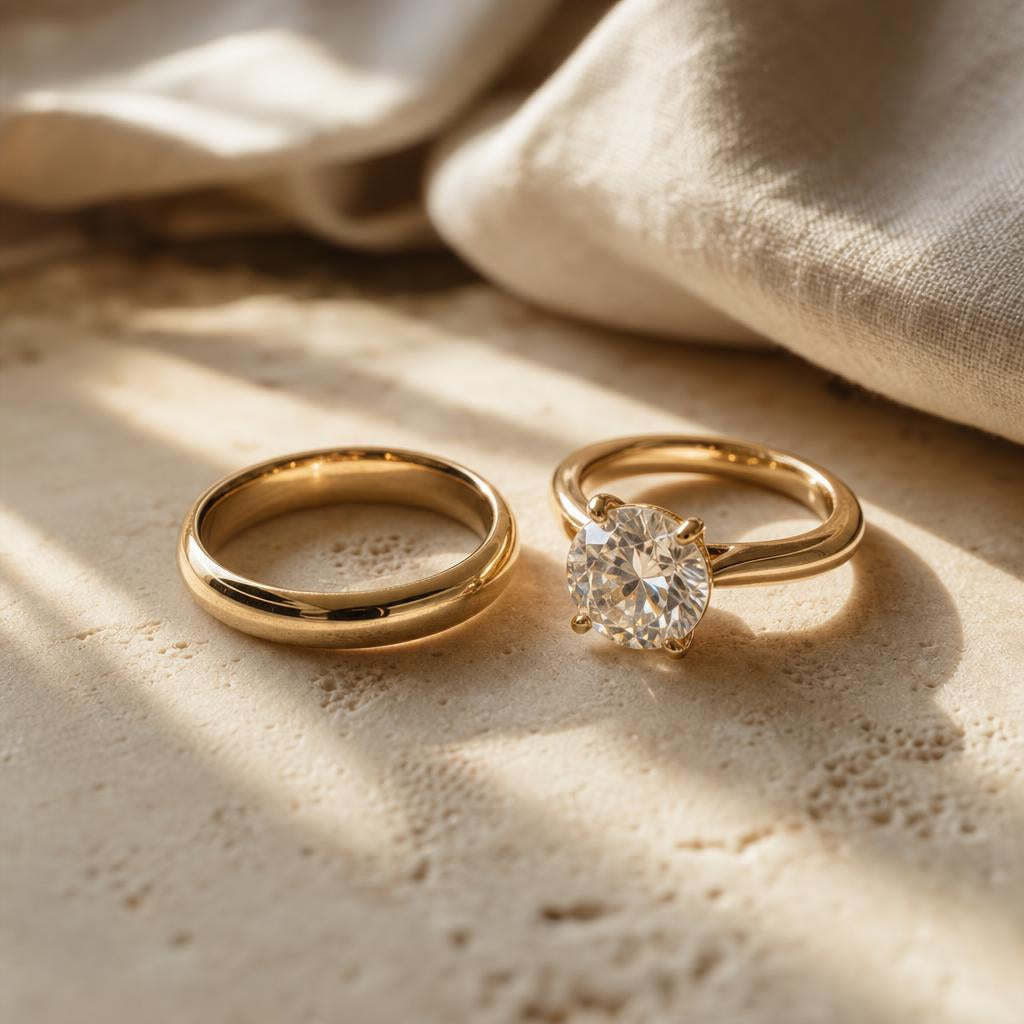
This is the comparison most people actually mean when they say "ring versus band." An engagement ring is given at the proposal and is built around a center stone — the whole point is that it draws the eye. A wedding band is exchanged at the ceremony itself, and traditionally it's the quieter piece: a plain or pavé-lined circle with no single stone competing for attention, designed to sit flush against whatever ring it's paired with. One announces an intention. The other confirms it, and then gets worn every single day for the rest of the story.
If you're shopping for the first kind — something with a clear focal point — seeing how oval vs round engagement rings compare side by side is a good place to start before you commit to a shape.

Odette Ring
A 3.5-carat oval stone, one setting, no distractions — this is what "ring" means when the word is doing its full, most dramatic job.
Shop Odette Ring →Is a Wedding Ring the Same As a Wedding Band?
Usually, yes — and this is where the terminology gets genuinely confusing rather than just technical. In everyday American usage, "wedding ring" and "wedding band" are treated as interchangeable, both referring to the piece exchanged at the ceremony. Jewelers use "band" more precisely to describe the shape — plain, continuous, no dominant stone — but plenty of wedding rings marketed under that name still qualify as bands by design. So what is a wedding band, really, once you strip away the marketing? It's a ring shaped a certain way, worn for a certain reason. The overlap isn't a mistake in the language — it's just two words pointing at mostly the same object from slightly different angles.
When the Words Really Do Mean the Same Thing
Here's the part that actually simplifies things: this is where a wedding band vs ring comparison usually collapses into the same object, once you're talking about design rather than occasion. A slim, uniform, no-centerpiece circle is a band, whether you bought it to celebrate a marriage, to wear on its own, or just because you liked how it sat against your other rings. Nobody's checking your relationship status at checkout. The shape is what earns the label — not the story behind why you're wearing it.
The Design Differences Behind the Names
Strip away the occasion and the real differences are structural. A ring built around a center stone sits higher off the hand, usually has a claw or halo setting doing visible work, and reads as the statement piece in any stack. A band sits low and flat, distributes its sparkle evenly instead of concentrating it in one spot, and is built to be worn alongside other rings without competing with them. That's why bands make such good stacking pieces — they're designed to support, not headline.

Stella Ring
A round-cut solitaire with a four-prong setting — proof that "ring," on its own, can mean anything from quietly classic to genuinely bold.
Shop Stella Ring →Worth knowing: The difference between an engagement ring and a wedding band was never about which one "counts" more. It's a division of labor — one piece makes the statement, the other makes it wearable every day without a second thought.
Do You Actually Need Both?
No. Plenty of women wear a single ring that does double duty, whether that's a solitaire they never take off or a band they wore before anyone proposed anything. The two-ring convention is a tradition, not a rule, and it's one more people are quietly opting out of — buying one piece they love rather than assembling a matched set because that's what's expected. Comfort plays into it too: a ring with a raised setting can catch on gloves, pockets, or bedding in a way a low, flat band never will, which is reason enough for some women to keep the statement piece for occasions and wear something quieter day to day. If you're building toward a full look, though, this is exactly where stacking comes in.
How This Plays Out When You're Stacking
Once you own more than one ring, the ring-versus-band distinction stops being trivia and starts being a styling tool. Bands are the connective tissue of a stack — thin, low-profile, built to sit flush against a statement piece instead of fighting it for attention. If you're just starting to put a stack together, five stacking combinations that look intentional, not accidental is worth reading before you add a second or third ring — most wedding ring stack ideas fail for the same reason, which is starting with too many statement pieces and not enough quiet ones to hold them together.
Sizing changes the calculus here too. A band that's slightly snug will still sit flush; one that's loose will spin and gap against whatever it's paired with. If you're stacking for the first time, it's worth understanding how sizing works for a stack before you order — the rules are a little different from sizing a single ring.
Quick Takeaways
- Every band is a ring, but not every ring is a band — "band" describes a specific shape, not just an occasion.
- An engagement ring centers on one stone; a wedding band is built to be quieter and worn daily without competing.
- "Wedding ring" and "wedding band" are used interchangeably in the US, and that overlap is normal, not a mistake.
- You don't need both — one ring that does the job is a completely valid way to wear this.
- Bands make the best stacking pieces because they're built to support a statement ring, not outshine it.
Frequently Asked Questions
What's the actual difference between a wedding ring and a wedding band?
In practice, almost none — both usually refer to the piece exchanged at a wedding ceremony. "Band" is the more precise term for the shape: a plain or pavé-lined circle without a dominant center stone. Most wedding rings are also, technically, bands.
Is a wedding band the same as a wedding ring?
Functionally, yes. They describe the same piece of jewelry in almost every everyday context. The distinction only matters if you're being precise about design — a ring with a center stone technically isn't a band, even if someone calls it one.
Which ring goes on first, the wedding band or the engagement ring?
Traditionally, the wedding band goes on first, sitting closest to the base of the finger, with the engagement ring stacked on top. It's a convention, not a rule — plenty of people wear it the other way around, or on separate hands, without anything going wrong.
Do you need to wear both an engagement ring and a wedding band?
No. Wearing just one — either piece — is common and increasingly normal. Some women wear a single ring for both roles, others switch between them depending on the day. There's no rule requiring both at once.
Can a wedding band be worn on its own, without any connection to marriage?
Yes, completely. A band is just a shape — plain or pavé, low-profile, no center stone. Plenty of women buy one purely because it's a great everyday ring or a clean stacking piece, with no wedding involved at all.
The short version: "ring" is the category, "band" is a shape within it, and the words overlap constantly because, most of the time, they're describing pieces that are meant to be worn together anyway. Once you know which one you're actually looking for, the rest of the shopping gets a lot easier.


