

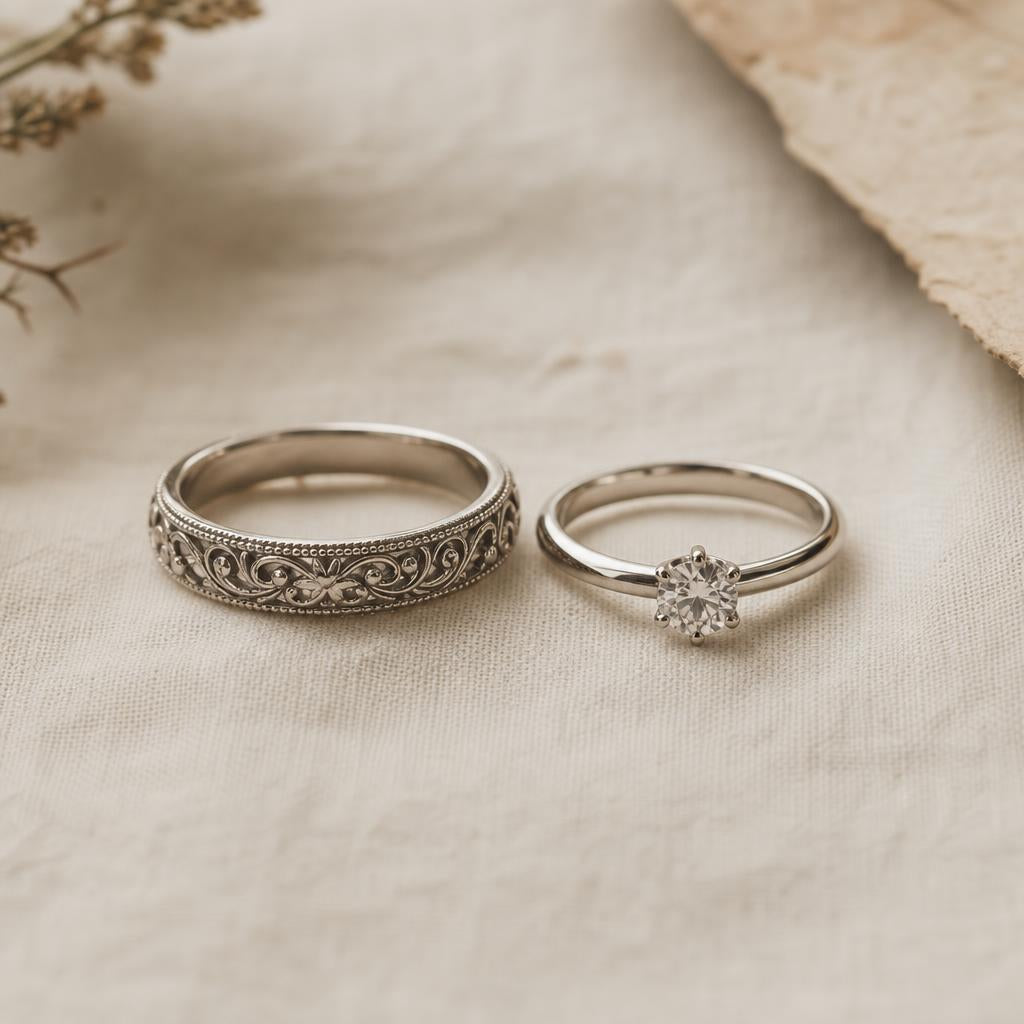
Vintage Filigree vs. Minimalist Engagement Rings: Two Directions, One Silver Base
There are two women standing in front of the same jewelry case. One wants a ring that looks like it's been in the family for a hundred years. The other wants a ring that looks like it was never trying to prove anything at all. Neither one is wrong. Neither one is settling. And — this is the part most guides skip — they're often choosing between two rings built from the exact same base.
Every Gemiros ring starts as 925 sterling silver, whether it ends up covered in hand-finished scrollwork or polished down to a single clean line. The difference isn't the foundation. It's everything you choose to do — or deliberately not do — on top of it. Before we get into how to pick a direction, here's a spread of both, so you can see the split for yourself.


The Case for Vintage Filigree
Filigree is the fine, lace-like metalwork you see winding around a stone or tracing the shoulders of a band — tiny twists and beads of metal, worked by hand into patterns that look like they were drawn before they were cast. It's not a trend that arrived last season. It's a technique with real history behind it, and that's exactly why it still reads as intentional rather than decorative-for-decoration's-sake. A filigree ring says you know your jewelry history and you chose the detail anyway — not because you were told to, but because it's genuinely beautiful under close inspection.
The woman drawn to this direction usually already dresses with a point of view. She's not afraid of a ring that invites a second look, and she's not interested in a piece that could belong to anyone. Milgrain edges, floral scrollwork, a slightly raised gallery — these are details you notice at eighteen inches, not across a room, which is precisely the point. It's a private kind of impressive.

Regent Ring
A 1.25 carat princess-cut center framed by a halo, with milgrain edging tracing the entire band — the kind of detail that rewards a closer look rather than needing one from across the room.
Shop Regent Ring →The Case for the Minimalist Engagement Ring
Now the other camp. A minimalist engagement ring isn't a ring with less thought put into it — it's a ring where every decision was made to get out of the stone's way. Clean prongs, a plain polished band, no pavé crowding the shoulders, nothing competing for attention. The whole idea is restraint as a design choice, not restraint as a compromise. When a stone is genuinely well-cut, it doesn't need a supporting cast of smaller stones to look expensive. It just needs room.
This is the ring for the woman who wants her hand to look put-together in every context — gym, desk, dinner, red-eye flight — without ever having to think about whether it's "too much" for the room she just walked into. It's also, practically speaking, the lowest-maintenance direction: fewer settings means fewer places for a stone to catch on a sweater or a car door, and a plain band shows wear more evenly than one crowded with tiny stones.

Stella Ring
A round-cut solitaire in a clean 4-prong setting — no halo, no pavé, nothing between the stone and the light hitting it. Minimalism with real presence.
Shop Stella Ring →Same Sterling Silver Base, Two Completely Different Moods
Here's the detail that actually matters when you're comparing the two directions: both start from identical materials. Every Gemiros ring, filigree or solitaire, is built on a 925 sterling silver foundation, set with a moissanite or lab-created stone that's indistinguishable from a diamond to the naked eye and passes diamond testers. Nothing about the vintage direction is a lesser build, and nothing about the minimalist direction is a stripped-down version of something else. They're two finished designs pulled from the same starting point, not a premium option and a budget one.
That's a meaningfully different proposition than what you'll find browsing sterling silver engagement rings for women elsewhere, where "simple" often really means "cut corners" and "detailed" often means a different, thinner metal entirely. Hypoallergenic, nickel-free, and finished with rhodium or 18k gold plating depending on the piece — the construction quality doesn't change based on how ornate the surface looks.
Worth knowing: If you're drawn to the vintage direction but want it in a warmer tone, several vintage-inspired styles — including the Beatrice — are also available in 18k gold and rose gold plating over the same sterling silver base, not just the classic platinum finish.
How to Actually Choose Between Them
Skip the trend forecasts. The better question is how you already dress and how you already move through a day. A few honest checkpoints:
- Look at your closet, not your Pinterest board. If your everyday wardrobe leans toward texture, layering, and a few statement pieces, filigree will feel like an extension of that instinct rather than a departure from it.
- Think about how your hands actually get used. If you type all day, lift at the gym, or travel constantly, a plain minimalist band with fewer raised details will simply survive daily life with less snagging and less visible wear.
- Consider what you already own. A ring doesn't exist in isolation — it sits next to your watch, your stacking bands, your everyday jewelry. Ornate pieces tend to want quieter neighbors; minimal pieces can carry more company without looking cluttered.
- Notice which one you keep going back to in photos. Not which one you think you should like — which one you keep zooming in on. That instinct is usually more honest than any style quiz.
If gold tone is part of the decision too, it's worth knowing the finish question is entirely separate from the style question. Simple engagement rings gold-plated over sterling silver read warmer and slightly softer than the platinum finish, regardless of whether the design underneath is ornate or plain — so you're really making two independent choices, not one combined one.
✦ Pro tip: Not sure which direction to commit to? Try both on the same finger, same lighting, same day. Aesthetic instincts are surprisingly clear once you're not comparing a photo on a screen to a memory of the other ring.
| Vintage Filigree | Modern Minimal |
|---|---|
| Reads as intentional, detailed, historically informed | Reads as clean, confident, effortless |
| Rewards a close-up look | Reads clearly from a distance |
| Pairs best with fewer, simpler stacking pieces | Pairs easily with more stacking pieces |
| More surface detail to catch on fabric or gloves | Lower snag risk for daily wear |
| Best for: buyers who want a ring with a point of view | Best for: buyers who want a ring that fits every context |
Quick Takeaways
- Vintage filigree and modern minimal designs are built on the same 925 sterling silver base — one isn't a lesser version of the other.
- Filigree rewards a close look; a clean solitaire reads confident from across a room.
- Match the direction to how you actually dress and use your hands day to day, not to a trend cycle.
- Gold-plated finishes are available across both directions, so metal tone and design style are two separate decisions.
Frequently Asked Questions
Are minimalist engagement rings in style?
Yes — and they've held that position for longer than most trends, because the appeal isn't seasonal. A clean solitaire or plain band works with every era of styling that comes after it, which is exactly why it keeps showing up in buying guides year after year rather than aging out of them.
What's the classiest type of engagement ring?
"Classy" usually just means a ring that looks intentional rather than accidental — and both directions can hit that mark. A well-proportioned filigree design and a clean solitaire are both classic choices; the classiest ring is the one that actually fits how you live, not the one with the most or fewest details.
What are the best inexpensive engagement ring options?
The best value isn't the lowest number on the tag — it's the ring that still looks intentional a year in. A well-built simulated diamond ring on a sterling silver base, in either a filigree or minimalist design, outperforms a "real" stone in a cheap setting every time, because the setting is doing as much visual work as the stone itself.
Can a simple ring still look expensive?
Genuinely, yes — often more so. A well-cut stone in a clean setting has nothing distracting the eye from the sparkle itself. Simulated diamonds set this way pass diamond testers and read as indistinguishable from a mined stone to the naked eye, so the "simple" part is a style choice, not a giveaway.
Is filigree harder to keep clean than a plain band?
Slightly, yes — more surface area means more places for lotion or dust to settle. A soft brush and warm water handle it in under a minute. It's a small trade-off for a design that most plain bands simply can't replicate.
Whichever direction you land on, the honest answer is that you're not choosing between "more effort" and "less effort" — you're choosing between two finished aesthetics, built the same way, priced the same way, and meant to be worn the same amount. The only real mistake is picking the one you think you're supposed to want instead of the one you keep coming back to.


