

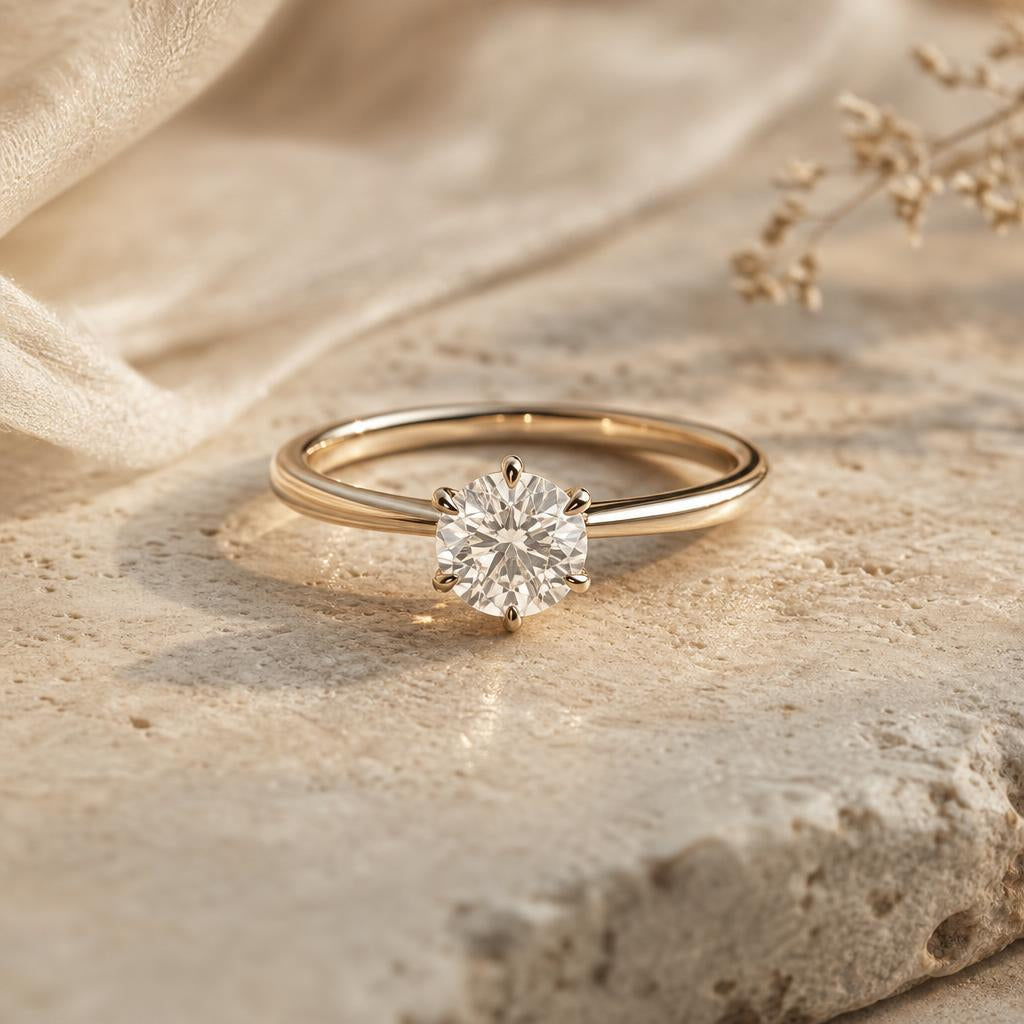
Types of Ring Prongs, Explained: What Happens Beyond 4 and 6
Most people can name two prong counts: four and six. That's where the conversation usually stops, and it's exactly why so many buyers end up guessing when a jeweler mentions "double claw" or "eight-prong" like it's obvious. It isn't. And the number of prongs on your ring changes more than you'd think — how secure the stone is, how big it looks, even how the ring catches light across a room.
Before you settle on a setting, it helps to walk through the types of prong settings that actually exist beyond the two defaults — and which rings in the Gemiros collection show each one well.


What Prongs Are Actually Doing
A prong is a small metal arm that rises from the setting and bends over the stone's girdle to hold it in place. That's the whole job: grip the stone, expose as much of it to light as possible, and stay out of the way visually. Everything else — the count, the shape, the placement — is a design decision layered on top of that one function.
Four prongs became the default because it's the minimum that reliably holds a stone: one at each compass point, tension distributed evenly, maximum surface area left bare for light to move through. Six prongs became the second default because it adds real security without covering much more metal — useful once a stone gets larger or the ring sees daily wear. Almost every general guide to types of ring prongs stops at that comparison. But four and six are the floor, not the ceiling.
Why a Ring Would Need More Than Six
Extra prongs aren't decorative. They show up in three specific situations, and none of them are about looking fancier for its own sake.
The stone is large. Once a center stone crosses roughly three carats, the girdle it needs to support gets wider and the consequences of a single worn prong get more serious. An eight-prong setting spreads that load across more contact points, so no single prong is carrying a disproportionate share of the stone's weight.
The shape has vulnerable corners. Pear, marquise, and princess cuts all have points that chip more easily than a rounded girdle. A plain round prong sitting on a sharp corner is a weak spot. That's where V-prongs come in — two thin prongs meeting at an angle to hug the point itself, rather than one prong sitting slightly off it.
The stone sits high or is worn hard. Rings worn daily, or set unusually high off the band, take more incidental knocks — door frames, gym equipment, gardening gloves. More contact points mean the setting tolerates a bump without the stone shifting. It's a small distinction, but it's the one that actually separates good engagement ring prongs from ones that need retipping within a couple of years.
Worth knowing: More prongs isn't automatically "more secure, full stop." Each added prong also covers a sliver more of the stone. Past a certain point you're trading brilliance for insurance you may not need — which is exactly why four and six remain the two most common counts.
There's also a visual side to the trade-off that's easy to miss in a spec sheet. Every extra prong adds a small shadow line across the stone's surface, which is invisible from a normal viewing distance but shows up under close, direct light — think a jeweler's loupe, or a macro photo. That's a real consideration if your ring is going to be photographed often, but a non-issue for how it actually looks on your hand day to day.
Double Prongs: More Contact Points, Not More Visible Metal
The most common way jewelers add security without changing the silhouette is the double prong, often built as double claw prongs — two slim, tapered prongs set close together in place of one. From a few feet away, a double-pronged ring reads almost identically to a standard four- or six-prong setting. Up close, each pair is doing the work of a thicker single prong, without the bulkier look.
This is a common feature on larger center stones and on three-stone designs, where the side stones need their own secure, low-profile mounts sitting right next to the center stone's setting. It's also one of the more requested upgrades for buyers who want a solitaire that reads as delicate but is actually built for a stone with real presence.

The Maxima Ring
A 3.5-carat cushion cut set beneath a hidden halo, with pavé carrying extra sparkle down the shoulders — proof that a large stone can be both secure and quiet about it.
Shop The Maxima Ring →Shared Prongs and Other Configurations You'll See on Bands
Solitaires aren't the only place prong count matters. On eternity and stacking bands, a shared-prong setting uses a single prong to secure the edge of two neighboring stones instead of giving each stone its own dedicated pair. The result is a continuous, low-profile row of sparkle with noticeably less visible metal between stones than a fully-pronged band would show.
It's a genuinely different design goal from a solitaire's prong count. On a solitaire, more prongs usually means more security for one large stone. On a band, shared prongs mean fewer total prongs across many small stones — the opposite direction, in service of the same idea: let the stones do the talking, not the metal.
Claw Prongs, Round Prongs, and Why the Shape Matters as Much as the Count
Prong count is only half the picture. The claw prongs vs round prongs decision changes the read of a ring just as much. Claw prongs taper to a fine point and cover the least amount of stone, which is why they're the choice when a stone needs to look as large and uninterrupted as possible. Round, or "button," prongs are thicker and rounder at the tip, trading a sliver of brilliance for a sturdier, more traditional finish that holds up well to daily wear.
Neither is objectively better. A claw setting on an active, hands-on lifestyle will need more attentive care over the years than a round one — but a round prong on a delicate, low-profile ring can look heavier than the design intended. The honest answer is that the right choice depends on the stone shape, the setting height, and how the ring is actually going to be worn, not on which style photographs better.

The Duchess Ring
A cushion cut framed by a hidden halo and a second halo layered above it — extra security built into the setting itself, so the prongs holding the center stone can stay minimal.
Shop The Duchess Ring →How to Actually Decide
Skip the idea that there's one correct prong count and work backward from three questions instead.
How big is the center stone? Under roughly two carats, a 4 prong ring setting is plenty — the stone is light enough that even minimal contact holds it securely for years. Past three carats, six or eight starts making practical sense, not just visual sense.
What shape is it? Anything with a point — pear, marquise, princess — benefits from V-prongs at that corner regardless of the total count elsewhere on the ring. This is a shape decision, not a count decision, and it's easy to miss if you're only thinking in terms of four versus six.
How hard will it be worn? A ring that comes off for the gym and goes back in a box overnight can get away with more delicate prongs than one that's on a hand doing dishes, gardening, and everything else, every single day — which is exactly the scenario a 6 prong ring setting was built for.
None of this is about spending more. A moissanite or lab-created center stone holds in a four-prong or eight-prong mount exactly the way a mined diamond does — the metalwork doesn't know or care what the stone is made of. The only thing that should decide your prong count is the stone's size, shape, and how you actually live in the ring.
Quick Takeaways
- Four and six prongs cover the vast majority of rings — they're defaults, not limits.
- Extra prongs (eight, or a double-prong pair) show up for larger stones, pointed shapes, or high-set stones that take more daily impact.
- Shared prongs on bands do the opposite job: fewer prongs, less visible metal, more continuous sparkle across many small stones.
- Claw vs. round is a separate decision from count — it trades a little brilliance for a little more durability, or vice versa.
- Decide based on carat weight, stone shape, and how often the ring actually comes off — not which number sounds more secure.
Frequently Asked Questions
Is a 4-prong or 6-prong setting better?
Neither is universally better — it depends on the stone. Four prongs expose more of the stone to light and suit smaller or more delicate designs. Six prongs add security with only a marginal loss of brilliance, which is why they're the more common pick for stones over roughly two carats.
Are double prongs more secure than a single prong?
Yes, generally. Two slim prongs set close together distribute a stone's weight across more contact points than one thicker prong would, which is why double prongs show up so often on larger center stones and on three-stone settings.
Do claw prongs snag on clothing?
They can, more than round prongs do. Claw prongs taper to a finer point, which maximizes sparkle but leaves a slightly sharper edge that can catch on delicate fabric or hair. Round prongs are the sturdier, lower-maintenance option for hands-on days.
What's the safest prong setting for everyday wear?
Six round prongs are generally considered the most reliable everyday combination — enough contact points to protect the stone through daily bumps, with a rounded finish that resists wear better than a tapered claw.
Why do some bands use shared prongs instead of individual settings?
Shared prongs let two neighboring stones use one prong between them instead of each stone getting its own pair. That keeps the metal footprint low across a full row of stones, which is what gives eternity and stacking bands their continuous, uninterrupted sparkle.
Do more prongs make a stone look smaller?
A little, yes — though it's rarely noticeable at a normal glance. Each additional prong covers a small amount of the stone's surface, so a heavily pronged setting shows marginally less of the stone than a clean four-prong mount would. For most center stones, the security trade-off is worth a difference that only shows up under close inspection.
Prong count is one of those details that seems small until you're the one wearing it every day. Get it right for your stone, your shape, and your actual routine, and it stops being a spec you had to research — it just quietly does its job for years.


