

The Friend Who Always Notices Your Ring: What Your Jewelry Says About You
There's always one. The friend who clocks a new ring before you've even sat down, who notices when you swap your stack, who says "wait — is that new?" while everyone else is still deciding what to order. It's easy to write her off as just someone who likes jewelry. She's actually reading something far more specific, and she's usually right.
What she's picking up on was never the price. It's the decision behind the ring: the shape you chose, the way you wear it, whether it looks borrowed from someone else's taste or unmistakably yours. That's the real question worth asking — not what it cost, but what your jewelry says about you in the three seconds before anyone says a word.


Why Do People Wear Jewelry in the First Place?
Strip away the marketing and the answer is simple: jewelry is one of the only things you wear that says something without you having to explain it. A jacket is weather. Shoes are logistics. A ring is a decision, worn in public, that nobody asked you to justify. That's exactly why do people wear jewelry at all when a bare hand would be simpler — because a bare hand says nothing, and most of us have something we'd rather say.
For the woman buying it for herself, the ring usually isn't a milestone marker. It's proof of a different kind: that she noticed the markup on "real" jewelry, decided it was mostly theater, and bought the version that let her skip the theater and keep the sparkle. That's not a compromise. That's the smarter move, and the friend who always notices your ring can usually tell the difference between someone who's compromising and someone who's decided.
So, What Does Your Jewelry Actually Say About You?
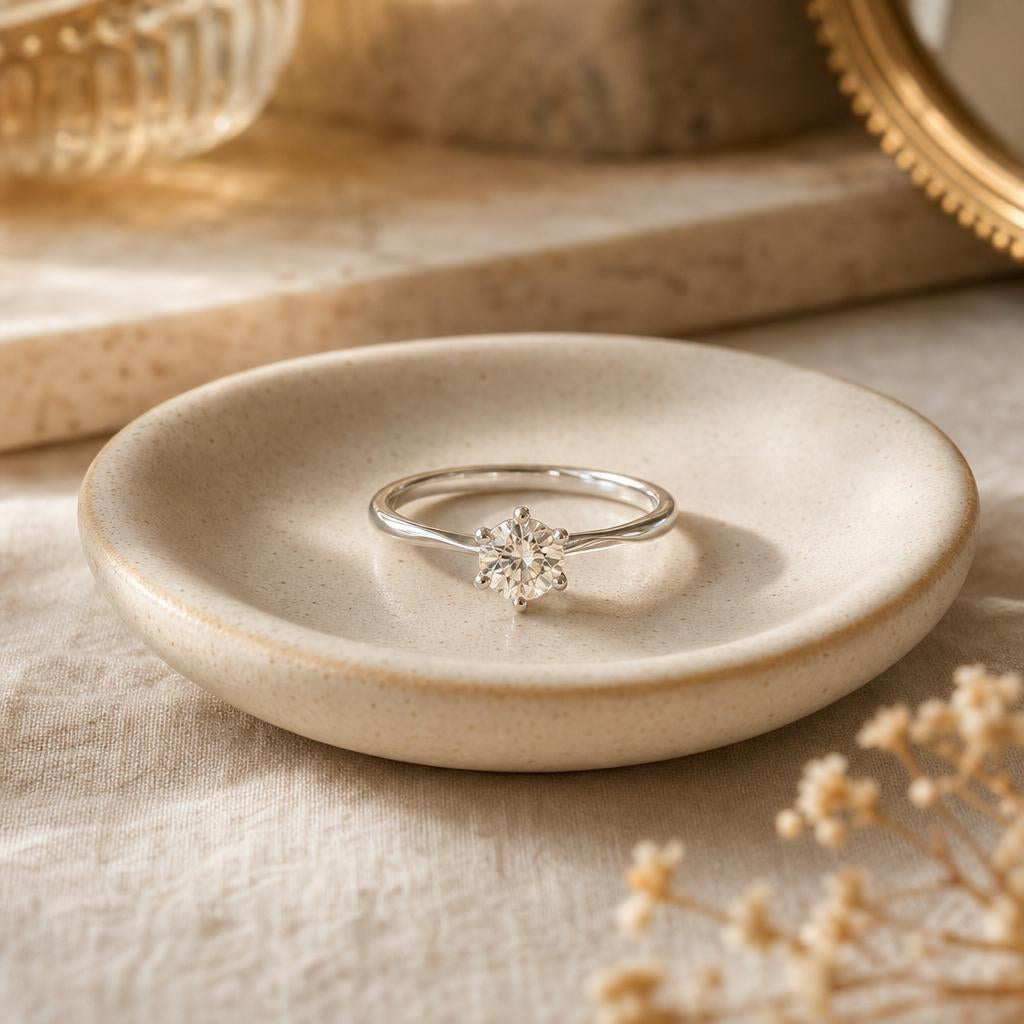
Every ring shape has a personality, whether you picked it on purpose or not. A bold cushion halo reads as confident and a little unbothered by attention. A single clean solitaire reads as someone who already knows what she likes and isn't padding the decision with extra sparkle. A full eternity band, worn on its own or stacked, tends to read as someone building something — a collection, a habit, a version of herself she's still adding to.
None of these are better than the others. They're just different answers to the same question. The mistake is choosing a ring that answers a question you're not actually being asked — buying "safe" because it's expected, when what you actually want is the ring that makes people do a double take.
This is also why ownership changes how a ring reads. A ring someone else chose for you carries a little of their taste until you make it yours; a ring you chose for yourself starts out already aligned with your own reasons. That overlap is part of why building confidence through what you wear on your hands works better than it sounds — it isn't about proving anything to a room, it's about closing the gap between how you feel and what you're actually showing people.

The Duchess
A double halo, cushion-cut centerpiece for the woman whose answer to "is that too much?" is always no. Set in 925 sterling silver with a pavé band that keeps the drama from ever looking cluttered.
Shop The Duchess →A Little Psychology of Jewelry, Minus the Jargon
Researchers who study this stuff generally land on the same handful of reasons people wear jewelry: identity signaling, sentiment, and social status. The first two are easy to make peace with — of course a ring can carry meaning, of course it's a form of self-expression. The third one is where most women flinch, because "status" sounds like showing off, and showing off feels like something to apologize for.
Here's the reframe worth sitting with: wanting to look like you have your life together isn't vanity, it's strategy. And the old rule that you had to overpay a jeweler thousands of dollars to earn that look was never really about the diamond — it was about who got to feel that way and who didn't. Buying a ring that gives you the exact same visual impact, at a fraction of the markup, isn't cutting a corner. It's the smarter version of the same instinct, and it's why more women are making this choice without a hint of apology.
The Compliment Was Never Really About the Ring
Here's what your observant friend is actually responding to, whether she'd put it this way or not: she's not testing whether your stone is a mined diamond. Nobody at brunch is running a diamond tester over your knuckle. She's responding to how you wear it — the fact that you chose it, that it suits your hand, that you're not shrinking from the attention it draws.
This matters because so much of the fear around simulated diamonds is really a fear of being caught. But a 925 sterling silver setting with a moissanite or lab-created stone is indistinguishable from a diamond to the eye, and it passes diamond testers — so the thing people worry about being "found out" for was never actually detectable in the first place. Your friend's radar isn't for authenticity. It's for confidence. Those are different signals, and only one of them has anything to do with the ring itself.

The Juliette
A pear-cut center stone flanked by two heart-cut side stones — the ring for the woman whose jewelry tells an actual story, not just a shape. It's the one people ask about, every time.
Shop The Juliette →Building a Ring Story That's Actually Yours
If you're choosing your next ring with an eye toward what it signals, start with what you actually want people to notice — not what you assume is expected. A few honest questions help more than any trend report:
- Do you want the ring people ask about, or the ring that quietly does its job every day?
- Are you buying to mark something, or simply because you decided you were allowed to?
- Would you still choose this shape if no one ever complimented it?
For some women, a ring works less like decoration and more like a boundary — a quiet way of marking independence that doesn't need to be announced to anyone. It sits on the hand as a small, permanent note to self, long after the moment that prompted the purchase has faded. That's a perfectly good reason to buy one, and it's arguably a better reason than most of the ones we're taught to expect.
Worth knowing: Buying yourself a ring has never required a reason — but it helps to know what you actually want it to say before someone else asks.
The women who wear their rings best aren't the ones with the biggest stone or the most predictable choice. They're the ones whose ring actually matches the answer they'd give if you asked them directly. That alignment is what your friend is clocking — not the carat weight, the coherence.
Quick Takeaways
- Jewelry signals identity long before it signals price — your friend is reading the decision, not the tag
- Different ring styles carry genuinely different personalities; there's no single "correct" signal to send
- The fear of being "found out" over a simulated stone rarely matches reality — no one is testing your ring, they're responding to how you wear it
- The most convincing rings are the ones that match what you'd actually say about yourself, not what's expected
Frequently Asked Questions
What does your jewelry actually say about a person?
Mostly, it signals identity and intention rather than income. The shape, the way it's worn, and how confidently someone talks about it tend to say far more than what it's made of. A bold statement ring reads as unbothered by attention; a single clean solitaire reads as decisive; a stacked eternity band reads as someone still building her collection.
What is the psychology behind wearing jewelry?
At its simplest, jewelry is non-verbal identity signaling — a way of communicating personality, taste, and self-regard without saying a word. It's also tied to genuine confidence: putting on a ring you love tends to change posture and mood before it changes anyone else's opinion of you. The psychology of jewelry has less to do with what a piece costs and more to do with how deliberately it was chosen.
Is it obvious that a ring is a simulated diamond instead of a mined one?
No — a well-made simulated diamond ring in 925 sterling silver is indistinguishable from a mined diamond to the naked eye and passes diamond testers. The compliments people give are based on how the ring looks and how it's worn, not a private test they're secretly running.
Does the price of a ring change what it signals to other people?
Less than most people assume. Once a ring looks intentional and suits the wearer, very few people are pricing it in real time. What actually reads is confidence and fit — whether the ring looks like it was chosen for you specifically, not pulled off a shelf to meet an expectation.
The next time someone clocks your ring before you've even said hello, take it as the compliment it actually is. She's not complimenting your bank account. She's noticing that you know exactly who you are when you got dressed this morning — and that the ring on your hand agrees with you.


