

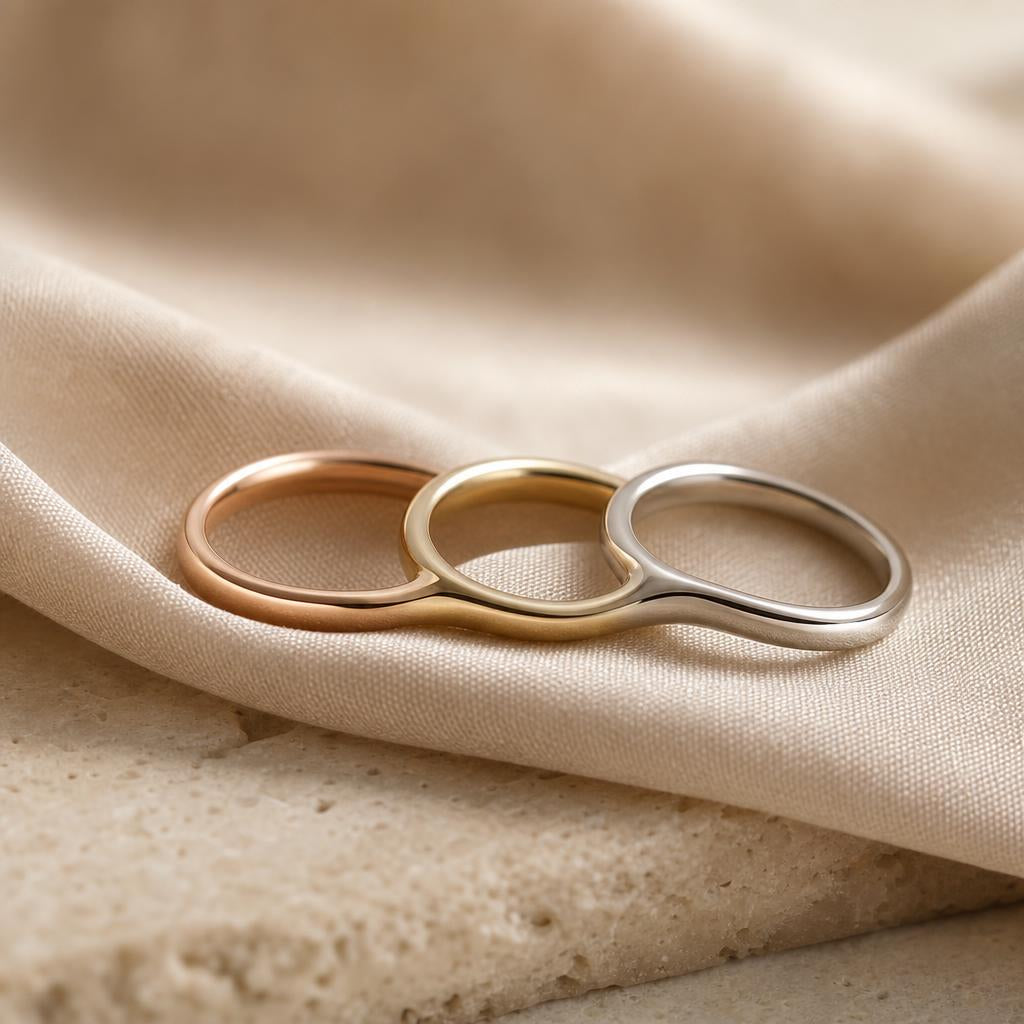
The Bridge Ring: The Stacking Piece That Closes the Gap Between Two Rings
Somewhere between "my stack looks effortless" and "my stack keeps sliding into one clump on the side of my finger" is a gap nobody warns you about — literally. It's the small space between two rings that never quite sit flush, no matter how carefully you line them up in the morning.
There's a piece built specifically to solve this, and most women building a stack have never heard its name: the bridge ring. It's not a filler purchase. It's the difference between a stack that looks curated and one that looks like it happened by accident.


What a bridge ring actually is
A bridge ring is a thin band worn between two other rings — usually your engagement-style ring and a wedding or stacking band — with one job: hold the gap closed. Not decoratively. Structurally. It sits in the space where your other two rings don't quite touch, so the whole stack reads as one connected piece instead of three separate rings that happen to share a finger.
The name comes from exactly what it does. It bridges. You'll also see it called a spacer band, a guard, or a shadow band, depending on who's describing it — but "bridge ring" is the term that best captures the actual function: a piece that closes a structural gap, not just a pretty in-between.
The gap nobody explains before you start stacking
Most stacking guidance focuses on which shapes and widths look good together. Almost none of it covers the physical reality of two curved bands sitting next to each other on a tapered finger. Two rings rarely nest perfectly on their own. A halo setting has more bulk near the base. A solitaire's prongs sit higher off the finger than a flat wedding band. The result is a visible sliver of skin between your rings — or worse, rings that shift and rotate independently through the day because nothing is holding the stack in formation.
Worth knowing: If your rings twist out of alignment by midday or you can see daylight between them when your hand is flat, that's not a sizing problem. It's a gap a bridge ring is built to close.
How to tell if your stack actually needs one
Lay your hand flat, fingers relaxed, and look at your stack from directly above. If your rings sit in a single unbroken line with no visible space and no independent movement, you don't need a bridge piece — your stack already reads as intentional. If there's a gap, a lean, or rotation, a bridge ring is the more elegant fix than sizing down your existing rings or living with the shift.
The width of the gap tells you what to shop for. A hairline gap calls for something slim — a plain 1.5–2mm band is often enough to close it without adding visual weight. A wider gap, common with hidden halo or three-stone settings that flare at the base, needs a bridge piece with more presence: a curved silhouette or a pavé detail that can fill the space without looking like an afterthought.

The Petal Ring
A marquise-inspired eternity band with enough shape to fill a wider gap between two curved settings, without overwhelming either ring.
Shop The Petal Ring →Choosing the right bridge ring for your stack
Three things determine whether a bridge piece actually works, rather than just adding a third ring to the pile.
Width
The bridge ring should almost always be the thinnest piece in your stack. Its job is to disappear into the gap, not to compete with the two rings it's connecting. If it's wider than either neighboring band, it stops reading as a bridge and starts reading as its own statement — which defeats the purpose.
Curve
A curved or contoured band follows the shape of a setting that flares at the base far more convincingly than a straight one. If you're bridging around a halo or three-stone ring, look for a piece with a gentle wave built into the shank rather than a perfectly straight band forced against a curve it wasn't designed for.
Metal and finish
The bridge ring doesn't need to match your other two rings exactly — it needs to belong with them. A pavé finish bridges a plain band and a halo setting more naturally than another plain band would. Matching metal tone (925 sterling silver with rhodium, 18k gold, or rose gold plating) matters more than matching style exactly.

The Beloved Ring
A pavé eternity band with a vintage-inspired profile — built to bridge a stack that already leans toward milgrain or antique detailing.
Shop The Beloved Ring →Matching the bridge to the gap
Not every gap needs the same fix. The table below is a rough starting point for narrowing down what to shop for, based on what's actually causing the space in your stack.
| What's causing the gap | What to look for | Why it works |
|---|---|---|
| Hairline gap, flat-based settings | Slim 1.5–2mm plain or pavé band | Fills the space without adding bulk to an already-fitted stack |
| Halo or hidden halo flares at the base | Curved or contoured shank | Follows the flare instead of sitting flush against a shape it doesn't match |
| Three-stone or side-stone rings | Slightly wider curved band with pavé detail | Bridges the extra width the side stones add on either edge |
| Vintage or milgrain detailing on the stack | Vintage-inspired pavé band | Reads as part of the design language rather than a plain filler piece |
✦ Pro tip: Buy your bridge ring last, once your other two rings are already on your finger together. It's far easier to judge the exact width and curve you need against the real gap than to guess at it from a product photo.
When a bridge ring isn't the answer
A bridge piece solves a gap problem. It doesn't solve a size problem. If a ring is genuinely too big or too small on its own — not just misaligned against its neighbor — sizing that individual ring correctly comes first. Layering a bridge band around an ill-fitting ring just adds a third piece to a stack that was never going to sit right in the first place. Worth checking before you shop: does each ring fit well on its own, worn alone? If yes, the gap is a stacking issue, and a bridge ring is exactly the right fix. If no, that's a separate conversation entirely.
Where the bridge ring goes — and how it stays there
It sits between your two existing rings, not on either outer edge. That's what makes it a bridge rather than just another stacking piece. Because it's flanked on both sides, it's held in place by the rings around it far more effectively than an end piece ever is — which is part of why it solves the rotation problem so well. Once it's seated, the whole stack moves as one unit instead of three independent bands competing for space.
If your rings are 925 sterling silver — as every Gemiros band is — sizing the bridge piece slightly snug against its neighbors, rather than loose, keeps the whole formation from sliding around your finger through the day. A jeweler can confirm the exact fit if you're stacking rings from more than one source, though matching sizes within the same collection generally solves this on its own.
Quick Takeaways
- A bridge ring closes the physical gap between two stacked rings — it's structural, not just decorative.
- Check for a visible gap or independent rotation to know if you actually need one.
- Keep it thinner than your other two rings so it disappears into the stack rather than competing with it.
- A curved or pavé profile bridges a flared setting far better than a straight plain band.
- It sits between your existing rings, which is exactly what keeps the whole stack from shifting.
Frequently asked questions
What is a bridge ring, exactly?
A bridge ring is a thin band worn between two other rings in a stack, positioned specifically to close the visible gap between them and keep both rings from shifting independently.
How do I know if I need a bridge ring instead of just resizing?
If your individual rings fit correctly on their own but leave a gap or rotate once you stack them together, that's a stacking problem, not a sizing problem — a bridge ring solves it without resizing either existing ring.
Can any thin band work as a bridge ring?
Most slim stacking bands can function as a bridge piece, but a curved or contoured shank closes a gap around a flared setting — like a halo or three-stone ring — far more convincingly than a straight band.
Will a bridge ring stop my stack from spinning?
Largely, yes. Because it sits flanked by the two rings on either side of it, a bridge ring holds the whole formation in place far more effectively than adding another ring to either outer edge of the stack.
Does the bridge ring need to match my other rings exactly?
No — it needs to belong with them, not replicate them. Matching the metal tone matters more than matching the exact style, and a pavé or vintage-inspired finish often bridges two different aesthetics better than a third plain band would.
A stack that sits flush isn't luck, and it isn't about buying more rings until something finally works. It's about recognizing that the gap in your stack has a name, a cause, and a piece built specifically to close it — and choosing that piece as deliberately as you chose the rings on either side of it.


