

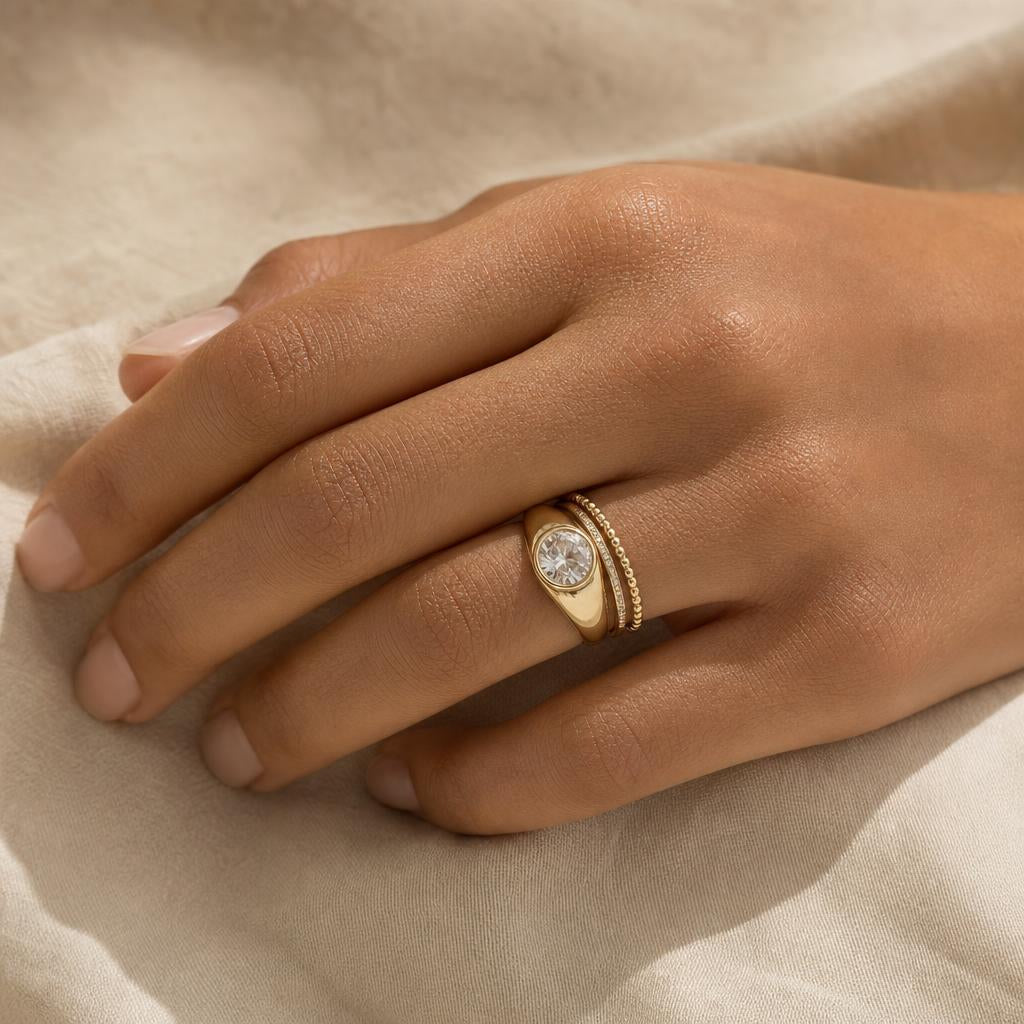
Stackable Rings for Your Engagement Ring: How to Stack Next to a Statement Piece
A statement ring doesn't need reinforcements. It needs a frame — something that makes the main stone look even more intentional without stealing a second of its spotlight.
That's the real challenge with stackable rings engagement shoppers run into once the ring itself is already bold: a hidden halo, an oversized oval, a wide pavé band. Add the wrong piece and the whole hand looks busy. Add the right one and it looks like you planned it from the start.


Why the Ring Doesn't Need Backup
There's a quiet assumption behind most stacking advice: that the engagement ring is the quiet one, and the band's job is to add sparkle. But a large statement ring flips that logic entirely. The center stone is already doing the talking — an oversized oval, a dramatic hidden halo, a wide pavé shoulder. Anything you stack next to it isn't there to compete. It's there to hold the frame steady.
This is where most stacking guides fall short. They're written for a delicate solitaire that needs company. A statement piece needs the opposite: restraint, proportion, and a band that reads as intentional rather than an afterthought bought because "you're supposed to stack something."
It's worth separating two different goals here, because they call for different bands. Some women want a stack that reads as a set, built to look like it was designed together from day one. Others are working from the ring they already own and adding to it slowly, which is closer to how most engagement ring stacking actually happens in practice. Neither approach is more correct than the other — but knowing which one you're going for changes what "the right band" even means.
The Three Approaches That Actually Work
1. The Quiet Frame
A slim, plain band on either side of the statement ring — no competing sparkle, no texture fighting for attention. This is the safest option and, on a bold center stone, often the most striking, because the eye has nowhere to go but the ring itself. The Infinity works well here: its crossover lines add just enough movement without introducing a second focal point.
2. The Matched Sparkle
If the statement ring already has pavé detailing on the shoulders, a full eternity band in the same stone cut — like the Everlasting — reads as a set rather than two separate purchases. The trick is matching brilliance, not size. A band with smaller, denser stones will echo the ring's sparkle without trying to out-shine it.
3. The Textural Contrast
Bezel-set bands, like the Cherish, take a different approach entirely: each stone gets its own frame instead of a shared prong line. Worn next to a bold centerpiece, the contrast in setting style — prongs versus bezels — reads as deliberate rather than mismatched, provided the metal tone stays consistent across both pieces. This approach also tends to suit chunky statement rings especially well, since a bezel edge holds its own presence without introducing a second competing sparkle.
Metal tone is where most stacks quietly fall apart. Two pieces in slightly different shades of white metal — one leaning warmer, one cooler — read as mismatched even when the styles work well together. If you're building a stack over time rather than buying every piece at once, it's worth confirming the finish of each new band against the ring you already wear, ideally in the same light, before deciding it belongs.
Worth knowing: The rings that look most "collected over time" are almost always chosen together, not accumulated at random. A cohesive stack starts with a plan, even a loose one.
Proportion Is the Whole Game
A wide, dramatic center stone next to a hair-thin band can look accidental — like the band got left on by mistake. The fix isn't to match width exactly; it's to make sure the stacking piece has enough presence to register as a choice. A 2mm band reads as delicate next to a slim solitaire, but disappears next to a large statement ring. Look for something with at least a little visual weight: a slightly domed profile, a continuous line of stones, or a bezel edge that catches light on its own.
This is also where chunky statement rings earn their reputation for being hard to stack. The bolder the centerpiece, the more a stacking band needs to hold its own without becoming a second statement — a fine line, but not an impossible one.

The Destiny
Delicate pavé bands that intertwine rather than sit flat — enough detail to feel considered next to a bold center stone, without adding a second focal point to the hand.
Shop the Destiny →What Actually Goes Wrong When People Stack a Statement Ring
Most stacking mistakes come down to one of three things: too much sparkle competing for the same attention, a band so thin it reads as an accident, or metal tones that don't match closely enough to look intentional. None of these are difficult to avoid once you know to look for them — they're just rarely mentioned in generic stacking advice, which tends to assume a modest solitaire rather than a ring built to be noticed on its own.
Mismatched stacked wedding bands aren't actually a problem in themselves — plenty of the best stacks mix setting styles on purpose. The issue is when the mismatch looks unintentional rather than chosen. A bezel band next to a prong-set statement ring works. A bezel band in a slightly different metal tone next to a prong-set statement ring in another tone usually doesn't.
A Note on Sizing
Because a statement ring often sits higher off the finger than a low-profile solitaire, a stacking band may need to sit slightly looser to clear the base of the setting comfortably. If you're between sizes, err toward the size that leaves a little breathing room at the base of the statement ring rather than one that pushes the two pieces flush against each other.

The Devotion
A continuous circle of baguette-cut simulated diamonds — a sharper, more architectural line for a stack that wants structure rather than softness next to a rounded center stone.
Shop the Devotion →Building It in Stages, Not All at Once
You don't need to solve the entire stack in one purchase. Most women who love the stacked wedding bands with engagement ring look didn't arrive at it in one purchase — they added a band, lived with it for a while, and decided whether the hand needed more or less. Starting with one quiet, well-proportioned piece and adding from there is a far more reliable way to land on a stack that looks intentional than committing to a full set upfront.
It's also the more forgiving approach if your statement ring is on the bolder end. A single band gives you real information about how the two pieces sit together before you add a third variable.
Quick Takeaways
- A statement ring needs a frame, not competition — pick bands that support the center stone rather than rival it.
- Match metal tone closely, even when mixing setting styles like bezel and prong.
- Skip anything under 2mm wide — thin bands disappear next to a bold centerpiece.
- Size stacking bands slightly looser if the statement ring sits high off the finger.
- Build the stack in stages rather than buying every piece at once.
Frequently Asked Questions
What order do you stack wedding bands and an engagement ring?
Most stacks put the engagement ring in the center, flanked by the stacking bands on either side — often called the "frame" approach. There's no rule requiring this, but it does keep the statement ring visually dominant, which is usually the goal when the center stone is already bold.
Are there real rules for ring stacking?
Not official ones — but a few practical guidelines hold up consistently: keep metal tones close, avoid pairing two pieces with equally dramatic sparkle, and make sure every band has enough width or texture to register as a deliberate choice rather than filler.
Can you mix and match wedding bands instead of using a matching set?
Yes, and next to a bold centerpiece ring it often looks better than a matched set would. A bezel band on one side and a slim pavé line on the other can read as curated rather than accidental, as long as the metal finish stays consistent across every piece.
What does a stacked ring look mean, style-wise?
It generally signals a collection built over time — an engagement ring joined by anniversary bands, a right-hand piece, or simply rings chosen because they work together. On a statement ring, a well-built stack signals that the bold centerpiece was a deliberate choice, not an impulse buy with nothing to support it.
A large statement ring was never the problem stacking guides made it out to be — it just needed different math. Frame it with the right proportions, keep the metal consistent, and add pieces one at a time. The ring was already the main event. The stack's job is just to make that official.


