

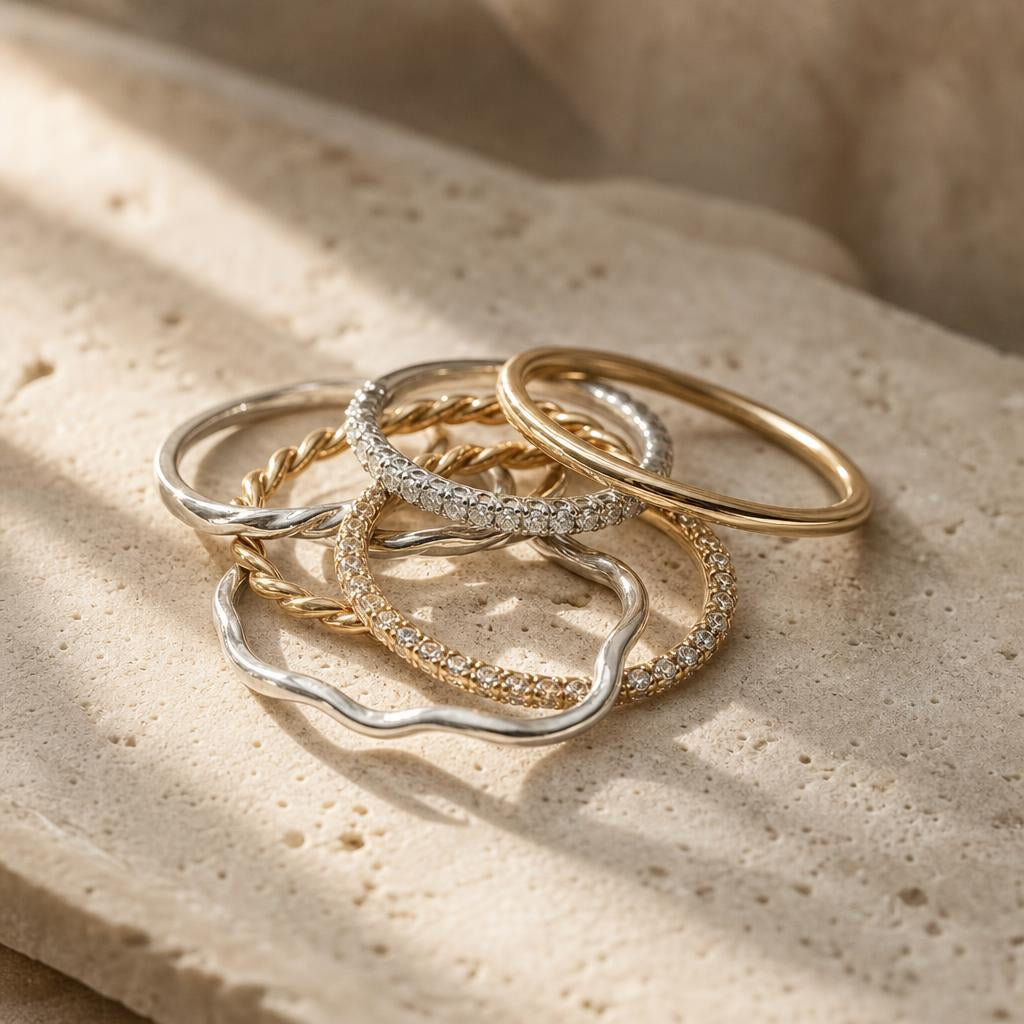
Silver Stacking Rings on a Budget: How to Build a Look With Fewer, Better Pieces
There's a version of ring shopping that assumes you need one perfect, expensive ring and nothing else. It's an old rule, and it's wrong. A stack — three or four rings sitting together on one finger — often reads as more considered, more collected, more her than a single showstopper ever could. And building one doesn't require the kind of spending that makes you wince at your own statement. It requires a plan.
The real skill isn't buying more rings. It's buying the right few, in styles designed to sit next to each other instead of compete. Here's where to start if you're working with a real budget and want a stack that looks like it took thought, not a spending spree — and how to keep adding to it without it ever looking cluttered.


The case for fewer, better-chosen silver stacking rings
It's tempting to think a bigger budget means a better stack. It doesn't. The stacks that actually look expensive are the ones where every piece earns its place — a base, an accent, something with a little texture — rather than a pile of rings bought because they were each, individually, fine. Three well-matched silver stacking rings, chosen for how they sit together rather than how they look alone, will always read as more finished than five picked at random. Start smaller than you think you need to.
Start with one band you'll wear every day
Before you add anything shaped, colored, or textured, you need a base — a slim, low-profile band that can sit under or beside almost anything else you own. A full pavé eternity band or a half-band pattern like the two in the grid above does this well: it reads as jewelry on its own on a quiet day, and it disappears into the background the moment you stack something more interesting next to it. This is the piece to buy first, because everything else in your stack gets built around it, not the other way around.
Add one shaped piece for personality
Once your base is in place, the second ring should feel distinct — not louder, just different enough that the stack doesn't blur into one line of metal. A shaped silhouette does this without asking you to spend more.

Petal Ring
Marquise stones set in a curved, botanical silhouette — the piece that gives an otherwise simple stack a shape worth noticing.
Shop Petal Ring →Let one piece do the durability work
If your hands are on a keyboard, a steering wheel, or a stack of dishes most of the day, at least one ring in your stack should be built for that. Bezel settings hold each stone flush against the band instead of raised above it, which means less catching on sleeves, gloves, and everything else your hands touch. It's the ring you don't think about, which is exactly the point.

Cherish Ring
Individually bezel-set stones circle the band for a low-profile, low-snag piece that holds up to daily wear without losing its sparkle.
Shop Cherish Ring →Do the metals have to match?
No — and this is where most budget stacks accidentally look more expensive than they are. Layering one or two rose gold stacking rings into a mostly silver stack reads as intentional, not mismatched, as long as the warm tone doesn't take over the whole hand. Two cool-toned pieces next to one warm one is a ratio worth remembering: it keeps the eye from bouncing between metals and gives the stack one clear story instead of three competing ones. The rings in the grid above show this in practice — a silver base, a gold accent, a rose gold piece layered in — and none of them fight for attention.
This is also where a lot of buyers overcorrect. Matching every single piece exactly, right down to the finish, can flatten a stack into something that reads as one solid band rather than several considered ones. A little contrast between pieces — a polished band next to a slightly textured one, a cool tone next to a single warm accent — is what actually reads as put-together, not a mismatch to be corrected.
How to make three rings look intentional, not accidental
The difference between a stack that looks styled and one that looks like a drawer emptied onto a finger usually comes down to a few small, deliberate choices.
✦ Pro tip: Vary the widths. A thin band, a slightly wider textured piece, and one shaped ring create visual rhythm — three identical widths just look like one thick, uneven band. Leave a sliver of visible finger between pieces where you can, and let your widest or most textured ring sit closest to the knuckle so the stack narrows as it moves down toward your hand.
How many rings is actually too many?
There's no fixed number, but three to four pieces is where most stacks stop looking curated and start looking crowded — especially on a smaller hand. If you find yourself needing to squeeze a new ring in sideways, or if the pieces you already own are starting to overlap instead of sit flush against each other, that's the stack telling you it's finished for now. Dainty stacking rings help stretch that ceiling a little further, since two or three thin bands take up roughly the same visual space as one wider piece — but even then, more isn't automatically better. It's still about what each ring adds.
What to skip until your stack basics are settled
Worth knowing: A wide statement band or a rare stone shape is a fourth-ring decision, not a first-ring one. Minimalist stacking rings — the thin, quiet pieces — are what make a stack wearable every day; save the bolder additions for once you already know how your base and accent pieces sit together on your actual hand.
It's a common instinct to want the most interesting ring in the collection first. Resist it. A stack built out of order — statement piece first, basics later — almost always needs to be rebuilt once the fundamentals are in place, which ends up costing more than starting with the boring-but-essential base band would have in the first place. Think of the first two purchases as infrastructure. The interesting piece will still be there once the foundation is right.
Building it in stages, not all at once
You don't need a complete stacking rings set delivered in one box to have a stack that looks finished. Buy the base this month. Add the shaped piece when it makes sense — a birthday, a bonus, a Tuesday that felt like it deserved something. The bezel band can come third, once you already know the first two work together on your hand. Building a stack this way isn't a compromise; it's how most well-assembled stacks actually come together, one considered piece at a time instead of one impulsive haul.
Check your hand before you check your cart
The same three rings can look completely different depending on the hand wearing them, so it's worth a quick, honest look before you buy the second or third piece. Wider knuckles usually favor bands with a little more width and simpler lines, since anything too delicate can look lost between the base of the finger and the joint. Slender fingers tend to carry thinner, more textured pieces well without them disappearing. Neither is a rule that should stop you from buying what you love — it's just a reason to try a piece on, virtually or in person, before assuming it will sit the way it does in a product photo.
Quick Takeaways
- Buy a slim, low-profile base band first — everything else gets built around it
- Add one shaped piece for personality before reaching for anything bold
- Include one bezel-set piece if your hands are active during the day
- Keep warm-toned metal to one piece in the stack for a story that reads as intentional
- Vary ring widths and buy in stages rather than all at once
Frequently Asked Questions
What are the rules for stacking rings?
There's no single rule, but a few guidelines hold up consistently: vary the widths so pieces don't blur together, keep warm-toned metal to one or two rings if you're mixing tones, and let your most textured or widest piece sit closest to the knuckle so the stack narrows toward your hand. Beyond that, the only real rule is that each piece should earn its place next to the others rather than simply happening to be nearby.
How long will a 925 sterling silver ring last?
With rhodium plating and normal daily wear, a 925 sterling silver stacking ring holds its shine for years, not months. It's the same base metal used across fine jewelry counters, it's nickel-free and safe for sensitive skin, and it doesn't discolor the finger underneath it. It's built to be worn every single day — sink, gym, and all — not saved for occasions.
Are stackable rings still in style?
Yes — and unlike a lot of jewelry trends, stacking has stayed relevant because it isn't really a trend at all. It's a way of wearing rings that adapts to whatever era of your life you're in: minimal in one season, layered and warm-toned in the next. That flexibility is exactly why it keeps showing up year after year instead of aging out the way single, of-the-moment styles tend to.
What are the best rings to buy on a budget?
The best affordable rings for a stack are the ones built to work together, not just the cheapest options in any one style. A slim base band, one shaped accent, and one durable bezel piece will take you further than three unrelated rings bought purely because each was inexpensive on its own. Buying with a plan, even a loose one, is what separates a stack that looks pulled-together from a handful of rings that happen to share a finger.
You don't need permission to build a ring stack, and you don't need a bigger budget than the one you already have. You need three considered pieces instead of five random ones, a rough sense of the order to buy them in, and the patience to add each one when it actually makes sense — not all at once, and not because a stack "should" be finished by a certain date. It gets to be a collection you build, not a purchase you make once and stop thinking about.


