

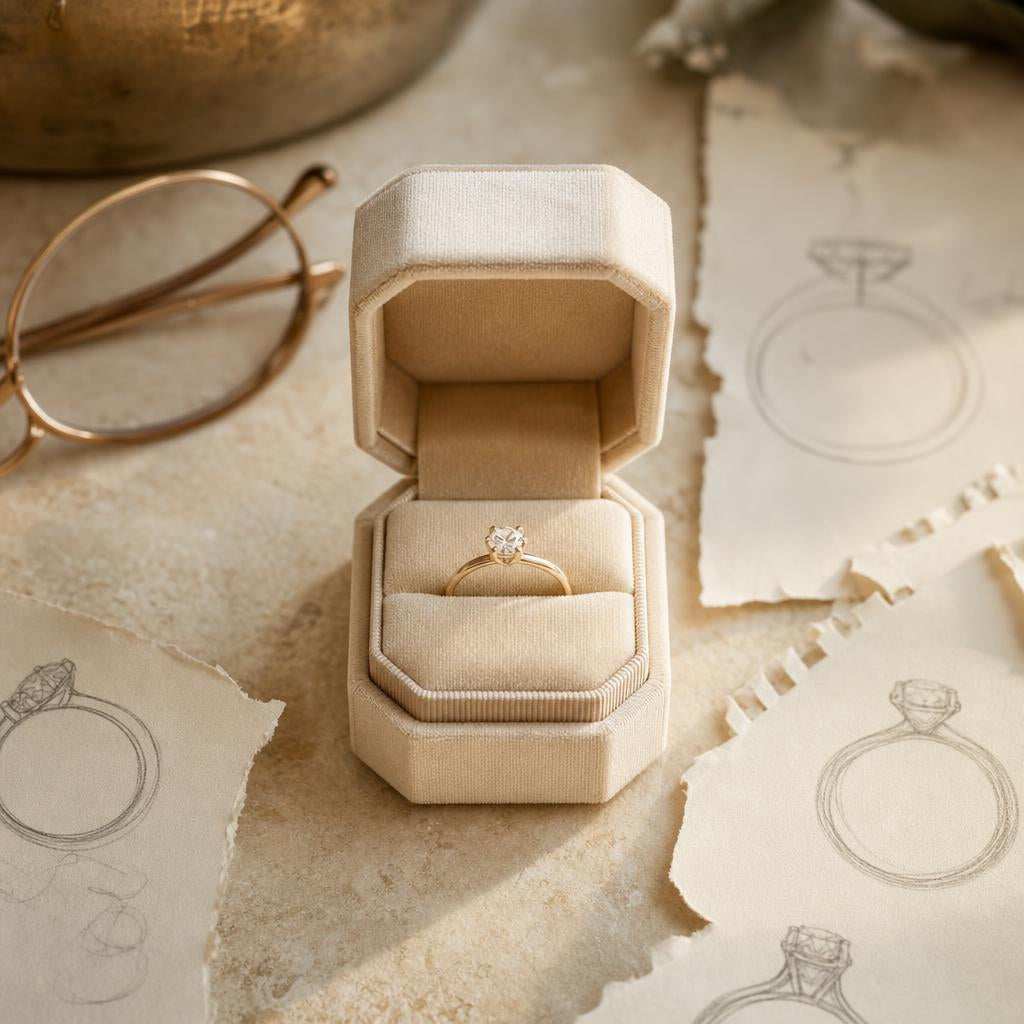
Ring Shopping Before You Propose: How Much Detail Is Too Much?
You've started thinking about proposing. Maybe you've been thinking about it for months. But somewhere between "I should probably get a ring" and actually buying one, a quieter question shows up: how much do you actually need to know about her taste before you spend real money on something she'll wear every day for the rest of her life?
It's a fair question, and most guides skip right past it — they jump straight to carat weight and setting types as if you've already got a clear picture of what she wants. You might not. And that's normal. Here's how to think about the amount of research that's actually useful, versus the amount that just delays you.


How much detail do you actually need before you buy?
Less than you probably think. The instinct, once you've decided to propose, is to treat ring shopping like solving a puzzle — as if there's a single correct answer buried somewhere in her Pinterest history, and your job is to find it before you're allowed to buy anything. That instinct is where most of the stress comes from, and it isn't really true.
What you actually need is a rough sense of three things: whether she tends to like classic pieces or something more unusual, whether she wears gold or silver-toned jewelry day to day, and roughly what size she is. That's it. Everything past that — the exact cut, the specific carat look, the precise setting style — is either something you can guess well with a broadly flattering style, or something that's genuinely easier to get right after the proposal than before it.
If you're feeling stuck because you don't have "enough" information, it's worth asking what more information would actually change. Often the honest answer is nothing — you'd still end up choosing between a handful of classic, well-loved styles, just with more anxiety attached to the decision.
Worth knowing: A ring bought without full certainty isn't a lesser proposal ring — it's often the placeholder or opening move in a longer story, with resizing and even restyling built in as a normal next step, not a failure.
The signals worth reading — and the ones you can safely ignore
Some research is genuinely useful. Some of it is just procrastination dressed up as diligence. Here's the difference.
Worth paying attention to: what she already wears daily. If every piece in her jewelry box is silver-toned, a yellow gold ring will look and feel foreign to her, no matter how beautiful it is on its own. If she wears delicate, minimal pieces, a large statement stone might feel like it belongs to someone else. These are real signals, and they're usually visible without asking a single direct question.
Worth mostly ignoring: the specific cut she once mentioned liking on someone else's hand two years ago, or a single Pinterest board that may or may not still reflect her current taste. Preferences shift, and a comment made in passing carries far less weight than the jewelry she's actually chosen to wear, repeatedly, on her own.
The goal isn't total certainty — it's picking a style broad and classic enough that it flatters most hands and most tastes, so that even if you're slightly off on the specifics, you're not far off on the whole.
Three levels of "not sure yet" — and what to do at each one
Not every partner is starting from the same place. Where you land changes what "enough research" actually looks like.
Level one: you know her taste, just not the exact ring
You've been together long enough to know she likes classic over trendy, or delicate over bold — you just haven't nailed down cut and setting. This is the easiest position to be in. Pick a well-loved, versatile silhouette in that general direction and you'll likely be very close. A round solitaire or an oval halo covers a wide range of "classic" tastes without committing to anything unusual.
Level two: you have a rough sense, but not much confidence
You think she leans toward simple over ornate, but you wouldn't bet on it. This is where a proposal placeholder ring earns its reputation — a beautiful, wearable ring for the moment itself, with the real, fully-considered ring chosen together afterward, once there's no surprise left to protect. It removes the pressure to get everything perfect in one purchase.
Level three: you're genuinely starting from very little
If you're honestly unsure where to even begin, that's still workable — it just means leaning harder on the safest, most broadly flattering options, and being upfront with yourself that this ring may not be the one she wears for the next fifty years. That's fine. A first ring doesn't have to be a final ring.

The Maxima Ring
A cushion-cut centre stone with a hidden halo tucked beneath it — a style that reads as classic and understated from the top, with a little extra sparkle hiding underneath for anyone who looks twice. A good middle ground between "safe" and "special."
Shop The Maxima Ring →What if you want to say something more, without knowing more?
Not every uncertain buyer wants the safest possible choice. Some want a ring that feels a little more considered, even without full certainty about her exact taste — something that shows thought without requiring detailed intel. A three-stone setting is a good option here: it carries built-in meaning (often read as past, present and future) that does some of the emotional work for you, regardless of the exact cut or size you land on.

The Juliette Ring
A pear-cut centre stone flanked by two heart-shaped side stones — a three-stone design with more sentiment built into the silhouette itself, for buyers who want the ring to say something even before the words do.
Shop The Juliette Ring →Getting the size close enough — without asking
Sizing causes more anxiety than style does, mostly because it feels like the one detail you truly can't guess your way around. In practice, you have more ways to find it out quietly than you'd expect — borrowing a ring she already wears on that finger, tracing it, or asking a friend to help without tipping her off. None of it needs to be perfect. Rings can be resized after the fact, and most jewelers expect that to happen at least once in a ring's life.
If you truly can't get a reliable read, sizing slightly large is generally the safer error — a ring that's a touch loose is a quick, inexpensive fix, while one that's too tight can be uncomfortable to wear at all until it's adjusted.
✦ Pro tip: If you're able to see her current rings at all — even briefly — note which finger and roughly how snug they sit. That single data point is often more reliable than anything you'll piece together from conversation.
What happens if you get it wrong
Less than you'd think. An engagement ring purchased under uncertainty is not a one-shot, unchangeable decision — it's usually step one of a longer process that includes resizing, and sometimes exchanging the ring entirely once you're choosing together with no surprise to protect. Most couples end up having at least one honest conversation about the ring after the proposal, whether the first choice was spot-on or not. That conversation isn't a sign anything went wrong. It's just how this usually works.
What actually matters on the day itself has very little to do with whether the cut is exactly right. It has to do with the moment, and the fact that you thought about it enough to try. The ring is important — but it's rarely the part anyone remembers most clearly a year later.
Quick Takeaways
- You need a rough sense of style, metal tone and size — not a complete picture. Anything more is often just delay.
- Trust what she wears daily over a single passing comment or an old Pinterest board.
- Classic, broadly flattering silhouettes — solitaire, oval halo, pear halo — are the safest bet when you're genuinely unsure.
- A placeholder ring is a legitimate option, not a compromise, when confidence is low.
- Sizing can be adjusted afterward. Getting it close is enough — it doesn't need to be exact.
Frequently Asked Questions
Is it bad to propose without knowing her exact ring size?
No. Most rings can be resized after the proposal, and many jewelers expect it. A close estimate is genuinely enough to start with.
What if she ends up not liking the ring I chose?
It happens more often than people admit, and it's rarely treated as a big deal. Exchanging or reselecting together afterward is a normal part of the process, not a sign the proposal went wrong.
Should I ask her friends or family for help figuring out her style?
Carefully, and only if you trust them to keep the secret. A single trusted friend can often confirm a style direction quickly, without the risk that comes from asking too many people.
Is a placeholder ring a good option if I'm really unsure?
Yes. It lets you propose with something beautiful and meaningful now, while leaving the final, fully-considered ring for a decision you make together, once there's nothing left to guess.
How much research is actually too much?
If you find yourself circling the same handful of options for weeks without new information changing anything, that's the signal to stop researching and start deciding. More time spent rarely produces more certainty.
Proposing without full certainty about her exact taste isn't a gap in your planning — it's the normal starting point for almost everyone who's ever done this. Choose a style that's broadly, honestly beautiful, get the size roughly right, and trust that the two of you will finish the details together. That's not a lesser version of getting it right. For most couples, it's simply how getting it right actually happens.


