

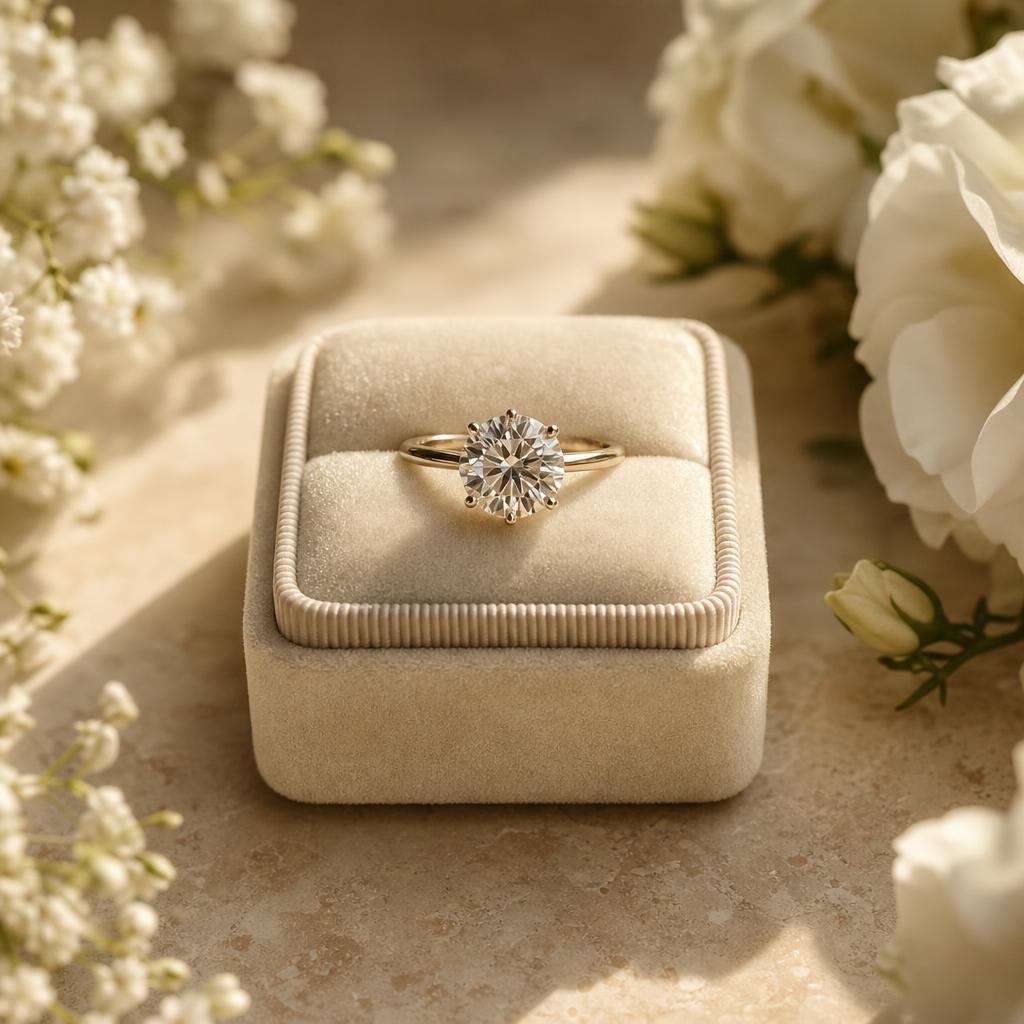
Proposing With a Moissanite Engagement Ring: Why More Couples Are Choosing It Over a Diamond
There's a particular kind of confidence in a couple who has already done the math. Somewhere along the way, "engagement ring" stopped meaning three months' salary and started meaning something else entirely — a stone that photographs the same, tests the same, and sparkles harder, chosen by two people who'd rather spend on the life than the label.
More couples are proposing with moissanite engagement rings this year than ever before, and it isn't a compromise story. It's a math story, a taste story, and — for a growing number of brides-to-be — a story about being the one who finally saw through the markup.


What a Moissanite Engagement Ring Actually Is
Moissanite is not a diamond wearing a disguise, and it's not glass or plastic playing dress-up for a night. It's silicon carbide — a genuine, naturally occurring mineral first identified in a meteorite crater, now grown in laboratories with enough precision to cut, facet, and set exactly like the stone it's so often compared to. That's also worth settling upfront, since it's one of the most common points of confusion buyers run into before they ever look at a ring: moissanite is not a lab-grown diamond. It's a different mineral entirely, with its own chemical identity, its own hardness rating — 9.25 on the Mohs scale, tough enough for decades of daily wear — and its own reason for existing beyond standing in for something else.
What it shares with a diamond is the part that actually matters at the altar: it passes diamond testers. It reads under a loupe the way a diamond reads. To every eye in the room, including a jeweler's, a well-cut moissanite in a well-made setting is indistinguishable from a mined stone. The difference only shows up on the receipt.
Why More Couples Are Choosing Moissanite Over a Mined Diamond
The old rule said a ring had to cost three months of salary to mean something. Nobody voted on that rule. A jewelry industry built it, decades of advertising reinforced it, and generations of couples paid it without asking who actually benefited. The couples choosing moissanite now aren't settling for less — they've simply stopped agreeing to overpay for a story.
That shift shows up in how these proposals actually happen: a ring that looks exactly as dramatic as the one behind the display case, chosen by two people who'd rather put the difference toward the deposit, the honeymoon, or simply staying out of debt over a single afternoon. It's not a smaller ring. It's the same ring, minus the markup nobody could ever really explain — which is worth thinking through properly if you haven't already settled on how much you actually want to spend on an engagement ring before you start shopping.

The Lumina Moissanite Ring
A six-prong round center stone lifted on a cathedral setting, with a fully connected double-row pavé band that keeps the sparkle going all the way around the finger.
Shop The Lumina Moissanite Ring →Moissanite vs. Lab Diamond vs. Cubic Zirconia: What Actually Sets Them Apart
These three get lumped together constantly, and the confusion costs buyers real money and real second-guessing at the counter. Here's the actual breakdown, no hedging:
| Stone | Composition | Hardness | Sparkle | Everyday Wear |
|---|---|---|---|---|
| Moissanite | Silicon carbide | 9.25 Mohs | High fire, colorful flashes | Built for daily wear, holds up for decades |
| Lab-Grown Diamond | Pure carbon | 10 Mohs | Classic white brilliance | Excellent, chemically identical to mined |
| Cubic Zirconia | Zirconium dioxide | 8–8.5 Mohs | Softer, can look flat over time | Scratches and clouds within a few years |
The short version, if you only remember one line: moissanite vs cubic zirconia isn't really a close call for an everyday engagement ring. CZ is soft, it clouds, and it eventually needs replacing. Moissanite is built to be worn — proposed with, married in, and passed down — without ever needing an apology.

The Vivienne Moissanite Ring
A plain radiant-cut solitaire on a four-claw mount — no pavé, no halo, just a sharp, architectural stone that carries the whole look on its own.
Shop The Vivienne Moissanite Ring →✦ Pro tip: If you're weighing moissanite vs lab diamond purely on brilliance, moissanite actually throws more colorful fire under direct light. Some buyers love the extra sparkle; others prefer a diamond's cooler white flash. Neither is the "correct" answer — it's a preference, not a downgrade.
Choosing the Right Cut and Setting for Your Proposal
There isn't one "right" moissanite ring any more than there's one diamond ring — the stone is a starting point, not a style. A round solitaire like the Éclat reads clean and classic. A halo like the Marchesa makes a smaller center stone look dramatically larger. A three-stone silhouette like the Victoire carries more visual weight and more symbolism, if that's the story you're telling. The right call depends entirely on her hand, her taste, and whatever she's already been quietly saving on a Pinterest board somewhere.
If you're proposing without her explicit input, resist the urge to guess something dramatically outside what she already wears day to day. A woman who lives in delicate, minimal jewelry is rarely thrilled by a huge cluster setting, however impressive it looks in the box. If you're genuinely unsure where to start, it's worth reading through the most common things men get wrong when buying an engagement ring before you commit to a specific style — most of the expensive mistakes are avoidable, not inevitable.
If you haven't proposed yet but need something for right now
Some couples solve the timing problem with a proposal placeholder ring — something simple worn in the interim while the real ring is still being decided on, sized, or kept as a surprise. It's a practical fix for a very real problem: not every proposal happens on the exact day the ring is finished.
If you're building toward the wedding day
Most couples don't buy the engagement ring and the wedding band as a matching pair, and that's fine. But if a coordinated look matters to you, several of the settings above pair cleanly with a plain or pavé band. That's really all a moissanite wedding set needs to be — two pieces that were never fighting each other in the first place, not a pre-boxed bundle bought purely to check a box.
Quick Takeaways
- Moissanite is a real, distinct mineral — not a diamond and not a lab-grown diamond — but it passes diamond testers and reads as diamond to the eye.
- It rates 9.25 on the Mohs hardness scale, tough enough for an engagement ring worn every single day for decades.
- Compared to cubic zirconia, moissanite doesn't cloud, chip, or need replacing — it's built for the long haul, not a stand-in.
- Choosing moissanite isn't a smaller ring. It's the same look, the same reaction, without the traditional markup.
Frequently Asked Questions
Will moissanite pass a diamond tester?
Yes. Moissanite is thermally and electrically conductive in a way that reads as diamond on standard testers used at jewelry counters and pawn shops alike. A well-cut moissanite in a proper setting doesn't announce itself — not to a friend, and not to a jeweler running a routine test.
Is moissanite worth it for an engagement ring?
For the price difference alone, most buyers find it isn't close. You get the size, the sparkle, and the daily-wear durability of a fine-jewelry piece at a fraction of what a comparable mined diamond costs — money that goes toward the wedding, the deposit, or simply staying out of debt.
Is moissanite a lab grown diamond?
No. Moissanite is silicon carbide, a different mineral with its own chemical identity — not a diamond grown in a lab, and not a diamond at all. It's compared to diamonds because it performs like one, not because it's trying to pass as one.
What is the downside of moissanite?
Under very bright, direct light, moissanite throws more colorful "fire" than a diamond's cooler white flash. Some people love the extra sparkle; others prefer the classic look. It's a style preference, not a durability or quality concern.
Do wealthy people wear moissanite?
Increasingly, yes — and not because they have to economize. A growing number of buyers who could easily pay diamond prices are choosing not to, on principle. The sparkle is identical. The reasoning is simply smarter.
Is moissanite a fake diamond?
No — moissanite isn't a diamond, and it isn't pretending to be one. It's 925 sterling silver set with a genuine, distinct gemstone that's indistinguishable from a diamond to the eye and passes diamond testers. Nothing about it is a substitute; it's simply a different, equally real, choice.
However the proposal actually happens — planned for months or decided on this week — the ring itself doesn't have to be the part you overthink. Choose the cut that looks like her, the setting that fits how she actually lives, and a stone that will still be exactly this brilliant on your fiftieth anniversary. That's the whole decision, once you take the old rules about what a ring is supposed to cost out of the equation entirely.


