

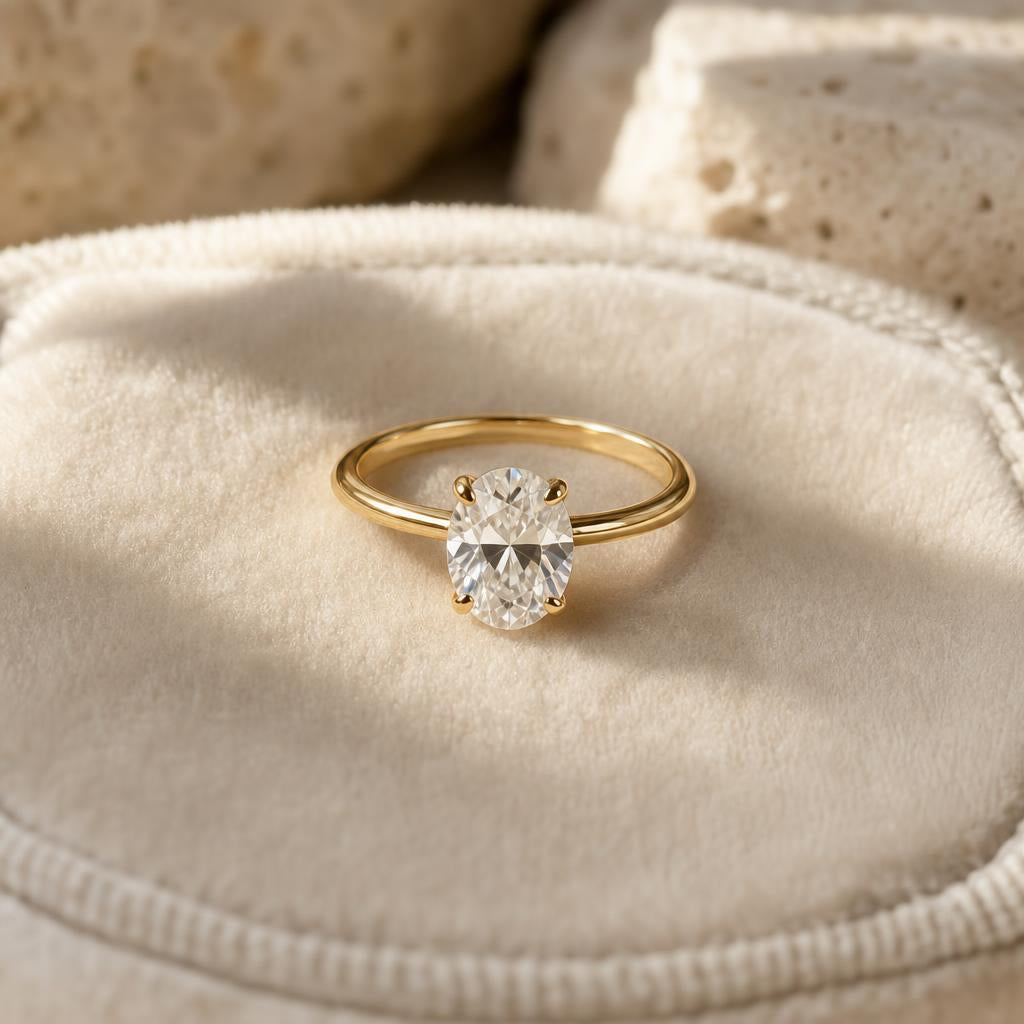
Product Photos vs. Real Life: What to Expect When Buying Rings Online
You've done it before: zoomed into a ring photo on your phone until the pixels blur, trying to decide whether it will really look like that once it's on your hand. It's one of the most reasonable instincts a smart shopper has — and it deserves a real answer, not a vague reassurance.
Here's the honest version. Product photos and the photos customers actually post are two different mediums doing two different jobs, and once you understand why, buying rings online stops feeling like a gamble and starts feeling like exactly what it is: a smarter way to shop.


Two Kinds of Photos, Two Different Jobs
A product photo exists to show you exactly what you're getting: the cut, the setting, the way the metal catches the prongs, the proportions of the stone against the band. It's shot in a controlled studio, under diffused lighting rigged specifically to make every facet visible at once, on equipment built to hold color and clarity steady. Its entire purpose is accuracy.
A customer photo exists to capture a moment. It's taken on a phone, usually one-handed, often in whatever light happened to be available — an office desk lamp, a car dashboard, a bathroom mirror at the end of a long day. None of that is a flaw in the photo. It's just a different assignment.
Once you separate what each photo is actually trying to do, the differences between them stop looking like a warning sign and start looking like exactly what they are: two accurate documents of the same ring, shot for two different reasons.
Why the Same Ring Reads Differently in Every Photo
Sparkle is not a fixed quantity. It's a reaction — light hits a faceted stone and bounces back toward the viewer, and how much of that bounce a camera catches depends entirely on the light source, its angle, and the distance between the ring and the lens. A studio photo uses multiple diffused lights specifically to maximize that reaction. A quick phone photo under a single overhead bulb captures a real ring under real, imperfect light — which will always look different from a piece photographed to show off its best angle.
Screens complicate this further. Every phone and monitor calibrates color slightly differently, which means the exact same image file can look warmer on one device and cooler on another, brighter in one browser and duller in the next. None of that is the ring changing. It's the glass in front of your eyes changing.
✦ Pro tip: If you want the truest read on a ring's true color and brilliance, look at it in natural daylight rather than under a screen's backlight — the same rule applies whether you're comparing product photos or your own ring once it arrives.
What Actually Stays Consistent
Here's the part that matters more than any single photo: the ring itself. A Gemiros ring set in 925 sterling silver with a moissanite or signature simulated diamond center is indistinguishable from a diamond to the naked eye. It passes diamond testers. No one — including your jeweler — will be able to tell the difference by looking. The cut, the carat, the setting style: those are fixed specifications, not photography variables. What changes from photo to photo is the light in the room, not the ring on the hand.
That distinction is the entire answer to the fear underneath the question. You're not worried about photography technique — you're worried it will look cheap, or that it won't hold up to a closer look. It will hold up. The materials are the same in every lighting condition; only the visibility of their sparkle shifts with the light around them.

The Beatrice Ring
A round-cut center stone set into a pavé, vintage-inspired band — the kind of detail that photographs a little differently every time, and looks stunning in every version.
Shop The Beatrice Ring →The Real Question Behind "Will It Look Different?"
Once you get past the usual pros and cons of buying engagement rings online, the hesitation almost always narrows down to one specific thing: not knowing what will show up in the box. That's a fair concern, and it's worth naming directly instead of talking around it.
The way to resolve it isn't to distrust every photo you see — it's to read photos the way a smart shopper actually should. Look at multiple angles if they're available. Look for close-up shots that show the setting detail, not just the sparkle. Read the specifics in the listing: stone shape, carat size, prong count, metal finish. Those details don't shift with lighting the way a sparkle shot does, and they tell you far more about what you're actually getting than any single glamour photo ever will.
What Customer Photos Are Actually Good For
Customer photos aren't a lesser version of product photos — they're a different kind of proof. A studio shot tells you what the ring is. A customer's photo, taken in a car, at a desk, in bad bathroom lighting, tells you something a studio never can: that the ring survives real life. It still sparkles under an unflattering fluorescent light. It still looks intentional in a blurry mirror selfie. That's not a lesser standard — it's a harder one, and real rings that pass it are worth paying attention to.
If a listing has both — polished studio photography and a handful of real, unfiltered customer shots — that combination tells you more than either one alone. The product photo shows craftsmanship. The customer photo shows durability under conditions no studio would ever recreate.

The Stella Ring
A round-cut solitaire on a clean four-prong setting — minimalist enough that its sparkle depends almost entirely on the light around it, which makes it a great example of exactly this effect.
Shop The Stella Ring →Shopping Smart When You Can't Hold It First
Buying rings online means trusting a process instead of a countertop, and that trust is easiest to build with a few concrete habits rather than blind optimism.
- Read the specifications, not just the sparkle — cut, carat, setting, and metal finish are fixed facts, not photography choices.
- Compare multiple photos of the same piece when they're available, including any close-up or on-hand shots.
- Check the return and warranty terms before you buy, so a preference mismatch is never a real risk.
- Trust the material claims when they're specific — "925 sterling silver, moissanite, passes diamond testers" is a fact you can hold a brand to, not a marketing phrase.
Worth knowing: Every Gemiros ring ships with a one-year warranty and free shipping on qualifying orders — the kind of terms that only make sense when a brand is confident the ring will match what you expected, not just what you saw.
Why This Isn't a Reason to Second-Guess Buying Online
The instinct to double-check a photo isn't a red flag about online shopping — it's what an intelligent buyer does before spending money on anything. The jewelry store countertop never solved this problem either; it just replaced photo lighting with store lighting, curated just as carefully to flatter the piece. Buying rings online simply moves that same judgment call to your own hands, on your own time, without a salesperson standing over your shoulder.
That's not a compromise. It's the more informed way to shop — one where you can read the actual specifications, compare real photos side by side, and make the decision on your own terms instead of under showroom lighting designed to rush you toward a sale.
Quick Takeaways
- Product photos and customer photos are shot for different reasons — accuracy versus a real moment — not different standards of honesty.
- Sparkle changes with light; the ring's actual cut, carat, and setting don't change at all.
- Screen calibration affects how any photo looks — that's the device, not the ring.
- Gemiros rings are 925 sterling silver with moissanite or simulated diamond centers, indistinguishable from a diamond and built to pass diamond testers.
- Reading specifications alongside photos gives you a far more reliable picture than sparkle alone.
Frequently Asked Questions
Is it safe to buy diamond rings online?
Yes, provided the retailer is specific about materials and terms. Look for exact details — stone type, metal composition, warranty length, and return policy — rather than vague claims. A brand willing to put those specifics in writing, alongside a real warranty, has nothing to hide about what arrives in the box.
Why does my ring look slightly different in person than in the photo?
Almost always, it's the light and the screen, not the ring. Studio photography is shot under diffused lighting designed to show maximum brilliance, while your own space has its own light temperature and your screen has its own color calibration. The ring's cut, carat, and setting are fixed — only how much sparkle a given light source reveals will shift.
How do I know if a jewelry website is legitimate before I buy?
Check for specific, verifiable claims rather than generic ones: named materials (925 sterling silver, moissanite, rhodium plating), a clear warranty period, a real return window, and consistent product details across every listing. Brands with nothing to hide are usually the most specific ones, not the vaguest.
Should I trust customer photos more than a brand's product photos?
Trust them for different things. Product photos show you the craftsmanship and specifications accurately. Customer photos show you how the ring performs under real, unstaged conditions. Together, they give a fuller picture than either one alone.
The next time you catch yourself zooming into a ring photo, trying to read past the lighting, take it as a sign you're shopping the smart way — questioning the image instead of accepting it at face value. That instinct is exactly what works in your favor when you shop this way: you get to read the specifications, compare the angles, and decide for yourself, on your own time, exactly what a showroom never let you do.


