

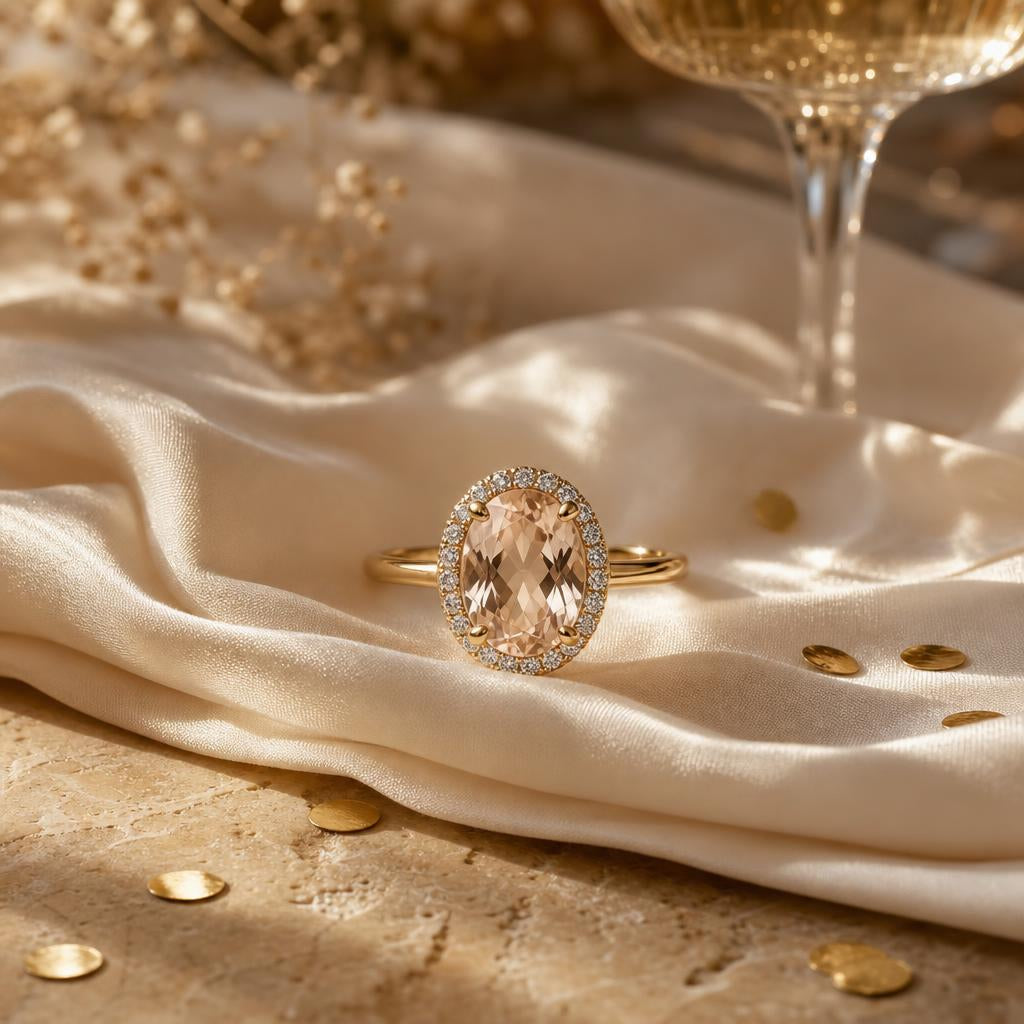
New Year's Eve Jewelry: The Rings That Actually Sparkle After Dark
Every camera flash on New Year's Eve is a small interrogation. It asks your ring a direct question — do you actually sparkle, or do you just look like you might, under the right light, if nobody gets too close? Most rings fail that test the second the lighting turns low, warm, and unflattering, which is exactly the lighting every countdown party actually has. A ring built for New Year's Eve jewelry has to do more than look pretty in a well-lit store. It has to hold its own at 11:58pm, three drinks in, under string lights and a phone flash.
The difference comes down to how a stone is cut and set, not how large it is. A few settings are built to catch light from every angle in the room; most are built to catch light from exactly one, which is why so many rings go flat in photos the second the sun goes down. Here's where to start.


Why Most Rings Go Flat the Second the Lights Go Low
A jewelry store is lit to flatter everything in the case. Overhead lighting is bright, even, and angled to hit every facet at once. None of that exists at a New Year's Eve party. You're working with string lights, candles, a dim bar, and a phone flash firing from one direction for half a second. A stone that depends on bright, even light to look alive will look ordinary in that setting — not because it's a lesser stone, but because its cut wasn't built for the job.
What actually holds up: a lot of small facets working together instead of one large flat surface. That's the entire logic behind pavé and halo settings — they surround a center stone with dozens of smaller stones, so even if the light only hits from one angle, something in the setting is going to catch it and throw it back. A hidden halo does the same thing from underneath, adding a ring of light exactly where a single solitaire would otherwise go dark.
Worth knowing: Cut quality does more for sparkle under low light than carat size does. A larger stone cut for maximum size over maximum brilliance can actually photograph duller than a smaller, better-cut one — the light just has fewer places to bounce.
What to Actually Look For in New Year's Eve Jewelry
If you're shopping specifically for New Year's Eve jewelry rather than an everyday piece, prioritize differently than you would for a ring you're wearing to the office. Look for a halo or hidden halo setting, a pavé band, or a multi-faceted cut like radiant or cushion — all three are engineered to scatter light rather than reflect it from a single point. Round and oval brilliant cuts do this well too, which is part of why they've stayed the default for so long.
The Ophelia is a good example of the principle in action. Its oval center stone sits inside a hidden halo, with a pavé band underneath — three separate light-catching elements stacked on one ring. On a person who's never seen it in person, it reads like it costs $15,000 or higher. It doesn't. It's 925 sterling silver and a simulated diamond cut and set specifically to behave like a mined stone under exactly this kind of unpredictable lighting — indistinguishable from a diamond, passing diamond testers, full stop.

The Statement Ring
A 3.5–4 carat radiant-cut center stone flanked by heart-cut side stones — built to be the one thing everyone notices the second your hand catches the light.
Shop The Statement Ring →How to Wear a Cocktail Ring Without It Wearing You
A bold ring on New Year's Eve only works if the rest of your hand gets out of the way. Keep everything else minimal — one ring, worn alone, does more than a bold ring stacked next to three others competing for the same attention. If you normally stack, this is the one night to take everything else off and let a single piece carry the whole look. It photographs better and it reads more intentional in person, too.
Placement matters more than people think. A large stone sits better on the ring or middle finger, where the width of the finger actually supports the size of the setting, rather than on a smaller finger where it can look like it's fighting for space. And if you're worried a piece this bold only works for one night a year — it doesn't. The same setting that photographs well at midnight photographs well in daylight, at your desk, or on a Tuesday. Nothing about the design is occasion-specific. You bought it for tonight; there's no reason it stays home after.
Gold or Silver: Which Actually Reads Better on Camera
Both work, but they do different jobs. Silver and platinum-toned settings throw a cooler, brighter flash back at the camera — closer to how a diamond reads under white light, which is part of why it's the more common choice for a stone-forward ring. Gold tones warm the whole hand under string lights and candlelight, which flatters skin tones that run warmer. Neither is more "correct." The Maxima and Fleur both photograph beautifully in platinum-tone settings if you want maximum cool-toned sparkle; if you'd rather the whole hand look warmer under low light, several Gemiros styles are also available in gold or rose gold plating.

The Empress Ring
An elongated 3.5 carat oval center stone flanked by two tapered baguette side stones — architectural, symmetrical, and built to catch light along three distinct edges instead of one.
Shop The Empress Ring →A Few Notes on Actually Photographing It Well
If you want proof of how a ring performs before you're standing under party lighting, take one photo before you leave the house. Natural window light late in the afternoon is the closest thing to a controlled test — it'll show you honestly whether a stone throws light or absorbs it. A ring that looks alive in that shot will hold up fine later under string lights and flash. One that looks flat in daylight isn't going to improve after dark.
When the photos do happen later, angle your hand slightly rather than holding it flat — a slight tilt lets more facets catch the light source at once instead of just the top table of the stone. It's a small adjustment, and it's the difference between a photo where the ring reads as an afterthought and one where it's clearly the whole point.
✦ Pro tip: If you're worried about a ring slipping during a night that involves a lot of hand-raising at midnight, double check your size before the 31st. A ring that's slightly loose is far more noticeable — and more likely to spin out of position — under a spotlight than it ever is at your desk.
It Doesn't Have to Be New
You don't need a reason to buy sparkly jewelry for one specific night, and you definitely don't need to justify it as a "special occasion" purchase. If a ring earns its place in your collection on December 31st, it earns its place every other day too — a well-cut stone doesn't know what the calendar says. Buy it because you want to feel like the best-dressed hand in the room, not because you're marking a date. That reasoning holds up fine on its own.
Quick Takeaways
- Facet count matters more than carat size for low-light sparkle — halo, pavé, and hidden halo settings all scatter light rather than reflecting it from one point.
- Test a ring's sparkle in natural window light before you trust it under party lighting — if it's flat in daylight, it won't improve after dark.
- Wear one bold piece alone rather than stacking on New Year's Eve; let it be the whole statement.
- Angle your hand slightly for photos so more facets catch the light at once.
- A ring built to sparkle under low light works exactly as well the other 364 days of the year.
Frequently Asked Questions
What jewelry should I actually wear on New Year's Eve?
Prioritize pieces with a lot of small facets over pieces with one large flat surface — a halo or pavé ring, faceted stud earrings, or a piece with movement will catch string lights and camera flash far better than a plain polished setting. One statement piece worn alone usually photographs better than several smaller pieces competing for attention.
Should I wear gold or silver jewelry on New Year's Eve?
Both work well under low light. Silver and platinum-toned settings throw a cooler, brighter flash back at the camera, while gold and rose gold warm the whole hand under string lights and candlelight. Choose based on your skin tone and the rest of your outfit rather than any rule about which one is more "festive."
What's the difference between a cocktail ring and a statement ring?
The terms overlap, but a cocktail ring traditionally refers to a bold piece meant for evening or special-occasion wear, while a statement ring can be worn more casually across a wider range of settings. In practice, most rings with a large center stone and a dramatic setting get called both.
Which finger should I wear a statement ring on?
Most people wear a large statement ring on the right hand's ring or middle finger, where the width of the finger supports the size of the setting. There's no rule requiring the right hand specifically — it's simply become the traditional placement so a bold piece doesn't compete with a wedding or engagement ring on the left.
Can I wear a bold ring on other days, or is it just for one night?
There's no rule that a dramatic setting is only appropriate for a single night of the year. A ring built with a lot of small facets photographs and sparkles exactly the same way in daylight as it does under string lights — it's just as reasonable to wear to dinner on a Tuesday as it is on December 31st.
Sparkle isn't seasonal, and it definitely isn't something you need an excuse for. Whether you're planning what to wear this New Year's Eve or just adding a ring that photographs beautifully year-round, the settings that hold up under the worst lighting of the year are the same ones that'll hold up on every other night, too.


