

Necklace Lengths: Why the Same Chain Looks Different on Every Neck
You saw an 18-inch chain on a friend and it sat perfectly on her collarbone. You ordered the same length, and on you it lands somewhere else entirely. Nothing is wrong with the necklace. A number of inches is a measurement of the chain, not of where it will rest on you.
Where a pendant ends up depends on your neck, your shoulders, your torso and your neckline, as much as on the chain. Here is how necklace lengths really behave on different frames, so the next necklace you choose lands exactly where you pictured it.


Why the same number lands in a different place
A chain is measured end to end, clasp included. The place it rests is a product of that length and the shape it has to travel around. Two women can wear identical chains and see two different results, for three reasons.
- Neck length. A longer neck leaves more room above the collarbone, so a given chain sits higher against the throat. A shorter neck pushes the same chain down toward the notch between the collarbones.
- Neck circumference. A chain has to go around the neck before it can hang. The wider the neck, the more of its length is used up on the way around, and the higher the pendant sits.
- Shoulders and torso. Sloped shoulders let a chain slide back and settle lower, while square shoulders hold it in place. Torso length and bust line decide where a longer drop finally ends.
This is why a published chart is a starting point rather than a verdict. The standard names are useful shorthand, and our guide to choker, princess and matinee lengths covers what each one is called. What the chart cannot tell you is how your own proportions bend the result.
| Length | Typical name | On a longer neck | On a shorter neck |
|---|---|---|---|
| 14–16 in | Collar / choker | Sits comfortably on the throat | Can feel snug and close to the jaw |
| 18 in | Princess | Rests just above or on the collarbone | Lands at the collarbone dip |
| 20–24 in | Matinee | Falls below the collarbone | Drops toward the top of the bust |
| 28 in and up | Opera | Hangs mid-chest | Hangs at or below the bust |
Find your own number, not the average one
You do not need a diagram, only a piece of string and a mirror. Hold one end at the back of your neck and let the string hang down the front to the exact spot where you want the pendant to rest. Pinch that point, lay the string flat against a ruler, and you have your target length in inches. Remember that chain length includes the clasp, so a piece described as 18 inches will rest slightly shorter than the string suggests once it is closed.
✦ Pro tip: Do the string test wearing the neckline you reach for most. A crew neck, a V-neck and a bare neckline all change where the same chain looks right.
Once you have your number, test it against the common sizes. Many women find the most useful reference point is an 18 inch necklace, because it falls near the collarbone on an average frame. Treat that as a comparison rather than a rule. If your string says 17 or 19, believe the string.
Proportions that move the number
If you have a longer, slender neck
You have room to play. Shorter chains look elegant on you, and a collar-length piece can read as a deliberate, editorial choice. You may find that a slightly longer chain, which falls where it would sit on a shorter neck, gives a softer line that you prefer.
If you have a shorter neck or a fuller throat
Moving up a size or two in length opens the neckline and lets the pendant sit on the collarbone instead of crowding the jaw. A chain with a vertical drop adds length to the visual line, which is why a pendant with some height can suit you better than a wide one.
If you have a smaller frame
Proportion works the other way. A long chain on a narrow torso can swallow the look. Our breakdown for a petite frame shows how a few inches either way changes the whole line.
If you have a broader chest or a fuller bust
A chain that lands on the bust will often tilt the pendant forward or push it sideways. Staying above the bust line, or committing to a clearly longer length that clears it, tends to keep the stone facing forward.
The pendant changes the math
A chain of the same length behaves differently depending on what hangs from it. A heavier stone pulls the chain taut and lets it sit lower. A light stone floats nearer the skin. The shape of the piece matters too, because a wide pendant eats horizontal space while a tall one extends the vertical line.

The Éclat Moissanite Necklace
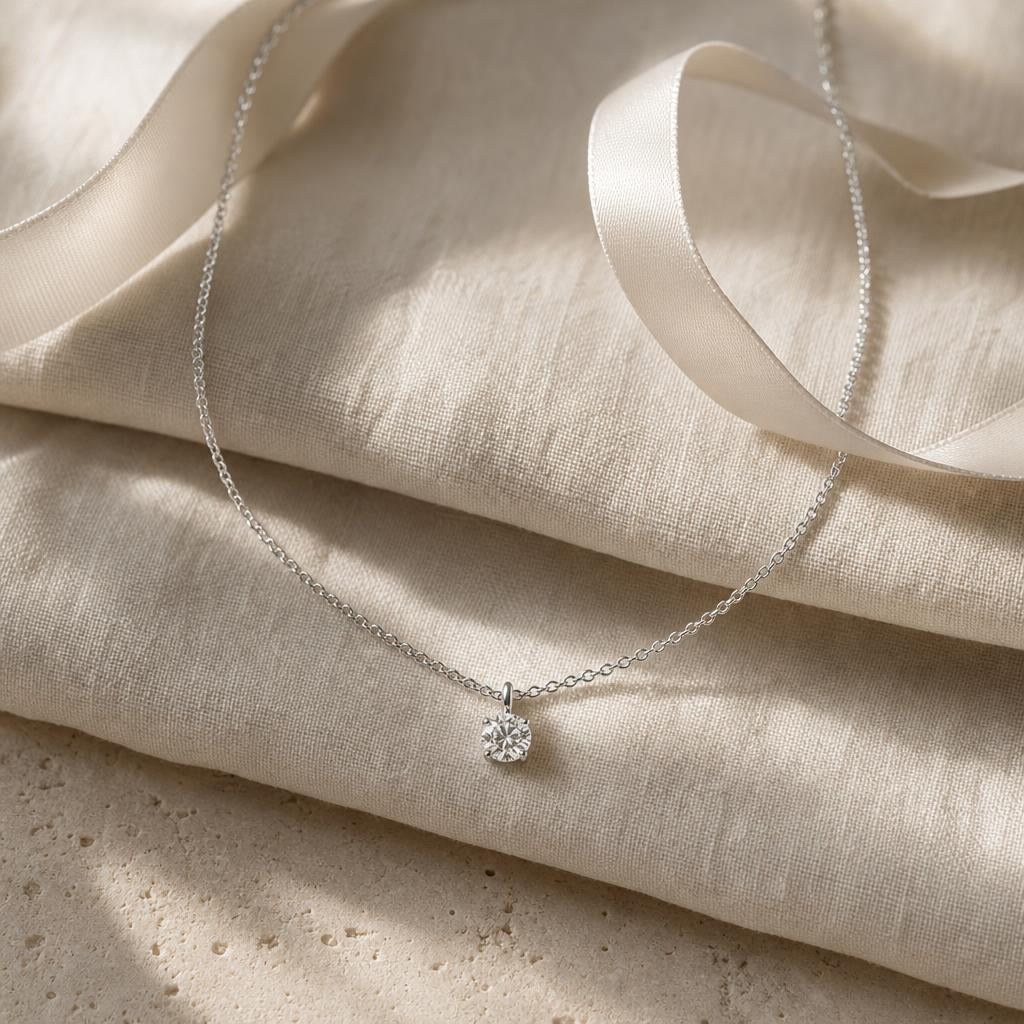
A round-cut moissanite in a six-prong solitaire, offered in 0.5, 1.0 and 2.0 carats. The stone size is the variable to think about here: a larger stone carries more weight and draws the eye lower, so it rewards a length that suits your collarbone line.
Shop The Éclat Moissanite Necklace →If you are drawn to one centered stone, a solitaire pendant is the clearest place to see all of this at work. With nothing else on the chain, its position is the whole look, so getting the length right matters more than it does for any other style.

The Aura Necklace
A radiant-cut simulated diamond in a clean floating setting, designed to sit flush against the skin. Indistinguishable from a diamond, and because it lies flat, it keeps its position on the chain no matter how your shoulders sit.
Shop The Aura Necklace →Match necklace lengths to the neckline you wear
Your neckline decides how much of the chain is visible, and visible chain is what the eye reads as length. A wide scoop or V opens space for a longer drop, while a high crew neck hides the top of the chain and makes a shorter piece look deliberate. We cover this in depth in our guide to matching length to neckline, but the principle is simple: let the chain frame the opening instead of fighting it.
Texture matters here, too. A fine chain nearly disappears under a patterned collar, while a pendant with a bit of presence holds its own against fabric. If you wear structured shirts to work, choose a length that sits above the collar line or clearly below it, never right where the fabric folds.

The Odette Necklace
A brilliant oval-cut simulated diamond suspended in a delicate floating setting, available in 1.5 or 4 carats. The oval's vertical shape lengthens the line from the collarbone down, which is a flattering trick on a shorter neck.
Shop The Odette Necklace →When you wear more than one
Layering turns every difference in proportion into a spacing question. Each chain needs its own landing point, usually two or so inches apart, and your neck length decides how many fit before the stack looks crowded. A shorter neck often does better with two chains, while a longer neck can carry three without strain. The layering order that works for your stack follows the same logic: start from the length that suits you, then build outward.
Worth knowing: Whole-number chain lengths are a convention. If you sit between two lengths, choose the longer one for a relaxed drape and the shorter one for a lifted, intentional line.
Reading a listing before you buy
Because the numbers behave differently on every neck, the safest habit is to compare the chain length on the product page with your own string measurement, not with a photo. Photos show a model with her own proportions. Your string shows yours. If the listing shows a pendant drop as well, add that to the chain length to find the lowest point the necklace will reach.
Take the same approach to a gift. If you are buying for someone else, the best clue is a necklace she already wears and loves. Measure where its pendant lands on her and match that, instead of guessing from a chart.
Quick Takeaways
- Chain length is a measurement of the chain, not of where it will rest. Your neck length, circumference and shoulders move the landing point.
- Use a piece of string in front of a mirror to find your own target length, and remember the clasp counts toward the total.
- A longer neck can wear shorter lengths. A shorter neck usually looks best with a bit more length and a vertical pendant.
- Heavier stones sit lower, and flush, floating settings hold their position.
- Let the neckline you wear most decide the final inch.
Frequently asked questions
What is the right necklace length?
The right length is the one that lands where you want the pendant to rest on your own frame. As a starting point, 16 inches sits at the base of the throat, 18 inches near the collarbone and 20 to 24 inches below it. Confirm your own number with the string test above.
Where should a necklace sit?
For a pendant, most women prefer the collarbone or just below it, because it frames the neckline without crowding the face. A plain chain can sit higher or lower depending on the look you want.
What is the most flattering necklace length?
There is no single answer, because flattering depends on neck length, shoulders and neckline. Many women find a length at or slightly below the collarbone the most versatile, and a simple necklace length chart gives a useful starting range before you personalize it.
Is a 22 or 24 inch chain better?
A 22 inch chain usually falls just below the collarbone to the upper chest, while 24 inches drops closer to the bust. Choose 22 on a smaller frame or with a higher neckline, and 24 when you want a long, open line with a V or scoop.
Does the clasp count toward chain length?
Yes. Chain length is measured from end to end, clasp included, so the closed necklace will rest a little shorter than a loose string measurement implies. Allow for it when you compare.
The best necklace length is a personal one. Measure once, choose the piece that fits the way you wear it, and every necklace after that gets easier to buy. That is the quiet advantage of knowing your own proportions better than any chart does.


