

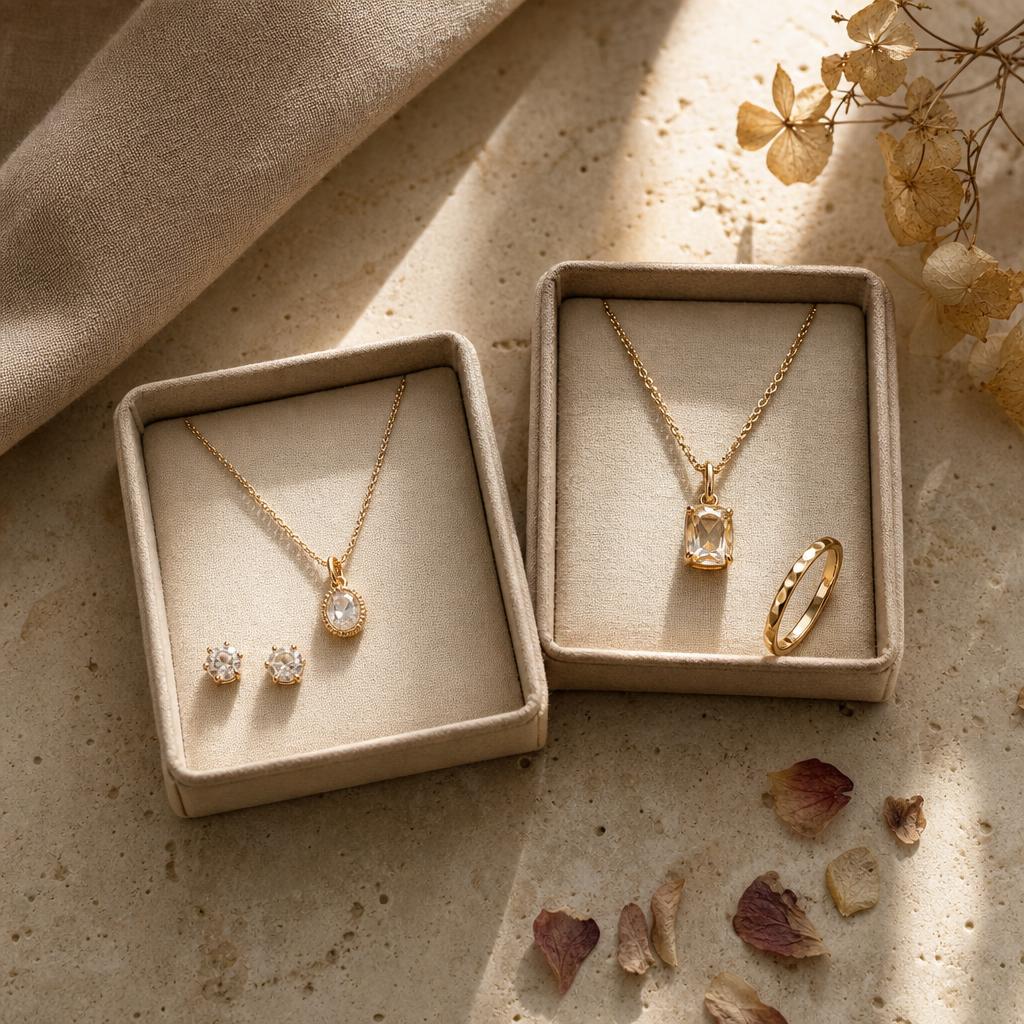
Mother-Daughter Jewelry That Isn't Identical: A Better Way to Match
Somewhere in a drawer, in nearly every family that has ever bought matching mom and daughter jewelry, there's a pair of identical necklaces that got worn twice — once for the photo, once for the thank-you card — and never again. Not because the sentiment was wrong. Because the jewelry was.
The instinct to buy the same piece in two sizes is understandable — it's the fastest way to signal "we belong together." But two women rarely have the same taste, the same style, or even the same neckline preference, and jewelry that ignores that ends up performing the bond instead of living inside it. There's a better way to build this — one where the connection is real, and so is the wear.


Why identical jewelry stops working the moment you put it on
Identical sets are designed to photograph well, not to be worn well. The problem shows up fast: a pendant sized for a 45-year-old's neckline sits wrong on a 22-year-old's collarbone. A delicate chain that suits an everyday minimalist look gets lost against a mother who reaches for bolder pieces. One of you loves how it looks. The other tolerates it out of loyalty. That's not coordination — that's a compromise dressed up as a gift.
A genuinely thoughtful mother daughter jewelry set doesn't ask both of you to want the same thing. It asks you to want related things — pieces that clearly belong to the same story without requiring either of you to wear something that isn't you.
Coordinate the idea, not the object
The shift that actually works is subtle: instead of buying the same piece twice, buy two pieces that share one deliberate thread — a stone, a metal tone, a silhouette family — and let everything else diverge. The North Star Necklace and the Amara Ruby Necklace above are a good example of what this looks like in practice. Both are pendant necklaces in the same silver tone, both sit at a similar length, and both are unmistakably from the same jewelry family — but one is a quiet, faceted starburst and the other is a warm, saturated halo. Worn side by side, they read as two women who clearly know each other, not two women who own the same thing.
This is also the more forgiving approach if your budget or timeline doesn't allow for a matched design to be produced twice. You're not hunting for a manufacturer who makes a specific set — you're choosing two pieces that were never designed as a pair but behave like one anyway.
Worth knowing: The pieces don't need to be the same category to coordinate. A necklace for one and a pair of studs or a stacking ring for the other can carry the same visual thread just as clearly as two necklaces would.
Three ways to build the connection without duplicating the piece
1. Match the stone, not the setting
If moissanite is the throughline, one of you can wear it in a pendant and the other in stud earrings or a slim stacking band. The sparkle reads as consistent even though the silhouette is completely different — which also means each piece gets chosen for how it actually sits on that specific person, instead of forced into a shared mold.
2. Match the metal, let the design wander
Sterling silver worn by both of you creates a quiet visual rhyme even across very different styles — a bold ruby pendant on one and a delicate huggie hoop on the other. Nobody has to explain the connection. It's simply consistent enough to notice and different enough to be personal.
3. Match the occasion, not the object
Sometimes the "set" isn't two pieces bought at once — it's two pieces bought for the same reason, months apart. A birthday ring for one, a graduation necklace for the other, both chosen with the same intention in mind. This is often the version that gets worn the longest, because neither piece was ever a compromise.

The Vivara Huggie Hoop Earrings
A sleeker counterpart to a bolder necklace — pavé moissanite set along a close, everyday huggie silhouette that a daughter reaches for on repeat.
Shop Vivara Huggie Hoops →When there's more than one daughter
The identical-set instinct gets even harder to defend once a third or fourth person enters the picture. A shared design that suits one daughter rarely suits three, and buying three of the same thing multiplies the original problem instead of solving it. The stone-or-metal approach scales more honestly here: give each daughter a piece in the same moissanite or the same silver tone, in whatever silhouette actually fits her — a pendant for one, studs for another, a stacking band for a third. Searching for a mother daughter necklace set of 2 online will surface plenty of matched pairs, but for larger families, building the set piece by piece almost always produces something everyone keeps wearing.

The Cherish Ring
A bezel-set eternity band that works as the "third piece" in a coordinated set — the ring instead of the second necklace, for the daughter who reaches for rings first.
Shop The Cherish Ring →What to actually look for before you buy
A few practical checks make the difference between a set that gets worn for years and one that gets photographed once:
- Skin sensitivity first. Nickel-free, hypoallergenic settings matter more in a shared gift than almost anything else — a piece that irritates skin never gets worn again, no matter how well it was chosen.
- Let each person's daily habits decide the silhouette. Someone who works with her hands all day will wear a huggie hoop far longer than a dangling drop; someone who dresses up often will get more use from a bolder pendant.
- Buy the connective piece last. Choose each woman's individual piece first, based on what she'd actually wear — then check that the two choices share a stone or metal tone. Reverse that order and you end up back at "identical," just with extra steps.
✦ Pro tip: If you're shopping as the daughter, gifting jewelry for mom from daughter is easiest when you already know what she reaches for daily — check her jewelry box before you check a catalog. The metal she already owns most of is almost always the safest coordinating choice.
An occasion checklist, not a calendar
Mother-daughter jewelry rarely needs a single "big" occasion to justify it. A birthday, a graduation, a first apartment, a new job, or simply a quiet Tuesday when you both happen to be shopping — any of these is reason enough, and honestly, the pieces chosen for smaller, quieter reasons tend to get worn more, because they weren't bought under pressure to make a moment feel bigger than it was.
Quick Takeaways
- Skip identical pieces — coordinate a stone, a metal tone, or an occasion instead, and let the silhouette differ.
- A necklace for one and studs or a ring for the other can coordinate just as clearly as two of the same piece.
- For more than two people, build the set person by person rather than multiplying one design.
- Choose each woman's piece based on what she'll actually wear daily, then check the connection — not the other way around.
Frequently Asked Questions
What's a thoughtful way to do matching jewelry without it looking identical?
Pick one shared element — the same stone, the same metal tone, or the same occasion — and let the setting, silhouette, and category differ. A pendant for one and studs for the other, both in moissanite, reads as coordinated without either piece feeling like a copy.
What is the 2:1:1 rule for jewelry?
It's a simple styling guideline for layering: roughly two smaller or delicate pieces, one medium piece, and one statement piece worn together, so the look feels intentional rather than cluttered. It's useful context here too — when you're coordinating jewelry across two people, aim for a similar balance rather than matching "statement for statement."
Is there a mother-daughter set that works for more than two people?
Rather than searching for a pre-made mother daughter necklace set of 2 and trying to stretch it to three or four people, it's usually more reliable to choose each person's piece individually in the same stone or metal tone. It scales cleanly to any family size and nobody ends up wearing a design that wasn't chosen with her in mind.
What finger do you wear a mother-daughter ring on?
There's no fixed rule — most women wear a sentimental stacking ring like this on the right hand, often the middle or ring finger, specifically so it doesn't get confused with an engagement or wedding ring on the left. Comfort and how it sits against your other rings matter more than a strict convention.
Where should I start if we both have very different styles?
Start with metal tone — it's the easiest thread to share across genuinely different taste. From there, browse matching necklaces for mom and daughter or mixed-category pieces separately, each chosen for the person wearing it, and let the shared tone do the quiet work of connecting them.
The best mother-daughter jewelry doesn't ask either of you to compromise — it just asks you to notice what you already share, and let the rest stay exactly as different as you actually are.


