

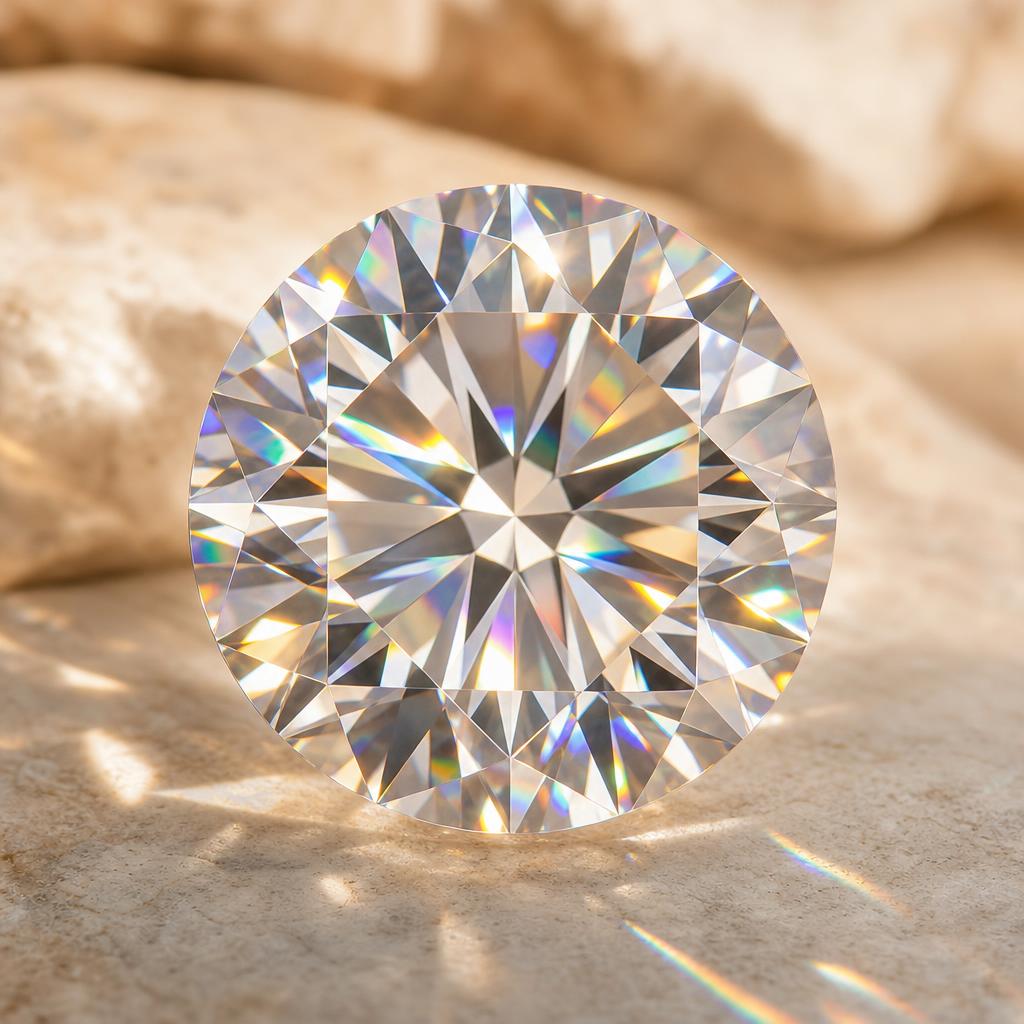
Moissanite Sparkle vs Diamond: Why Some Stones Catch More Light Than Others
Everyone assumes a bigger stone means a brighter one. Stand two rings of the same size next to each other under the same light, and one will look alive while the other looks flat — and carat has almost nothing to do with it.
The difference comes down to something most buyers never think to ask about: how the stone is cut, how many facets it has, and how efficiently those facets move light back to your eye. Once you understand that, a lot of ring shopping gets a lot less confusing — including the moissanite sparkle vs diamond question that comes up in almost every comparison thread.


What Actually Makes a Stone Sparkle
Jewelers break sparkle down into three separate effects, and once you can name them, you start seeing them everywhere. Brilliance is the bright white light that bounces straight back at you — the crisp, clean flash you notice from across a room. Fire is the flash of rainbow color you catch when the stone tilts under a strong light source. Scintillation is the pattern of light and dark that flickers across the stone as it moves, or as you move around it. This is really what makes a diamond sparkle, or any faceted stone for that matter — not one single quality, but three effects working together, all of them governed by how the stone was cut.
None of the three depend on size. A smaller, well-cut stone will out-sparkle a larger, poorly cut one every time, because sparkle is a function of geometry, not mass.
Facet Count, Explained
A facet is simply one of the small, flat, polished surfaces cut into a stone's surface — each one acts like a tiny mirror, angled precisely to catch and redirect light. A standard round brilliant has 57 or 58 facets: 33 on the crown (the top half), 24 on the pavilion (the bottom half), and sometimes a small flat culet at the very tip. Fancy shapes vary — a cushion-cut stone can carry 60-plus facets, while a step-cut shape like an emerald or asscher has fewer, broader facets built for a cleaner, more understated glow rather than maximum fire.
Here's where the common assumption breaks down: more facets do not automatically mean more sparkle. Facet count matters far less than facet precision. A stone with the textbook-perfect 58 facets but sloppy angles will leak light out the bottom and look dull. A stone cut with slightly fewer facets, but with every angle aligned to send light straight back to the eye, will out-perform it every time. Symmetry and proportion do the heavy lifting — the facet count is just the canvas.
Worth knowing: Every Gemiros stone is cut and set to maximize light return first, facet count second — which is exactly why a 4.5ct Ophelia reads as a showstopper the moment it catches a room's light, not just on paper.
Moissanite Sparkle vs Diamond: The Real Difference
This is the comparison that actually matters if you're deciding between the two — and the science is refreshingly clear-cut. Moissanite has a higher refractive index than diamond (roughly 2.65–2.69 versus 2.42), meaning it bends and scatters light more aggressively. It's also doubly refractive, splitting each ray of light into two as it passes through the stone, which is part of why a well-cut moissanite can throw noticeably more colorful fire than a diamond of the same size. A diamond's sparkle leans crisp and white; a moissanite's leans toward that vivid, rainbow-flecked flash people describe as a disco-ball effect.
Neither look is "better" in an objective sense — it's a difference in character, not quality. But it does mean a well-cut moissanite is never the quiet, dimmer alternative people sometimes assume it is. Under the same light, moissanite is often the stone throwing more color, not less.

The Odette Ring
A 3.5ct oval solitaire on a pavé band, cut for exactly this kind of light performance — clean brilliance from the center stone, quiet sparkle running the length of the band.
Shop the Odette →Why the Setting Changes What You See
Facet count and cut quality get most of the credit, but the setting plays a real role too — it controls how much light actually reaches the stone in the first place. A hidden halo, like the one underneath the Ophelia's center stone, tucks a ring of smaller stones beneath the main one, so the halo boosts the overall glow without ever competing with the center stone's own brilliance. A square halo, like Maxima's, does the opposite on purpose — it frames a cushion-cut stone with visible sparkle on every side, so the whole ring reads as one continuous light source rather than a single point.
Prong count matters here too. A 6-prong solitaire setting, like Soleil's, holds the stone more securely and exposes slightly less of its surface than a 4-prong does — a genuine trade-off between security and maximum light exposure, not one style being objectively better than the other.

The Belle Ring
A 1.3ct round brilliant in a halo setting with a half pavé band — the classic 58-facet cut, framed to catch light from every angle you tilt your hand.
Shop the Belle →Diamond Scintillation and Why Movement Matters
Most of the science above describes a stone sitting still under a fixed light. But real life isn't static — you talk with your hands, you catch the light walking past a window, and that's where diamond scintillation actually earns its name. It's the flash pattern that appears the instant the stone, the light, or you move, and it's often the effect people notice first without knowing what to call it. A stone cut with precise, well-aligned facets scintillates in short, sharp bursts. A poorly cut one just shifts between dull and duller.
This is also where moissanite tends to have the edge: its higher dispersion means the color component of its scintillation is more pronounced, so the flashes read as more dramatic in everyday movement — under office lighting, in a car, walking past a restaurant window — not just under a jeweler's spotlight.
✦ Pro tip: If you want to judge a stone's real light performance before buying, don't just look at it head-on under one light. Tilt it, walk it past a window, and watch it under both warm and cool light — that's the closest you'll get to seeing how it actually behaves once it's on your hand.
Cut Quality Over Carat, Every Time
If there's one thing worth taking away from all of this, it's that cut quality outperforms size on every meaningful measure of sparkle. A slightly smaller stone, precisely cut, will consistently out-shine a larger one with lazy proportions — and that's true whether you're comparing two diamonds, two moissanites, or one of each. It's also, frankly, the more intelligent way to shop: chasing carat weight alone is exactly the kind of thinking the traditional jewelry store wants you to default to, because it's an easier number to markup than craftsmanship is.
Every Gemiros ring is set in 925 sterling silver with moissanite or CZ stones cut for light performance first — which is a large part of why they pass the only test that actually matters to most people wearing one: they're indistinguishable from a diamond, they pass diamond testers, and no one — including a jeweler — clocks the difference at a glance.
Quick Takeaways
- Sparkle is three separate effects — brilliance, fire, and scintillation — not one single quality.
- A standard round brilliant has 57–58 facets, but more facets don't automatically mean more sparkle.
- Cut precision and proportion matter far more than facet count or carat size.
- Moissanite has a higher refractive index than diamond and is doubly refractive, which is why it often throws more colorful fire.
- The setting — halo, hidden halo, prong count — changes how much light reaches the stone in the first place.
Frequently Asked Questions
Does moissanite sparkle more than a diamond?
Often, yes — moissanite has a higher refractive index and is doubly refractive, so a well-cut moissanite typically throws more visible fire (colorful flashes) than a diamond of the same size. A diamond's sparkle tends to read whiter and crisper; moissanite's tends to read more colorful and dramatic. Neither is more or less real — they're simply different optical signatures.
How many facets does a round stone actually have?
A standard round brilliant cut has 57 or 58 facets — 33 on the crown, 24 on the pavilion, and an optional culet at the tip. Other shapes vary: cushion cuts often run higher, step cuts like emerald and asscher run lower and rely on fewer, broader facets for a cleaner glow instead of maximum fire.
What's the actual difference between brilliance, fire, and scintillation?
Brilliance is the steady white light a stone reflects back to your eye. Fire is the rainbow-colored flash you see when light disperses inside the stone. Scintillation is the flickering pattern of light and dark that appears only when the stone, the light, or you move. All three come from the same cut — they're just measured differently.
Are more facets always better for sparkle?
No — this is the most common misconception. Facet count sets the canvas, but precision and symmetry determine whether light actually returns to your eye or leaks out the bottom of the stone. A well-proportioned stone with a standard facet count will consistently outshine a poorly cut stone with a higher one.
Does moissanite look like a diamond?
Yes — to the naked eye, a well-cut moissanite is indistinguishable from a diamond, and it passes diamond testers. The only detectable differences show up under magnification or specialized equipment most people, including most jewelers glancing at a ring in daily life, simply never use.
✦ ✦ ✦
Once you understand what's actually happening on the surface of a stone — the facets, the angles, the way light bounces and splits and flickers — carat size stops being the only number worth asking about. A precisely cut moissanite in a light-maximizing setting will out-sparkle a bigger, lazier stone every single time. That's not a compromise. That's just the more informed way to shop.


