

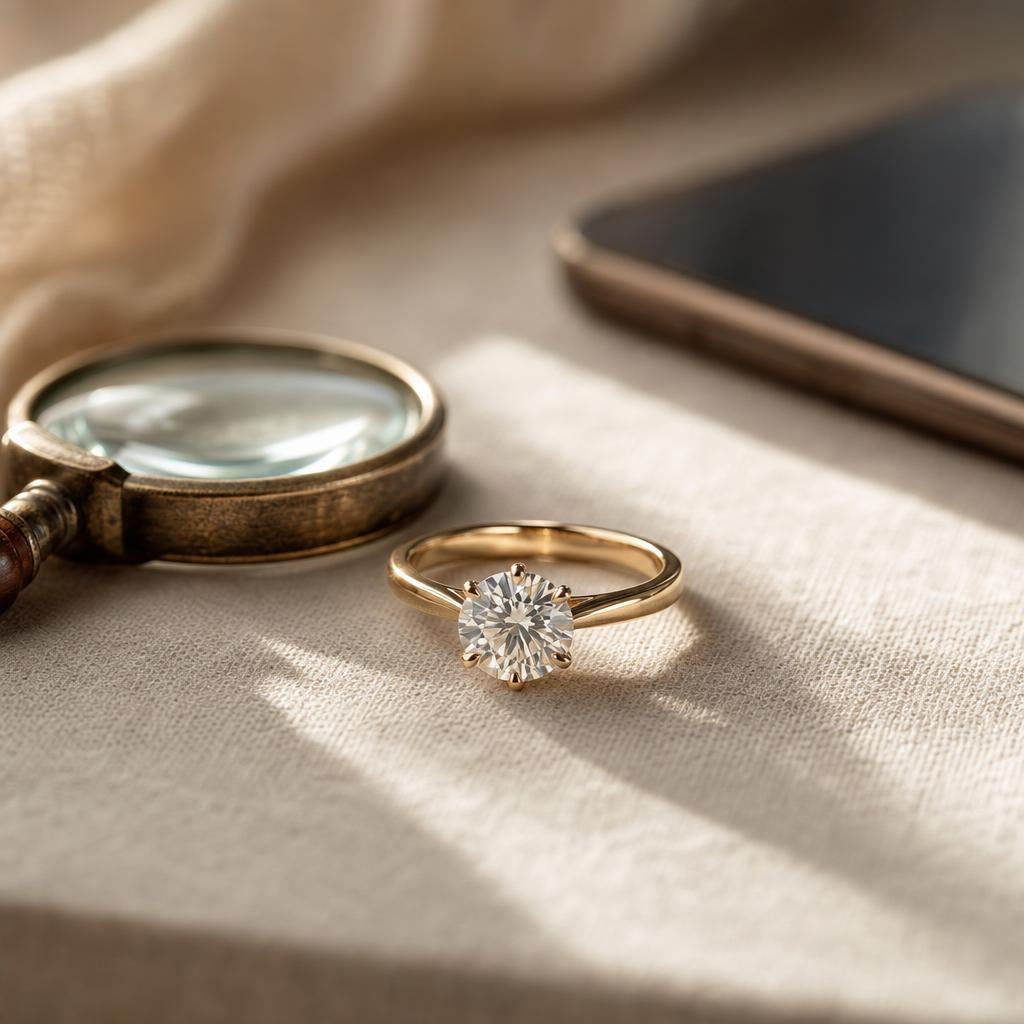
How to Read a Simulated Diamond Ring Listing Photo Before You Buy
Every ring you've ever swiped past online was lit by someone whose entire job was to make it sparkle harder than it ever will on your actual hand. That's not dishonest — it's product photography doing exactly what it's paid to do. But it also means that photo was never built to answer the question you actually have: what is this going to look like when it's not sitting under three studio lights?
You don't need a lighting degree to shop smarter, and buying rings online doesn't have to mean guessing. You just need to know what a ring photo is doing to the stone, and what to look for once you know the trick. Before we get into it, here's a spread of styles worth a closer look while you're at it.


Why Ring Photos Are the Hardest Product Photos to Read
A sweater photo is shot from a few feet away, in light close to what your living room already has. A ring photo is shot inches from the lens, under equipment built specifically to make faceted surfaces throw as much light as physically possible. Nothing else in your cart gets that treatment. It's the one product category where the "hero shot" and the real-world experience are almost guaranteed to diverge, simply because of how small and how reflective the object is.
That gap isn't a red flag on its own. It's just the format. The problem is that most shoppers read a ring photo the same way they'd read a photo of a lamp or a pair of shoes — as a literal preview — when it's closer to a highlight reel.
What Studio Lighting Is Actually Doing to That Stone
Jewelry photography typically uses a ring of small lights — sometimes four, sometimes six — arranged so that at least one of them is hitting every facet of the stone at once, from every angle, simultaneously. Your bedroom has one overhead light and maybe a window. No stone, mined or simulated, throws that much fire under a single ambient source the way it does under a rig built to catch all of it at once.
Worth knowing: Macro lenses used for jewelry shots also compress distance, which makes the stone look larger relative to the band and the hand than it will in a mirror selfie taken at arm's length.
The Angle Every Listing Photo Defaults To
Most hero shots are taken looking almost straight down into the table of the stone — the flat top facet — because that's the angle that reflects the most light back into the lens. It's rarely the angle you actually see your own ring from during the day, which tends to be a side or three-quarter view while your hand is moving. A ring that looks explosive from directly above can look completely different, and often quieter, from the angle you'll actually wear it at.
The Tells of a Listing You Can Actually Trust
None of this means every ring photo is misleading you. It means some listings give you more to work with than others, and the difference is worth learning to spot before you buy rather than after.
- More than one angle. A listing with only a single hero shot from directly above is giving you the most flattering frame possible and nothing else.
- A worn or on-hand shot. Even one photo taken in normal light, on an actual hand, tells you more than five studio close-ups combined.
- A video or 360° spin. Movement is much harder to fake than a still frame — sparkle that holds up while the ring turns is a genuinely good sign.
- Measurements given in millimeters, not just carat language. "Looks like 2 carats" is marketing. An actual stone dimension is a fact you can check against your own hand.
- No obvious added glow. Digitally boosted sparkle usually looks slightly too uniform, like every facet is lit identically — real light doesn't behave that evenly.

The Ophelia Ring
An oval hidden halo built to read like the kind of ring people assume costs $15,000 or higher — worth studying from more than one angle before you decide if the silhouette is right for you.
Shop The Ophelia →Why This Matters More for a Simulated Diamond Ring
If you've spent any time comparing rings, you've probably assumed a simulated diamond ring needs the lighting trick more than a mined stone does — that the sparkle is doing overtime to compensate for something. It's the opposite. A well-cut moissanite or cubic zirconia is engineered specifically for maximum brilliance and fire, which is why it throws light under ordinary ambient conditions, not just a six-point studio rig. Indistinguishable from a diamond to the naked eye, and it passes diamond testers — that's chemistry and cut, not a lighting department.
That's also exactly why an honest, well-lit photo of a simulated stone is such a fair test. If a ring only looks convincing under studio conditions, that's information. If it holds up in a video, a worn shot, and a still frame taken from an unflattering angle, that's a ring doing the work on its own.
✦ Pro tip: Before you buy, hold your hand near a window at home — not under a bathroom bulb — and picture the ring there. Indirect natural light is closer to how you'll actually see it every day than any studio flash will ever be.
A Five-Minute Checklist Before You Click "Add to Cart"
- Zoom into the setting, not just the stone. Prongs, pavé, and the underside of the band are where cheap construction actually shows up.
- Look for a video or 360° view. If a listing only has stills, that's not disqualifying, but it's a smaller sample size to judge from.
- Check for measurements in millimeters. This is the fastest way to translate a photo into something you can actually picture on your own hand.
- Read the return policy before you fall for the photo. A generous return window is the honest backup plan for a purchase you're making from a picture.
- Compare listings if the style exists elsewhere. The same silhouette can be described, lit, and priced very differently by different sellers — worth a second look before you commit.

The Maxima Ring
A cushion cut halo with enough genuine brilliance that it photographs consistently well from almost any angle you try — a good style to practice the checklist on.
Shop The Maxima →Buying Engagement Rings Online: What You Actually Give Up
Skipping the showroom means trusting a photograph to do a job it was never fully built for, but it also means you're not paying for the overhead of that showroom, a commissioned salesperson, or a velvet tray under a spotlight designed to make you say yes faster than you planned to. In person, you get to hold the ring under whatever light the store has — which, worth noting, is often engineered to flatter just as deliberately as any product photo. Online, you trade that single moment of handling for the ability to zoom, compare, read reviews, and walk away without anyone watching you decide.
Neither approach is more honest than the other. They're just different amounts of information, delivered differently — which is exactly why knowing how to read what you're actually looking at matters more online than it ever did in a store with only one ring in front of you at a time.
Quick Takeaways
- Ring photos are shot under lighting no room in your home will ever replicate — that's normal, not deceptive.
- The most common hero angle (looking straight down) reflects the most light and isn't how you'll actually see your ring day to day.
- Trustworthy listings show more than one angle, ideally a video, a worn shot, and real measurements in millimeters.
- A well-cut simulated stone doesn't need lighting tricks — it's built to throw fire under ordinary light too.
- A generous return policy is the honest safety net for any purchase made from a photo instead of in person.
Frequently Asked Questions
What Is a Simulated Diamond Ring, Exactly?
It's a ring set with a stone — typically moissanite or cubic zirconia — cut and faceted to replicate the brilliance and fire of a mined diamond, without the mining or the markup. Cut quality is what determines how convincing it looks, not the price of the raw material underneath it.
Is It Safe to Buy a Ring Online If You Can Only See Photos?
Yes, as long as the listing gives you enough to work with — multiple angles, ideally video, real measurements, and a clear return policy. The risk isn't buying online itself; it's buying from a single flattering photo with nothing else to check it against.
Do Simulated Diamonds Look Different in Photos Than in Person?
Slightly, the same way any faceted stone does under different light — but a well-cut one won't look convincing only under a camera and dull everywhere else. If the sparkle disappears the moment you step away from studio lighting, that's a cut quality issue, not something specific to simulated stones.
Buying Engagement Rings Online vs. In Store: Which Is Actually Better?
Neither wins outright. In store, you handle the ring once under the retailer's own flattering lighting. Online, you get to zoom, compare styles side by side, and read reviews at your own pace — but only if the listing gives you real information to work with instead of a single hero shot.
Will a Simulated Stone Really Hold Up Outside a Studio Photo?
A well-cut one will. The brilliance comes from precise faceting designed to bend and return light efficiently — that's a physical property of the cut, not a lighting effect added after the fact. It's the same reason these stones pass diamond testers: the performance is real, not staged.
How Do I Know If a Jewelry Website Is Legitimate?
Look for the same signals that make any listing trustworthy: honest photography with multiple angles, a specific return and exchange policy, real customer photos or reviews, and material details that are consistent across every product page rather than vague on the ones that matter most.
The smartest thing you can do before buying a ring online isn't distrusting every photo — it's knowing exactly what each one is, and isn't, showing you. That's not a compromise. It's just shopping like someone who already knows how the picture was taken.


