

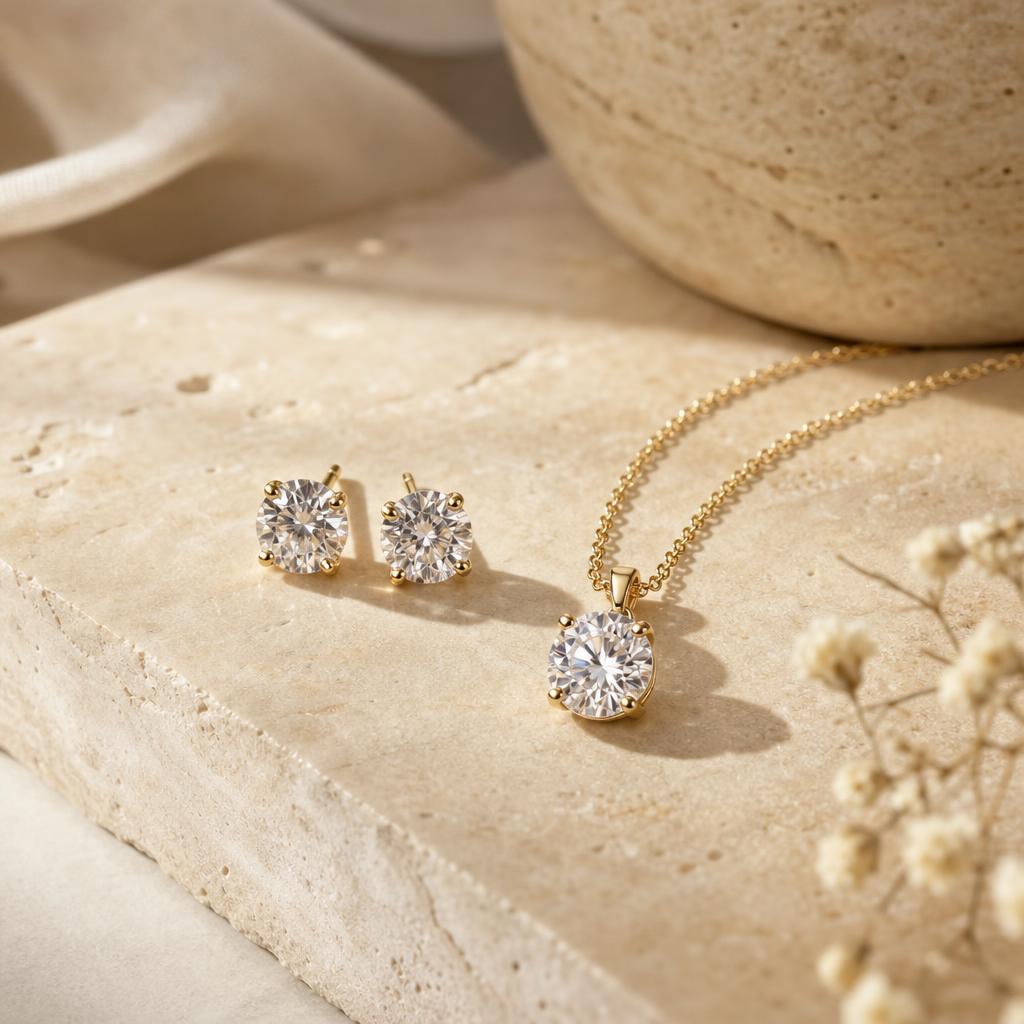
How to Match Earrings With a Necklace (Without Looking Matchy)
Nobody hands you a rulebook for putting earrings and a necklace on the same morning. So most of us default to one of two moves: match everything exactly, or take everything off and start over. There is a third option, and it is the one that looks like you have a stylist.
The short version: stop matching your earrings to your necklace as if they were a set, and start matching them as a family. Same stone shape, same visual weight, same metal tone, and one piece allowed to lead. Here are the pairs that make the idea obvious.


Why "match" is the wrong instinct
Classic jewelry advice treated earrings and necklaces as a matched suite: identical stones, identical drops, identical everything, bought together and worn together. It photographs well in a catalog and looks heavy in real life, because two identical focal points on the same face compete for the same patch of attention.
The women who always look pulled together are doing something subtler. They are choosing one piece to lead and letting the other agree with it. That is the whole logic behind how to match earrings with a necklace: agreement, not duplication. Four things have to agree: shape, scale, metal and neckline.
Rule one: share a shape language
Look at the stone, not the style name. A round solitaire pendant and a round solitaire stud speak the same language, so they read as intentional even when you bought them months apart. An oval pendant with oval studs does the same, and so does a princess-cut pair with a square pendant.
Where it goes wrong is crossing languages at full volume: an angular princess-cut stud with a soft oval pendant, both big, both bright. One of them has to be quiet. If you love both, make the shape you want noticed the larger one and keep the other small.
This is also why several Gemiros designs exist in more than one category with the same stone and setting. The Stella, Belle, Ophelia and Morgan names above each exist as studs and as pendant necklaces, so if you already wear one you know exactly what its partner will look like.
Rule two: let one piece lead
Scale is where most mismatched looks are really decided. A useful rule: your necklace and your earrings should not both be the loudest thing on you.
- Bold earrings, quiet chain. A large halo stud or a big emerald cut deserves a fine chain and a small pendant, or no pendant at all.
- Statement pendant, small studs. If the necklace is the event, a small round solitaire stud finishes the look without competing.
- Everything medium. If you want both present, keep both at the same modest size and let the shared shape do the work.
If you tend toward the understated end, our guide to minimalist earrings and what the understated look requires covers how small is small enough. And if you are wondering whether you can wear a statement pair and a necklace at all, the answer is yes, provided the chain is fine enough to stay out of the way.
The two-second test: look in the mirror and squint. If your eye jumps back and forth between your ears and your collarbone, one piece is too loud. Quiet the smaller one down until your eye lands in one place.
Rule three: keep the metal tone consistent, or contrast it on purpose
Consistency is the easy route. A platinum-tone pendant with platinum-tone studs, or a gold pendant with gold studs, never looks wrong. Mixing is entirely allowed, but it has to look decided rather than accidental. The simplest way to make mixed metals read as deliberate is to repeat each metal at least twice, so there is a bridge between them. Our walkthrough on layering gold and silver necklaces explains how that repetition works, and the same logic applies when the second metal is in your ears.
One practical note: several Gemiros designs come in both a platinum-tone and a gold version, including the Éclat studs and necklace, so you can choose the tone first and the shape second.
Rule four: let the neckline set the length
Earrings frame the face, a necklace frames the neckline, and each has to leave the other room. A pendant that lands in a V-neck repeats the V, so studs or small huggies keep the look clean. A high crew neck swallows a pendant but leaves your ears fully visible, which is the moment to put the effort into your earrings.
Long drop earrings and a collarbone-length pendant on a low neckline is the combination that most often feels like too much. When in doubt, go with the pairing that leaves a visible stretch of bare skin between your jaw and your pendant.
Pairs that make the rule obvious
A good starting point is a design that already exists in both categories, so the shape language is settled before you think about it. Here are three that work as a partnership without looking like a set.

The Leighton Stud Earrings
A 0.5ct round center in a cushion-shaped halo. Pair with the Leighton Necklace for the same halo language at collarbone height, or keep the necklace plain and let these lead.
Shop The Leighton Stud Earrings →
The Stella Huggie Hoop Earrings
A round-cut stone in a four-prong setting on a huggie hoop. They agree with the Stella Necklace on the stone while giving your ears a different silhouette, which is the whole point.
Shop The Stella Huggie Hoop Earrings →
The Éclat Moissanite Stud Earrings
Round-cut moissanite in a classic six-prong setting, available in platinum-tone and gold. The Éclat Moissanite Necklace shares the six-prong round solitaire, so the pair reads as a deliberate signature look.
Shop The Éclat Moissanite Stud Earrings →Dressing the same pair up or down
The advantage of an agreement-based approach is that one pairing travels. A round solitaire pendant with round studs is crisp with a blazer and a white shirt, and it holds its own with a slip dress at dinner. For the office, keep the chain at a modest length and the studs small. For the evening, swap in the halo studs and leave the pendant exactly where it is. You change one piece, not two, and the look still reads as one thought.
The same applies to travel. Two pairings that share a shape language pack into a pouch the size of your palm and cover a week of outfits, because any earring from one pair works with any pendant from the other.
Adding a stack on top
Once the necklace and earrings agree, a second or third earring in the same ear is a different question. Keep the extra earring smaller than the first, and in the same metal. The full approach, including how many is too many, lives in our piece on earring stack ideas.
✦ Pro tip: when you are building a collection from scratch, buy the earrings first. They sit closest to your face, they are worn with every neckline, and the necklace then becomes a choice rather than a requirement.
The quality question disappears
The reason this approach works especially well with Gemiros is simple: the stones carry the look. Gemiros earrings are 925 sterling silver with rhodium or 18k gold plating, set with stones that are indistinguishable from diamonds and pass diamond testers, nickel-free and tarnish-resistant, with a one-year warranty. You are choosing shape and scale. You are not hedging on whether it looks the part.
Quick Takeaways
- Match as a family, not a set: same stone shape, one piece leading.
- Never let both earrings and necklace be the loudest thing on you.
- Keep the metal tone consistent, or repeat each metal at least twice.
- Let the neckline decide the length, and leave some bare skin between jaw and pendant.
- Start with a design that exists as both studs and a pendant so the shape is already settled.
Frequently asked questions
Do necklaces and earrings need to match?
No. They need to agree. Sharing a stone shape, a metal tone or a similar scale is enough, and identical sets are optional rather than required.
How do I find matching earrings for a necklace?
Identify what the pendant is made of: the stone cut, the setting (solitaire or halo) and the metal tone. Then choose studs or huggies that repeat one or two of those, at a smaller or equal size.
Is it in style to wear matching earrings and necklaces?
Yes, when it looks chosen rather than boxed. Coordinated pieces with a shared shape are current. A fully identical suite worn at full volume is what tends to look dated.
Can I wear gold earrings with a silver necklace?
Yes. Repeat each metal at least twice somewhere in the look, with a ring or a second earring, so the mix reads as deliberate.
Should I wear earrings and a necklace at the same time?
Almost always. The exception is a very bold pair of earrings, where a plain fine chain is the better partner than a pendant.
The woman who always looks pulled together does not own a drawer of perfect sets. She has a handful of pieces that agree with each other and the confidence to let one of them lead. That is a better system than any set, and it costs far less than the jewelry store version.


