

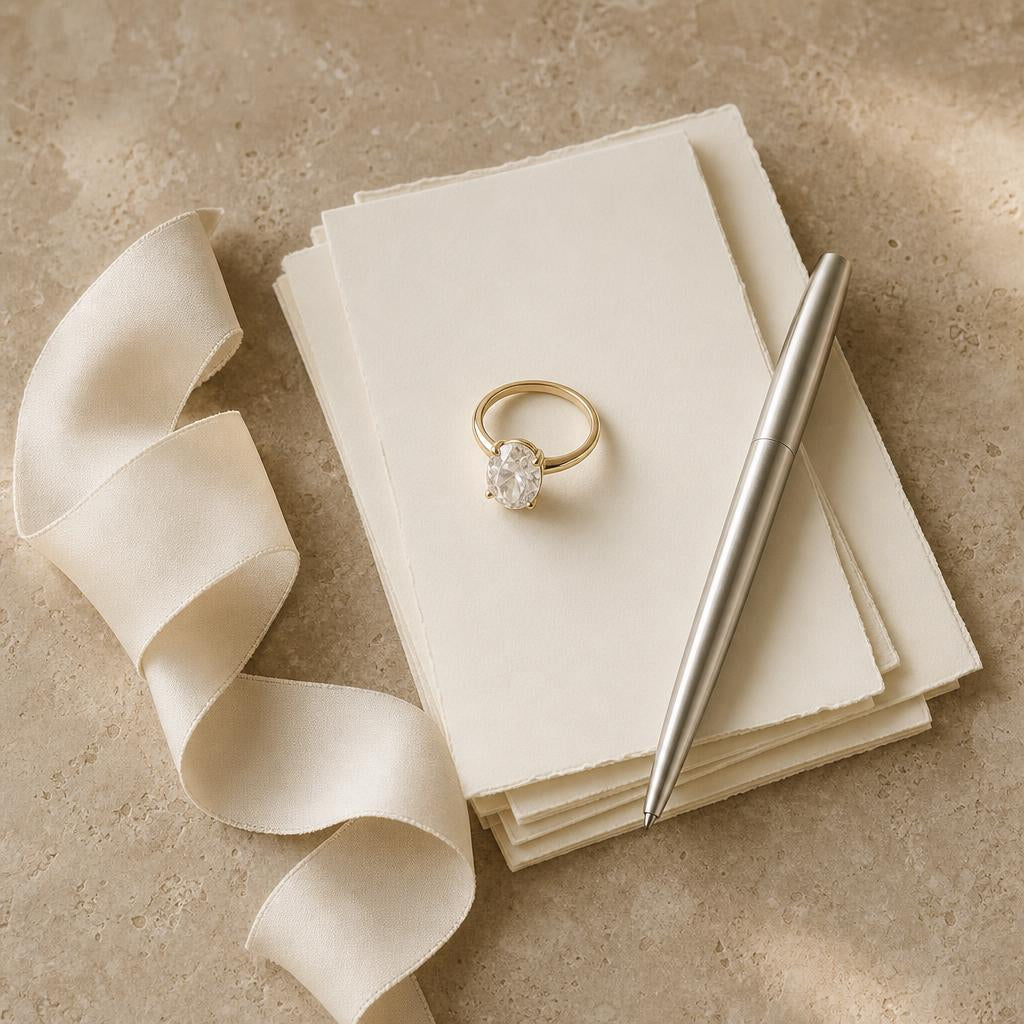
How to Choose an Engagement Ring: The Partner Buyer FAQ, Answered Directly
You've decided to propose. You have not decided anything else. Every guide you've opened so far assumes you already know the difference between a halo and a hidden halo, that you have a five-figure budget, and that you've been quietly cataloguing her jewelry preferences for years. None of that is true, and none of it needs to be. This is the actual, no-performance answer to how to choose an engagement ring — the questions men really ask, answered the way a smart friend would answer them.
Start here: the ring does not need to cost what the diamond industry told your father it should cost. It needs to look right, fit right, and arrive without you losing a month of your life to research you didn't sign up for. These four cover the range — halo, solitaire, oval, round — so you can see what you're actually choosing between before you read another word.


How much should I actually spend?
Ignore the three-months'-salary rule. It was never a rule — it was a De Beers ad campaign from the 1930s, repeated so often it calcified into "tradition." Nobody's grandmother wrote it into the family Bible. It exists to make you feel cheap for spending a reasonable amount, and it works embarrassingly well.
The actual answer is simpler: spend what you can pay for outright, without financing a proposal you'll still be paying off during the wedding. A ring set in 925 sterling silver with a moissanite or Gemiros Signature Simulated Diamond center stone gets you the oval-halo or cushion-cut look that used to require a mined diamond and a bank loan — at a fraction of the number your uncle will assume you paid. That's not a compromise. It's the math finally working in your favor.
The engagement ring buying guide nobody actually hands you
Every generic guide walks you through the 4Cs like you're about to grade a mined diamond yourself. You're not. Here's what actually determines whether the ring looks expensive and holds up:
- The setting matters more than the stone size. A hidden halo or pavé band makes a center stone read visibly larger without changing the carat number. A plain four-prong solitaire lets the stone do all the talking — better for a woman who already wears minimal jewelry.
- Metal color is not optional guesswork. Look at what she already wears — earrings, her watch, other rings. Warm skin tones and vintage-leaning taste tend to favor gold; cooler tones and a modern wardrobe tend to favor platinum-look silver or white metal finishes.
- Cut quality beats carat weight. A well-cut 2ct stone throws more light than a poorly cut 3ct stone. This is true whether the center stone is mined, lab-grown, or simulated — light performance is a setting-and-cut problem, not a price problem.
Worth knowing: A Gemiros ring isn't a placeholder or a "good enough for now" option. It's 925 sterling silver and moissanite, indistinguishable from a diamond to the eye and to a diamond tester. Nobody — including her jeweler — is going to clock the difference at a glance.
How do I find out her ring size without giving it away?
This is the question that derails more proposals than budget ever does. Three ways that actually work without a confession: borrow a ring she already wears on that finger while she's asleep or in the shower, trace the inside circle on paper, and compare it to a printable sizing guide. Ask her mother, sister, or best friend directly — women talk about this more openly than men expect, and most will happily keep the secret. Or size up slightly on purpose; a ring that's a touch loose is a five-minute fix at resizing, while a ring that doesn't fit at all becomes a whole event.
One more thing worth knowing before you buy: Gemiros rings come in whole sizes only, and there's no in-house resizing service — a local jeweler can usually adjust a sterling silver band, but check that before you assume it's covered.

Duchess Ring
If she's the type who wants maximum visible sparkle without a five-figure price tag attached to it, the Duchess stacks two halos of pavé around a cushion-cut center stone — more presence than a single halo, with the same easy sizing.
Shop Duchess Ring →What if I don't know anything about her style?
You know more than you think. Look at what's already in rotation: does she wear a lot of thin, stacked jewelry, or one statement piece at a time? Gold or silver-toned metal? Does she gravitate toward rounder, softer shapes in her clothes and accessories, or sharper, more architectural ones? An oval center stone reads soft and elongating; a cushion cut reads a little more classic and structured; a round solitaire reads timeless and doesn't commit to a trend either way.
If you genuinely have nothing to go on, a solitaire is the safest instinct in the entire category — it's the one silhouette that has never gone out of style and never will, because there's nothing about it to date. Pair that with a screenshot she saved once, a comment she made about a friend's ring, or a five-minute conversation with her sister, and you'll land closer than you expect.
Should I buy it online or from a jeweler?
Local jewelers earn their price with in-person guidance, on-the-spot resizing, and the ability to see the stone in person before you commit — genuinely valuable if you're buying a natural diamond, where every stone is priced individually on rarity. That entire calculation disappears once the center stone is a lab-created moissanite or a Gemiros Signature Simulated Diamond: quality is engineered to be consistent, not scavenger-hunted, so there's nothing a showroom visit tells you that a clear product photo and a return policy don't already cover. Buying online isn't the compromise version of this decision. It's the version that skips the markup built entirely around information you no longer need a middleman to provide.

Lumière Ring
A 4-carat round brilliant center stone in a refined 4-prong setting — built for the woman whose taste is "one stone, no distractions, make it undeniable."
Shop Lumière Ring →Does it need to be a real diamond for her to say yes?
No, and the women who'd tell you otherwise generally aren't the women you're proposing to. What she notices is the design, the fit, and whether you clearly put thought into it — not a certificate she'll never ask to see. A moissanite or simulated diamond center stone passes a diamond tester and reads identical to the eye at arm's length, which is the only distance most people ever look at a ring from anyway. The things to know before buying an engagement ring have less to do with stone origin than they do with getting the setting, the size, and the moment right.
What if she says it isn't her style?
It happens, and it's not the disaster it feels like in the moment. Check the exchange window before you buy — most online jewelers, Gemiros included, give you a real return period, not a store-credit consolation prize. A ring is not a one-shot purchase the way it was framed to be a generation ago; it's the first piece in a collection she'll build over years, and the first piece doesn't have to be the perfect one, just a genuine one.
Quick Takeaways
- Skip the three-months'-salary rule — it's marketing, not tradition, and it has nothing to do with what the ring actually needs to cost.
- Setting and cut quality matter more to how "expensive" a ring looks than carat size alone.
- Borrowing an existing ring or asking her inner circle beats guessing on size.
- A well-made simulated diamond or moissanite ring is indistinguishable to the eye and passes diamond testers — no hedging required.
- Buying online skips a markup built for a decision-making process simulated stones no longer require.
Frequently Asked Questions
Is there an actual rule for how much to spend on an engagement ring?
No — the "two or three months' salary" guideline is a decades-old marketing line, not a financial standard. Spend what you can pay for outright and put the rest toward the life you're actually proposing to build together.
How long before proposing should I actually buy the ring?
Give yourself a few weeks of buffer, not months. Online retailers ship quickly, sizing is usually straightforward, and buying too far ahead just gives you more time to second-guess a decision you'd already made.
Is it better to buy from a local jeweler or online?
Local jewelers add real value when you're pricing a natural diamond, since every stone is individually rare. With a lab-created moissanite or simulated diamond, quality is consistent by design, so a clear product listing and a solid return policy cover what a showroom visit used to.
What if I get the size wrong?
It's the most common and most fixable mistake in the entire process. Check the resizing and exchange policy before you buy — a slightly loose ring is a quick adjustment at a local jeweler, and most online retailers will exchange for the correct size within a set return window.
Does she need to know the stone isn't a mined diamond?
That's entirely your call to make together, but there's nothing to hide. A well-made simulated diamond or moissanite center stone is indistinguishable from a mined one to the eye and passes diamond testers — the honesty is easy because the quality doesn't need defending.
You didn't need a jewelry degree. You needed the three or four facts that actually change the decision, and now you have them. Pick the silhouette that matches how she already dresses, get the size right using someone who already knows it, and buy from a place that stands behind the ring after you've paid for it. That's the whole guide.


