

How to Build a Jewelry Wardrobe That Actually Makes Sense
Open most jewelry boxes and you'll find the same story: a drawer of rings bought on impulse, at airports, during sales, as gifts to herself after a hard week — each one lovely on its own, none of them actually working together. There's no plan. There's just accumulation.
A jewelry wardrobe is different. It's a small, deliberate collection where every piece earns its place — either because it anchors your everyday look, layers beautifully with what you already own, or covers the one occasion your other rings can't. Here are four pieces that do exactly that, each one built to work with the others rather than compete against them.


Start With One Foundation Piece, Not Five Options
The instinct when you first start buying rings for yourself is to cast a wide net — a little of everything, in case one style doesn't work out. It's a reasonable impulse, and it's also exactly how jewelry boxes end up full of rings nobody reaches for. A wardrobe starts narrower than that: one foundation piece, worn often enough that you actually learn what you like.
A round or oval solitaire is the obvious place to begin. It's the piece that goes with a blazer and with bare shoulders, that photographs well without trying, and that doesn't compete with anything you layer next to it later. The case for one stone, no distractions holds up here: a solitaire isn't a placeholder until you find something more interesting. For a lot of women, it's the piece that ends up worn the longest.
If you already own a statement ring and are starting the wardrobe conversation from the opposite direction — too much sparkle, not enough foundation — the same logic applies in reverse. Add the quiet piece before you add another loud one.
The Three-Piece Rule: Anchor, Layer, Statement
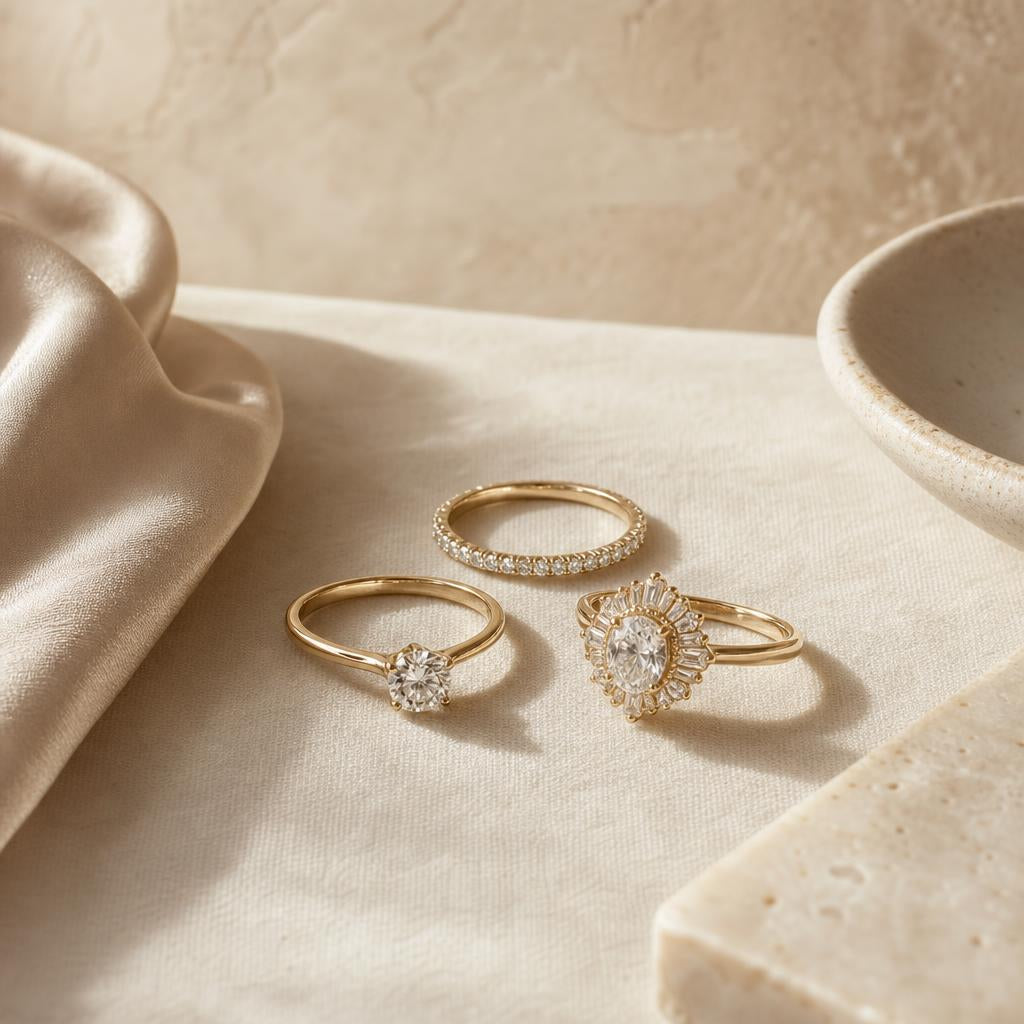
Once the foundation piece is settled, the easiest way to think about everything after it is a simple three-part structure: an anchor, a layer, and a statement. You don't need six rings. You need one from each category, chosen so they actually sit well together on the hand.
- The anchor — your solitaire or simple everyday ring. Worn alone, worn daily, worn without a second thought.
- The layer — a slim pavé or eternity band that sits flush against the anchor and adds sparkle without changing the silhouette.
- The statement — a halo, a larger stone, or an unusual cut that comes out for the nights the anchor alone doesn't feel like enough.
This is the same logic behind stacking combinations that look intentional, not accidental — the difference between a look that reads as curated and one that reads as cluttered usually comes down to having exactly one of each role, not two or three competing for the same job.

The Destiny Ring
A slim pavé crossover band designed to sit flush against a solitaire without adding bulk — this is the layering piece the three-piece rule is built around.
Shop The Destiny Ring →Notice what's missing from that list: a second anchor, a third layering band, a backup statement piece "just in case." A wardrobe works because each piece has one clear job. The moment two rings compete for the same role, you're back to accumulation instead of building something.
Building on a Budget: Where to Spend and Where to Save
You don't need to buy all three pieces at once, and you definitely don't need to buy the most expensive version of each. The honest budget logic looks more like this: spend a little more on the anchor, since it's the piece you'll wear the most and photograph the most. Save on the layering piece — a simpler pavé band does the job just as well as an elaborate one, since it's rarely the focal point. And treat the statement piece as the one you wait for, rather than rush.
Worth knowing: Because simulated diamonds don't carry the same cost structure as mined stones, building all three pieces in this framework typically costs less than a single mined-diamond solitaire — which is exactly what makes the three-piece approach realistic instead of aspirational.
The entry point doesn't have to be expensive to feel considered. A simple eternity band under $150 can do real work in a wardrobe — not as the statement piece, but as an easy, low-cost way to test whether stacking is even a habit you'll keep up.

The Forever Ring
A clean, continuous pavé eternity band at one of our most accessible price points — a low-risk way to start building a stack before committing to a full three-piece wardrobe.
Shop The Forever Ring →If you're shopping with a genuinely fixed number in mind, it's worth thinking about the sequence, not just the total — how to get the most ring for a fixed number covers the same prioritization from the angle of a single purchase, which is useful groundwork before you're managing three.
How Many Rings Do You Actually Need?
Fewer than you think, and that's not a limitation — it's the actual point of a wardrobe versus a collection. Three well-chosen rings that were bought to work together will get more wear, and look more considered, than eight rings bought at eight different moments with no relationship to each other.
This is easiest to see on the hand itself. Two rings that don't relate in width, metal tone, or sparkle level tend to visually cancel each other out — the eye can't tell which one you meant as the focal point. Three rings chosen against the anchor-layer-statement structure never have that problem, because each one already knows its job.
Signs You're Buying Randomly, Not Building a Wardrobe
A few honest signals worth checking yourself against: you own more than one ring in the exact same role (two halos, two thin bands) and reach for only one of them. You've bought a ring because it was on sale rather than because it filled a gap. You can't say, out loud, what each ring in your current rotation is "for." None of these are dealbreakers — they're just useful signs that the next purchase should fill an actual gap rather than add another option to a pile.
Buying in the Right Order
If you're starting from nothing, the anchor comes first — always. It's the piece you'll wear on its own for months before adding anything else, so it needs to hold up alone. The layering piece comes second, once you already know how the anchor sits on your hand and what width actually clears it without gapping. The statement piece comes last, and honestly, there's no rush on it. It's the one purchase in this framework that benefits from waiting for the right moment — an anniversary, a milestone, a Tuesday that felt like it deserved something bigger.
Buying in this order also means you're never paying for a piece before you know it'll earn its place. A statement ring bought first, before the anchor, often ends up being the only ring you own — which isn't a wardrobe, it's just one very nice ring with nothing to build around.
Quick Takeaways
- Start with one foundation piece — a solitaire — and wear it alone long enough to know what you actually like.
- Build toward three roles, not three rings of the same kind: an anchor, a layer, and a statement.
- Spend more on the anchor, save on the layering piece, and let the statement piece be the one you wait for.
- Buy in order — anchor, then layer, then statement — so every purchase earns its place before the next one arrives.
- Fewer, better-chosen pieces will get more wear than a drawer full of rings with no relationship to each other.
Frequently Asked Questions
Do I need to buy all three pieces from the same collection?
No — the anchor-layer-statement structure is about role, not matching sets. What matters more is that the metal tone stays consistent and that the layering piece's band width actually clears your anchor without gapping at the base.
What if I already own a statement ring but no anchor piece?
Build backwards — add the solitaire next. It will feel like the "plainest" purchase in the wardrobe, but it's the piece you'll actually reach for on ordinary days, and it gives the statement ring somewhere to retreat to when you want quieter days.
How long should I wait between adding each piece?
There's no fixed timeline, but giving yourself a few months with each piece before adding the next one is a useful discipline — it's long enough to know whether you actually wear it the way you thought you would.
Is it worth repeating a role — like owning two layering bands?
Only once the first is genuinely in daily rotation. A second layering band in a different width or finish can extend the wardrobe, but a second one bought before the first earns its place usually just becomes another drawer item.
A jewelry wardrobe isn't a bigger collection — it's a smaller, more deliberate one, where every ring has a reason for being there. Start with the piece you'll wear the most, add only what genuinely fills a gap, and let the rest wait until it's actually earned.


