

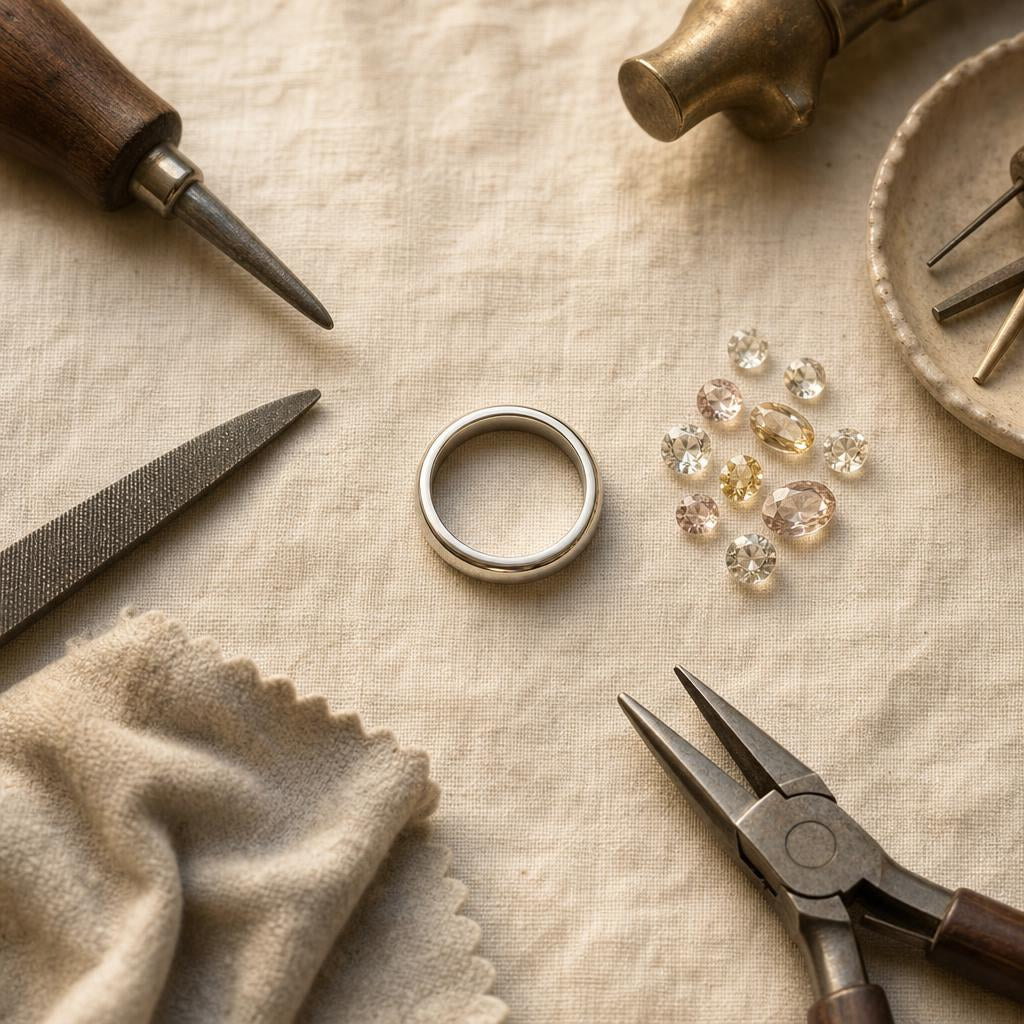
How a Ring Is Actually Made: From Setting to Polish, a Behind-the-Scenes Look
Most women have never actually watched a ring get made. They've seen the finished piece on a velvet tray, lit like a museum object, and assumed the process behind it is some kind of mystery reserved for old European ateliers. It isn't. It's a specific, learnable sequence of steps — casting or fabricating a shape, setting a stone, polishing it to a mirror finish — and once you understand how a ring is made, you start looking at price tags very differently.
That's not a coincidence. The jewelry industry has a vested interest in keeping the process mysterious, because mystery is what makes a markup feel justified. Here's what actually happens between a design sketch and the ring on your hand — and why knowing it changes what you're willing to pay for one.


How a Ring Is Made: Two Paths to a Finished Piece
Nearly every ring in the world is built one of two ways. The first is casting: a jeweler sculpts or CAD-models the design, produces a wax version of it, and surrounds that wax in a plaster-like material called investment. The whole thing goes into a kiln, the wax burns away, and what's left is a hollow cavity in the exact shape of the ring. Molten metal gets poured into that cavity, cools, and is broken out of the mold as a raw, unfinished band.
The second method is hand fabrication — cutting a strip or wire of metal, bending it around a mandrel into a circle, and soldering the seam closed with a torch. Fabrication is slower and better suited to simple bands; casting is what makes it possible to repeat a complex, detailed design consistently, piece after piece, without every unit being a one-off experiment. Almost every ring you've ever bought — regardless of the price on the tag — started as one of these two things.
Worth knowing: Casting isn't a shortcut or a lesser method. It's what allows a setting as detailed as a hidden halo or a pavé band to be produced accurately at all — hand fabrication alone can't replicate that level of intricacy reliably.
Setting the Stone: Where the Ring Actually Comes Alive
A cast or fabricated band is just a frame until a stone goes into it, and this is the step that separates a ring that photographs flat from one that catches light from across a room. Prongs — the small metal claws you see gripping a solitaire stone — get individually soldered into place, then bent and tightened around the stone's girdle until it sits securely. A halo setting adds a ring of tiny accent stones around the center stone, each one seated into its own micro-prong or pavé bead. Pavé itself is its own small feat: dozens of stones set so close together that the metal between them all but disappears, so all you see is a continuous field of sparkle.
This is also the step where a ring's actual quality shows up, regardless of what the stone is made of. A stone set slightly off-center, prongs that are uneven, pavé that's sparse in places — these are the tells of a rushed setting, and they're visible whether the center stone is a mined diamond or a lab-created one. The setting is craftsmanship. The stone is a separate decision entirely.

The Maxima Ring
A 3.5-carat cushion-cut center stone wrapped in a halo and hidden halo, both finished in pavé — the kind of layered setting work that takes real precision to get right.
Shop The Maxima Ring →Finishing: Plating and Polish
A freshly set ring still isn't done. It goes through a series of polishing wheels and ultrasonic baths to smooth every surface to a mirror finish and clear away any residue from the setting process. Then, if the design calls for a gold or rose gold finish over a silver base — which is how the vast majority of demi-fine and even fine jewelry actually achieves those tones — the ring goes through an electroplating bath. A thin, even layer of 18k gold or rhodium bonds to the surface, giving the piece its final color and, in rhodium's case, extra shine and scratch resistance.
✦ Pro tip: Rhodium and gold plating wear gradually with contact — lotion, friction, chlorine. Rinse your ring after swimming and give it a gentle wipe with a soft cloth before bed, and the finish holds its shine for far longer.
Every Gemiros ring is built on this exact framework — cast in 925 sterling silver, hand-set stone by stone, then finished in rhodium, 18k gold, or rose gold plating. Nothing about the manufacturing process is simplified or skipped to hit a lower price point. What's different is what sits at the center of the setting.
Why the Stone Matters as Much as the Setting
The center stone in a Gemiros ring isn't a diamond — it's moissanite or a lab-created simulated diamond, set using the same prong, pavé, and halo techniques a diamond ring uses. It isn't a lesser version of the real thing waiting to be found out. It's indistinguishable from a diamond to the naked eye and passes diamond testers, because the setting craftsmanship and the stone's optical performance are doing the same job a mined diamond does — reflecting light in a way that reads as brilliance, full stop.
This is the part most people never get explained to them: a stone's visible sparkle comes from its cut and its refractive properties, not from where it was mined. Once you understand how a ring is made — that the setting is craftsmanship and the stone is a material choice — the idea that you need to spend thousands to get a ring that looks and performs beautifully stops making sense.

The Juliette Ring
A pear-cut center stone flanked by two heart-cut side stones, each one individually prong-set — a three-stone build that takes noticeably more setting work than a single solitaire.
Shop The Juliette Ring →What This Actually Means for What You Pay
Here's the part that's easy to miss: a huge portion of what a traditional jewelry store charges has nothing to do with the casting, setting, or polishing work described above. It covers the mined stone itself, the retail markup, the showroom, the sales commission. The manufacturing process — the actual craft — is a comparatively small slice of that final number.
Gemiros rings go through every stage described here: cast, hand-set, plated, polished, quality-checked. What's removed is the mined-stone premium and the traditional retail markup — not the craftsmanship. That's why a ring that can look like it costs $15,000 or higher can be priced under $200. It's not a trick. It's just a supply chain without the parts that don't affect how the ring actually looks or wears.
Quick Takeaways
- Rings are built through casting (lost-wax) or hand fabrication — casting is what allows detailed settings like halos and pavé to be reproduced accurately.
- Stone setting is where craftsmanship actually shows: prong placement, pavé density, and symmetry matter regardless of what the center stone is made of.
- Plating (rhodium, 18k gold, rose gold) happens after polishing and gives a silver-based ring its final color and shine.
- A stone's sparkle comes from its cut and optical properties — not from where it was mined.
- Gemiros rings go through the same casting, setting, and polishing stages as rings costing far more — what's removed is the mined-stone premium and retail markup.
Frequently Asked Questions
How long does it take to make a ring?
A cast ring typically moves through design, casting, setting, and polishing over several days to a couple of weeks, depending on how detailed the setting is. A hidden halo or pavé design takes noticeably longer to set by hand than a plain solitaire.
Why aren't rings made of pure 24k gold?
Pure gold is too soft to hold a setting securely or resist everyday scratching, so it's alloyed with other metals for strength, or used as a thin plated layer over a sturdier base metal like sterling silver — which is exactly how Gemiros' 18k gold and rose gold finishes work.
How can you tell if a ring's finish is real gold plating versus a cheap coating?
Quality plating is applied through electroplating, which bonds the gold evenly at a consistent thickness rather than sitting on top as a thin spray. It should feel smooth with no visible brush marks, and it should hold its color evenly rather than wearing unevenly in patches within the first few wears.
Is a hand-set stone more secure than a machine-set one?
Stone setting is inherently a hands-on, precision step even in modern manufacturing — prongs are individually placed and tightened around each stone by a setter, whether the piece is a one-off or produced at scale. What matters most for security is the quality of that setting work, not the production volume.
Does understanding the manufacturing process change how I should shop for a ring?
It should. Once you can separate the cost of craftsmanship from the cost of the stone and the retail markup, you can ask a more useful question when comparing rings: is this price paying for setting quality and finish, or mostly for the material and the showroom?
The next time you try on a ring — anywhere, at any price — look past the sparkle for a second. Check the prong work. Run a finger along the pavé. That's the part someone actually made, and it's the part worth paying attention to.


