

Hidden Halo vs. No Halo Engagement Ring: Why Simplicity Is Winning
There's a particular kind of confidence in a ring that doesn't ask for backup. No halo circling the center stone, no extra sparkle borrowed from somewhere else — just one stone, one band, and nothing standing between the two. More women are choosing exactly that, and it isn't a compromise. It's a decision.
If you've spent any time comparing settings, you've probably run into the same standoff everyone else does: halo, or nothing at all? Below are a few solitaire and near-solitaire styles worth a closer look before we get into the why.


What "No Halo" Actually Means
A halo setting rings the center stone with a circle of smaller accent stones, usually to make the center look larger or to add sparkle from every angle. A no-halo ring skips that entirely. The stone sits alone, held by prongs, a bezel, or a slim gallery, with nothing framing it. In plain terms, a solitaire is the most common form of no-halo design: one stone, centered, on a clean band, with the cut and proportions of that single stone doing all the work.
Bezel settings and three-stone rings without a halo count too, but solitaire is the style most people picture when they hear "no halo." It's also the oldest form an engagement ring has taken — long before halos, pavé bands, or hidden accents became standard options, this was simply what a ring looked like. Round, oval, emerald, pear, and asscher cuts all take to a no-halo setting differently, which is part of why the category never feels as narrow as "plain" might suggest.

The Ondine Ring
A 2-carat pear-cut center stone set east-west on a fluid, unadorned band — proof that no-halo doesn't mean predictable.
Shop The Ondine Ring →Hidden Halo vs. No Halo Engagement Ring: What's the Real Difference
A hidden halo sits underneath the center stone instead of around it — invisible from above, catching light only from the side. It's a genuinely clever middle ground: the top-down view reads clean and solitaire-like, while the profile carries a little extra sparkle most people will never notice unless they're looking for it. A true no-halo ring skips that layer altogether. There's no hidden row of stones doing quiet work beneath the setting — just the center stone, the metal, and nothing else asking to be accounted for.
Neither is more "correct." A hidden halo adds a small, deliberate detail for someone who wants a little more without changing the silhouette. A no-halo ring commits fully to restraint. The difference comes down to what you're actually trying to say with the ring: added dimension, or absolute clarity.
Gemiros stocks both, because both are legitimate answers to the same question. This isn't a debate with a winning side — it's a matter of which one makes you feel like you chose well, and that's a call only you can make.
Why the No-Halo Movement Is Having a Moment
For a long time, bigger and busier was treated as the default upgrade — more stones, more sparkle, more visual noise around the center. The no-halo shift is really a rejection of that assumption. It's the same instinct behind quiet luxury in clothing: the most expensive-looking thing in the room is rarely the loudest one. A solitaire says the stone itself is confident enough to stand there unaccompanied, and that reads as more deliberate, not less.
There's a practical case here too, and it's not a small one. A no-halo ring is indistinguishable from a diamond, passes diamond testers, and does it without a single extra prong or crevice for lotion, soap, or dust to hide in. Fewer settings means fewer things that can catch on a sweater, snag a glove, or need a professional cleaning to look right again. It's the setting built for someone who wears her ring every single day and never wants to think about it.
There's also something quietly rational about choosing a no-halo ring on a 925 sterling silver, moissanite base rather than a mined diamond in the same setting: the same clarity, the same six-prong presence, at a fraction of what a jewelry store would ask for it. No one at your dinner table is going to clock the difference — they're going to notice the ring, full stop.
This is really the same instinct that shows up everywhere else in how she shops now: she's done the math on the traditional jewelry store markup and decided it doesn't buy her anything a no-halo ring in 925 sterling silver and moissanite can't already deliver. Choosing simplicity here isn't settling for less detail — it's refusing to pay for detail that was never going to be visible from across a room anyway.

The Stella Ring
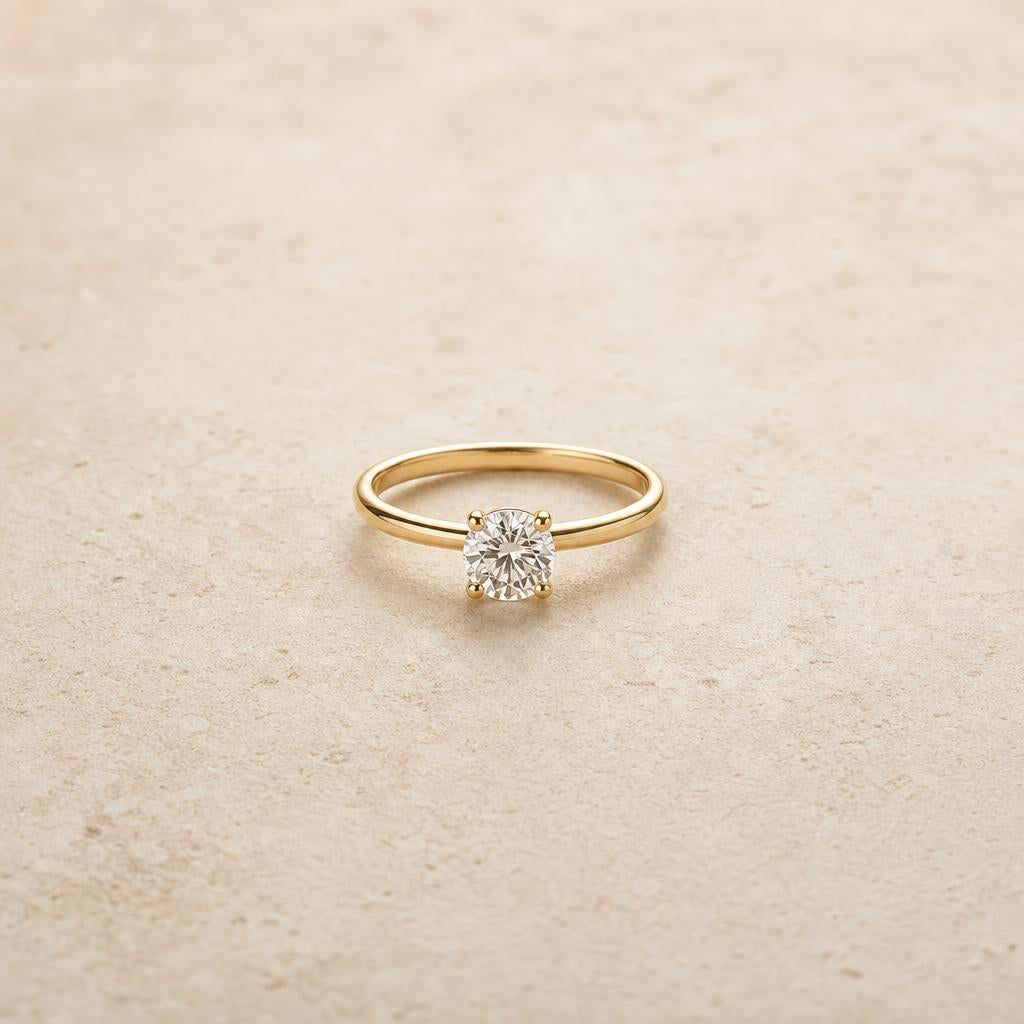
A round-cut solitaire on a classic 4-prong setting — the ring that proves minimalism was never the same thing as quiet.
Shop The Stella Ring →Is a No-Halo Setting Right for You?
If you're drawn to clean lines, you already know it — a no-halo ring tends to appeal to the same person who prefers one great coat over five mediocre ones. It photographs cleanly, it pairs easily with almost any wedding or stacking band since there's no extra width or gallery to clear, and it puts the full weight of the design on cut quality rather than stone count.
Worth knowing: Because a no-halo setting has fewer components, sizing and any future adjustments tend to be simpler than on a halo or hidden halo ring, where resizing means accounting for the accent stones too.
Stacking is another place a no-halo ring quietly wins. Because there's no wide gallery or raised halo basket to clear, a solitaire generally sits flush against a wedding band or a curved guard ring with far less fuss — no custom-fit contour band required, no gap to disguise. If you already know you'll want to build a stack around your engagement ring eventually, a no-halo center simplifies that decision considerably. It's one less variable to plan around later.
Where a no-halo comparison actually gets interesting is stone shape. An oval or pear solitaire elongates the finger on its own, without a halo's help. A round or cushion solitaire reads as more classic. An emerald or asscher cut leans architectural, its step-cut facets doing quieter, more geometric work than a brilliant cut would. The shape carries more of the personality when there's nothing else competing for attention — which is exactly the point.
If instead you like the idea of a little extra sparkle without changing the overall look, that's precisely what a hidden halo is built for. There's no wrong answer here, only the one that actually matches how you want the ring to read on your hand. Cost is worth a mention too: because a no-halo setting uses less metal and no accent stones, it's generally the more efficient of the two to produce, which is one reason solitaires have stayed a reliable, accessible choice across generations of buyers rather than a passing trend.
Quick Takeaways
- No-halo rings — including solitaires, bezels, and unhaloed three-stone styles — put full focus on the center stone with no surrounding accent stones.
- A hidden halo sits beneath the stone and adds side-angle sparkle without changing the top-down look; a true no-halo setting skips that layer entirely.
- Fewer prongs and crevices make no-halo rings easier to clean and lower-maintenance for daily wear.
- Stone shape does more visual work in a no-halo setting since there's no halo to lean on.
- Neither halo nor no-halo is objectively better — the right one matches the level of detail you actually want.
Frequently Asked Questions
What is a solitaire engagement ring?
A solitaire engagement ring features one center stone set alone on the band, with no side stones, halo, or pavé accents. It's the simplest and most classic no-halo style, and the one most people picture when they imagine a "plain" setting.
Should an engagement ring have a halo at all?
Only if you want one. A halo adds visual size and extra sparkle at the cost of more upkeep. Plenty of rings — and plenty of women — look and feel more intentional without one. It's entirely a matter of preference, not a rule.
What does "no halo" mean on a ring?
It means the center stone has no ring of accent stones around or beneath it — just the stone itself, held by prongs or a bezel, with nothing added around the edges.
Hidden halo vs. no halo engagement ring — which one should you choose?
Choose a hidden halo if you want a touch of extra sparkle from the side without changing the top-down silhouette. Choose true no-halo if you want the center stone to carry the entire look with nothing else in the setting. Both hold up equally well for daily wear.
Can a solitaire have a hidden halo?
Yes — a hidden halo solitaire looks like a plain solitaire from above but carries a small ring of accent stones tucked beneath the center stone, visible only from the side. It's a distinct style from a true no-halo solitaire, which has no accent stones anywhere in the setting.
What is a solitaire diamond?
The term describes any single stone set alone as the focal point of a piece of jewelry, most often in a ring. In a solitaire setting, that single stone — whether a mined diamond, lab-grown diamond, or moissanite — sits without any side stones or halo around it.
Whichever you land on, the ring should read as a decision, not a default. If you've been circling the same setting for weeks and it still feels right every time you look at it, that's usually the answer. The rest is just details.


