

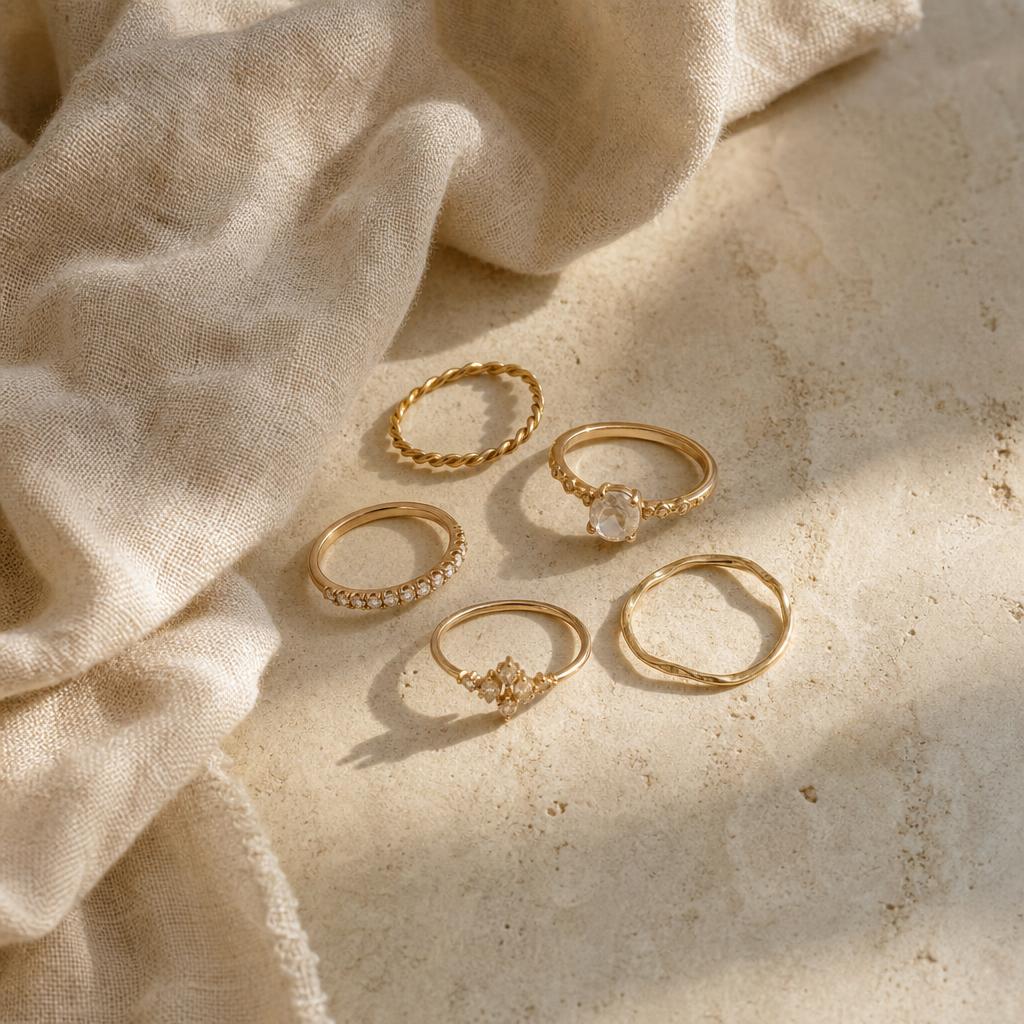
Editorial vs. Everyday Ring Style: What Actually Wears Well
A ring can look extraordinary under studio lighting, styled at an angle no hand actually holds, photographed once and never touched again. That is editorial styling — and it is not the same test as whether a ring can survive a Tuesday. If you have ever fallen for a ring in a photoshoot and wondered whether it would actually earn its place in your daily rotation, you are asking the right question.
The good news: the two aren't opposites. Some of the most photogenic settings are also the most wearable — you just have to know what to look for underneath the styling. Here's where to start.


The Question Editorial Photos Never Answer
A photoshoot ring is judged on one criterion: how it reads in a single frame, under controlled light, held at the most flattering angle a stylist could find. None of that tells you how the setting sits against a laptop keyboard, whether the prongs catch on a wool sweater, or how the stone photographs in the flat gray light of an ordinary Tuesday. Editorial styling answers "does this look incredible right now." An everyday ring has to answer a harder question: "will I still reach for this in six months."
That distinction matters more than it sounds like it should. A ring bought purely for how it photographed on someone else's hand, in someone else's lighting, is a ring bought for a moment that already ended. The better approach is to separate what actually makes a design photogenic from what actually makes it livable — because, more often than you'd expect, the two overlap.
What "Editorial" Actually Means on a Ring
Editorial pieces are usually built to catch light from multiple angles: a halo that throws extra brilliance around the center stone, a pavé band that sparkles even in dim rooms, a larger carat size that reads clearly from across a room. These are real, defensible design choices — they photograph well because they perform well under light, not because they're an illusion that falls apart up close.

The Belle Ring
A round-cut center stone set inside a halo, with a pavé band that keeps the sparkle going past the center. It's the kind of design that photographs beautifully in raking light — and, set in 925 sterling silver with a secure prong setting, it holds up just as well against a Tuesday commute.
Shop The Belle Ring →Where editorial styling gets misleading is scale and context. A ring shot in extreme close-up, cropped tight so the hand fills the frame, can make a modest center stone look enormous — or make a genuinely large stone look impossible to type with. Neither tells you the truth. The only way to know how a ring will actually sit on your hand is to look at it in proportion: your knuckle size, your finger length, the rings you already wear next to it.
What an Everyday Ring Actually Requires
This kind of ring has different priorities than a photoshoot piece, even if the two sometimes describe the same object. A setting built for daily wear needs a low enough profile that it doesn't snag on gloves, pockets, or hair; prongs secure enough that you don't think about the stone while typing; and a band substantial enough to keep its shape after months of wear, not just one afternoon in front of a camera.
Worth knowing: Gemiros rings are set in 925 sterling silver with rhodium, 18k gold, or rose gold plating — hypoallergenic and nickel-free, so the question isn't whether the metal will irritate sensitive skin. It's whether the setting style suits how you actually move through a day.
This is where a genuinely low-maintenance design earns its reputation. Choosing a quiet, pared-back setting isn't about owning less sparkle — it's about picking pieces that don't require daily thought. A solitaire with a secure four-prong setting, a slim pavé band that sits flush against your other rings, a stacking band with no raised elements to catch: these are the designs that disappear into your routine instead of demanding attention from it.

The Stella Ring
A round-cut solitaire on a clean band — the kind of design that looks intentional in a photograph and requires zero adjustment for real life. No raised halo to catch, no cluster of stones to snag, just a secure setting that photographs as confidently as it wears.
Shop The Stella Ring →The 2:1:1 Rule, and Why It's Useful Here
✦ Pro tip: Stylists sometimes use a rough 2:1:1 ratio when building a jewelry look — one dominant, editorial-leaning piece, balanced by two quieter, everyday pieces that don't compete with it. Applied to rings, that means you don't need every ring in your collection to do the same job. One statement piece, paired with settings built for daily wear, reads as more considered than five rings all shouting at once.
This is a useful way to reframe the editorial-versus-everyday question. It isn't actually a choice between two categories — it's a ratio. A single dramatic ring, worn with restraint, does more work than an entire hand of rings competing for attention. The trick is knowing which piece in your collection is allowed to be the loud one.
Three Questions to Ask Before You Buy From a Photo
Before a ring you found in a photoshoot or on a styled feed makes it into your cart, run it through three practical checks. First: does the setting have a low enough profile to survive a full workday without catching on gloves, keyboards, or pocket linings? Second: is the center stone secured by prongs you can actually see and count, rather than a cluster setting that hides how the stone is held? Third — and this is the one editorial photos are specifically designed to obscure — how does it look at arm's length, in ordinary daylight, next to the rings you already own?
None of these questions require you to choose the safest, smallest option. They just separate styling from substance. A ring can be dramatic and durable at the same time; the point is knowing which of its features are doing real work and which are only doing it for the camera.
When a Statement Ring Earns Its Place in Daily Life
Not every editorial-leaning ring should be reserved for special occasions. Some are built with enough structural integrity — secure prongs, a well-proportioned setting, a band that won't thin out — to genuinely earn a spot in daily wear, not just a photograph.

The Ophelia Ring
An oval center stone with a hidden halo and pavé band, built to read like it costs $15,000 or higher — and priced nowhere close to it. It's a genuinely editorial design, but the setting is secure enough that it isn't confined to special occasions. This is the one that's allowed to be the loud piece.
Shop The Ophelia Ring →The point isn't that statement rings are impractical and minimalist ones are the only responsible choice. It's that the ring's actual construction — not how it was lit for a photograph — determines whether it belongs in your everyday rotation. A hidden halo and a secure hidden-basket setting can be every bit as daily-wearable as a plain band, once you know to look past the styling and check the substance.
Building a Collection That Photographs and Wears Well
The most useful way to think about your ring collection isn't editorial versus everyday as a permanent split — it's about knowing which category each piece belongs to before you buy it, so you're not disappointed when a photoshoot ring doesn't survive real life, or surprised when a "practical" ring turns out to photograph beautifully too. Gemiros pieces are designed to do both: every setting — from the plainest stacking band to the most dramatic hidden halo — passes diamond testers and is checked for the kind of prong security that holds up outside a studio.
Quick Takeaways
- Editorial styling tells you how a ring photographs in one frame — not how it wears over months.
- Check prong visibility, setting profile, and proportion at arm's length before trusting a styled photo.
- A modern minimalist jewelry approach favors low-profile, secure settings that don't require daily thought.
- Use the 2:1:1 ratio: one statement piece, balanced by everyday settings that don't compete with it.
- Construction — not lighting — determines whether a statement ring can be worn daily.
Frequently Asked Questions
What is the best ring for everyday wear?
The best everyday ring has a secure, low-profile setting — visible prongs, a band substantial enough to hold its shape, and no raised elements that catch on fabric or hair. Solitaires, slim pavé bands, and stacking rings tend to wear the most easily, though a halo setting with a secure basket can work just as well.
What rings can be worn daily?
Any ring with a durable setting can be worn daily, regardless of how dramatic it looks. What matters is the construction: secure prongs, a well-fitted band, and a metal that won't irritate your skin over time. 925 sterling silver with rhodium or gold plating is hypoallergenic and nickel-free, which makes it a dependable daily-wear base for both minimalist and statement styles.
What is the 2:1:1 rule in jewelry?
It's a loose styling ratio — one dominant, editorial-leaning piece balanced by two quieter, everyday pieces that don't compete with it. Applied to rings, it means you don't need your whole hand to make a statement. One ring can carry the drama while the rest quietly support it.
What are the current trends in minimalist jewelry?
Minimalist jewelry right now leans toward low-profile solitaires, slim stacking bands, and settings that photograph cleanly without relying on size alone. The through-line is intentionality — fewer, better-considered pieces rather than a hand full of unrelated styles.
The next time a ring stops you mid-scroll, don't ask whether you love the photo — ask whether you'd still love it on a Wednesday, unstyled, under regular light. The ones that pass both tests are the ones worth actually owning.


