

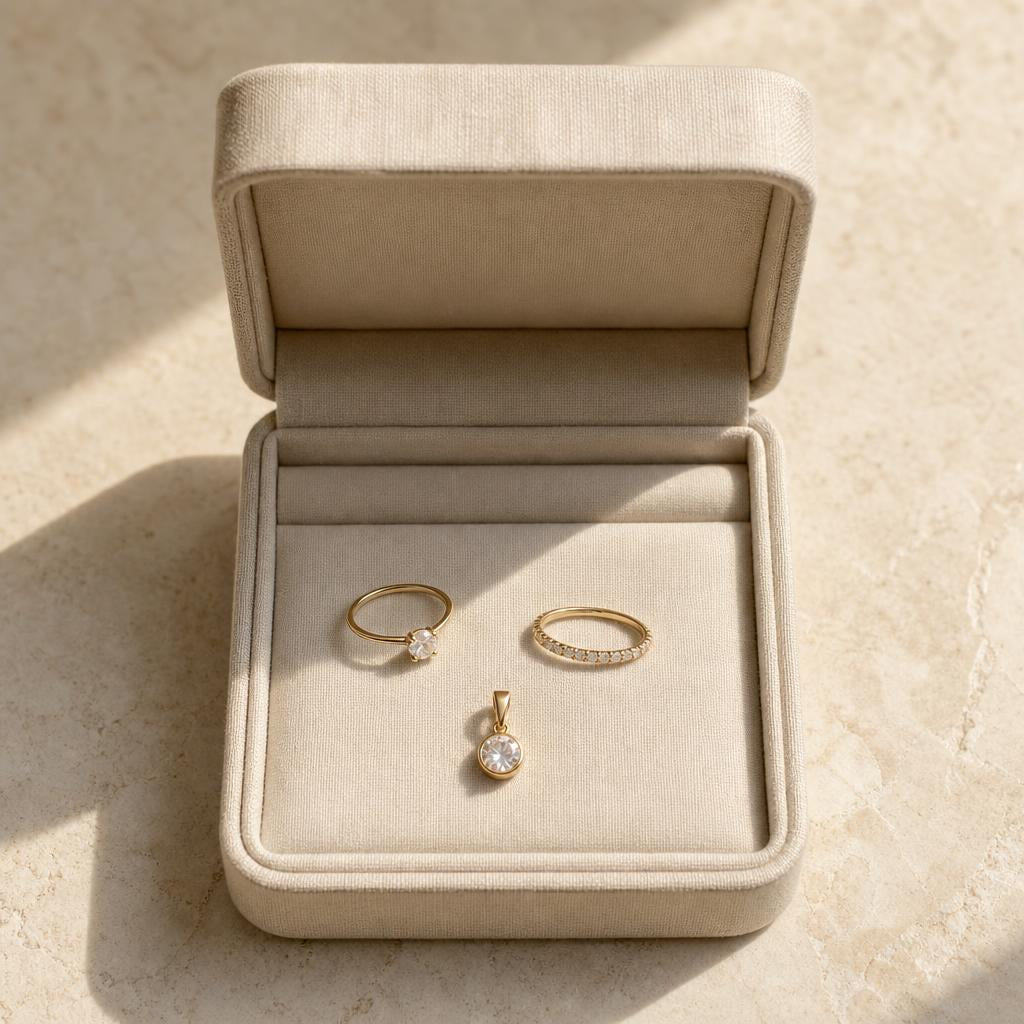
Decluttering Your Jewelry Box: What to Keep, Sell, or Finally Let Go Of
Somewhere in your house is a drawer, a dish, or a tangled velvet pouch holding more jewelry than you actually wear. A few pieces you reach for weekly. A dozen more you haven't touched since a wedding three summers ago. And a handful you keep meaning to deal with — mismatched earrings, a chain with a broken clasp, a ring that never quite fit — because dealing with it feels like more effort than it's worth.
It doesn't have to be a big project. Decluttering a jewelry box isn't about ruthlessly emptying it — it's about being honest with yourself about what earns its place, so the pieces you actually love aren't buried under the ones you don't. Here's a practical way to sort through it, and a few of the pieces worth making room for once you do.


Why the Jewelry Box Gets This Way
Nobody sets out to accumulate a drawer of jewelry they don't wear. It happens a piece at a time — a gift you felt obligated to keep, a trend you tried once, a pair of earrings bought for a single event and never worn again. None of it feels like a decision in the moment. It's only when you open the box looking for one specific thing and have to dig through fifteen others that the clutter actually registers.
There's also a quieter reason jewelry piles up rather than gets edited: unlike clothes, it doesn't take up visible space, and unlike shoes, it doesn't wear out in a way that forces a decision. A tarnished chain or a ring that's lost its shine can sit in a drawer for years without anyone confronting it. So it just... stays. The fix isn't willpower — it's a system that makes the decision easier than the indecision.
The Three-Pile Method
Tip everything out onto a flat surface — a bed, a table, good light. Then sort into exactly three piles. Not four, not a "maybe" pile that becomes a fourth drawer of indecision. Three.
Keep
This pile is for pieces that meet at least two of three criteria: you've worn it in the last six months, it still looks the way it did when you bought it, and you'd be genuinely annoyed if it went missing. Be strict here. "I might wear it" is not the same as "I do wear it" — and a smaller keep pile, worn on rotation, will always look more put-together than a large one gathering dust.
Sell or Consign
Anything with real resale value — mined diamonds, solid gold, branded pieces — belongs here, even if you still like it. If it's been sitting unworn for a year, its value to you is sentimental at best and financial at worst; letting it convert back into cash (or into a piece you'll actually wear) is usually the better trade. Simulated diamond and sterling silver pieces rarely have meaningful resale value, so this pile is mostly reserved for fine jewelry and precious metals.
Let Go
Broken clasps you've been meaning to fix for two years. Costume pieces that have gone green or lost their plating. Single earrings with no partner. Gifts you kept out of guilt rather than genuine attachment. This pile isn't a failure — it's the whole point of the exercise. Donate what's still wearable, recycle what isn't, and stop letting it take up the good real estate in your box.
Worth knowing: Cheap costume jewelry often contains nickel or base metals that oxidize and can irritate sensitive skin over time. If a piece has started to itch, discolor your skin, or turn a dull grey-green, that's a signal to let it go rather than keep pushing through it.
What Actually Deserves Box Space
Once you've cleared out what isn't working, the goal is to fill that space back up deliberately — not by buying more, but by buying better. A smaller collection of pieces that are genuinely nickel-free, hold their finish, and mix easily with each other will always outperform a crowded box of near-duplicates. This is where a lot of women quietly upgrade a few costume staples — the everyday studs, the ring they wear daily, the one necklace that layers with everything — into pieces built to actually last in rotation.

The Eternity Ring – Rose Gold
A full pavé band that reads as a single, quiet layer rather than a competing statement — the kind of ring that earns a permanent spot once the noisier pieces have been cleared out.
Shop The Eternity Ring →The same logic applies to earrings. A pair of simple studs gets worn far more often than a bold statement pair — which is exactly why they're usually the first thing to wear out, tarnish, or lose their shine if they weren't built well to begin with.

The Ophelia Stud Earrings
Oval-cut studs sized for everyday wear — small enough to forget you have them on, sturdy enough to survive the daily rotation that wears down cheaper pairs.
Shop The Ophelia Studs →Signs a Piece Should Go
If you're stuck on a specific item, run it through these questions instead of relying on gut feeling alone:
- Have you worn it in the last year — not "would I," but did you actually put it on?
- Does it still look the way it did when you got it, or has the plating worn through and the shine dulled?
- Would you buy it again today, at today's version of yourself?
- Is it holding a spot that a piece you actually wear could be using instead?
A "no" to two or more of these is usually a clear enough answer, even when the sentimental pull says otherwise.
✦ Pro tip: Before you let go of anything with sentimental weight, photograph it. A quick photo preserves the memory without requiring the physical piece to keep taking up space — and it's a genuinely effective way to make peace with parting with something.
Building the Smaller, Better Collection
Once the box is edited down, the pieces that remain start to work together instead of competing for attention. A stacking band pairs cleanly with a solitaire. A pair of simple studs goes with everything, which means you reach for them constantly instead of hunting for the "right" earrings every morning. This table breaks down how to think about what to keep versus what to finally release:
| Category | Keep if... | Let go if... |
|---|---|---|
| Everyday rings | Worn weekly, still holds its shine | Discolored, loose, or replaced in your rotation |
| Stacking bands | Sits flush, mixes with current pieces | Doesn't match your current metal tones |
| Statement pieces | Worn at least a few times a year for real occasions | Bought for one event, untouched since |
| Studs & small earrings | Comfortable enough for all-day wear | Irritates ears or has lost a back/post |
| Sentimental pieces | You'd genuinely be upset if it went missing | Kept from guilt, rarely thought about otherwise |
How Often to Redo This
A full sort doesn't need to happen more than once or twice a year. The easiest trigger is a seasonal wardrobe swap — when you're already pulling out different clothes, take ten extra minutes to do the same with your jewelry box. Anything that's sat in the "let go" pile for more than a month without you missing it can leave for good. If you keep circling back to save something "just in case," that's usually the piece worth keeping after all — the process is meant to clarify your instincts, not override them.
Quick Takeaways
- Sort into exactly three piles: keep, sell/consign, let go — resist a fourth "maybe" pile
- Keep pieces you've actually worn in the last six months, not ones you might wear someday
- Fine jewelry and solid metals go to consignment; costume pieces rarely have resale value
- Photograph sentimental pieces before parting with them to ease the decision
- Replace worn-out staples with fewer, better-built pieces that mix easily together
- Redo the sort once or twice a year, ideally alongside a seasonal wardrobe swap
Frequently Asked Questions
How do I know if a piece is actually worth selling?
Solid gold, solid silver, and mined-diamond pieces usually hold resale value, even if it's less than what you paid. Costume jewelry and gold-plated pieces almost never do — those are better donated or recycled than listed for sale.
What should I do with tangled or broken chains?
If a chain is fine metal, a jeweler can usually repair a broken clasp for less than the cost of replacing it. If it's costume-grade and already tangled beyond an easy fix, it's rarely worth the time — let it go and replace it with one well-made piece instead.
Is it wasteful to get rid of jewelry I paid for?
Money already spent doesn't come back by keeping something unworn in a drawer. If a piece isn't earning its space, holding onto it out of guilt doesn't create value — it just delays the decision you'll eventually make anyway.
How small should my "keep" collection actually be?
There's no fixed number — it depends on your lifestyle. The better test is whether you can name what you'd reach for on a normal Tuesday without having to think about it. If you can, your collection is already the right size.
A decluttered jewelry box isn't about owning less for its own sake — it's about making sure the pieces you actually reach for aren't buried under the ones you don't. Clear the space, keep what earns it, and let the rest go. What you choose to fill it back up with is the fun part.


