

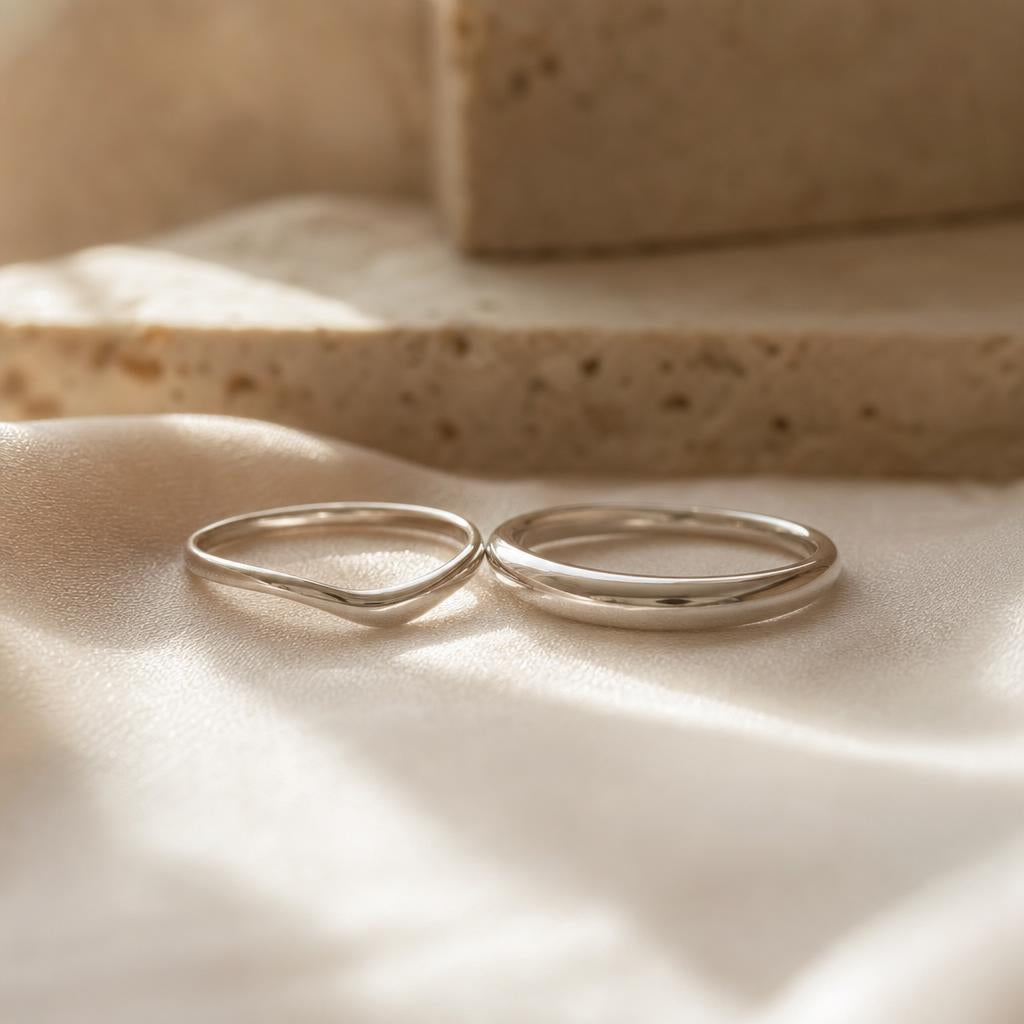
Contour Wedding Bands: What They Are and When They're Worth the Extra Piece
Somewhere between "I love my ring" and "I wish it sat a little flatter against my hand," there's a piece almost nobody mentions until they've already gone looking for one: the contour band. It's not a wedding band in the traditional sense, and it's not a stacking ring you picked because it looked pretty next to the others. It's built, quite literally, around the shape of the ring you already own.
A contour wedding band — sometimes called a curved band, a shadow band, or a nesting band — is cut, notched, or arched to trace the outline of a specific center stone and setting, so the two rings sit flush instead of gapping at the base. It's a small structural decision that changes how an entire stack looks and feels on the hand. Here's what it actually is, when it earns its place in your collection, and which Gemiros stacking bands already do the job.


What a contour wedding band actually is
This kind of band is shaped — curved, arched, or notched — to follow the profile of a specific engagement ring so the two sit flush against each other on the finger instead of leaving a gap at the base of the center stone. The name describes the construction, not a single look: some contour bands curve gently around a low-set solitaire, others notch sharply around a wide halo, and some are built with a visible cutout that traces the exact silhouette of the stone beside them.
You'll also see this category called a curved wedding band or a shadow band, depending on who's selling it. A curved band is the broader term — any band with an arc instead of a straight line. A shadow band usually refers to one built specifically to sit underneath or against a raised setting, filling the negative space a straight band would leave. Functionally, they solve the same problem: they let a shaped or elevated center stone sit next to another ring without visible daylight between them.
Why the gap happens in the first place
Most engagement ring settings aren't flat. A hidden halo lifts the stone. A pavé shoulder tapers. An oval or cushion-cut center stone curves outward at its widest point. A straight, uniform stacking band pressed against any of these will contact the ring at one or two points and leave visible space everywhere else — which reads, at a glance, as a stack that doesn't quite belong together. A contour band is built to close that space on purpose.
Worth knowing: You don't need a contour band with every ring. A classic solitaire on a plain shank often stacks perfectly well with a straight band. The gap problem shows up specifically with halo settings, raised prong work, and curved or asymmetrical center stones — that's the profile a contour band is solving for.
When a contour band is worth the extra piece
A dedicated contour band isn't a default purchase — it's a solution to a specific fit problem. It's worth adding to your stack when:
- Your center stone is oval, cushion, or pear-shaped. Curved outlines are exactly what leave gaps against a straight band, and the right wedding band for an oval engagement ring is almost always a curved one.
- Your setting has a hidden halo or raised gallery. The extra height under the stone is precisely what a straight band can't clear cleanly.
- You've noticed your rings shift or rock against each other when worn together — a sign the fit, not the finish, is the actual issue.
- You want the stack to read as one considered piece rather than two rings that happen to share a finger.
It's less necessary if your center stone is round on a low, simple setting, or if you're not planning to wear the two rings together every day. In those cases, a straight or lightly domed stacking band will usually sit close enough that the difference isn't worth chasing.
Contour, curved, and shadow bands: are they different?
In practice, the three terms overlap more than they diverge. All three describe a band engineered around another ring's profile rather than sold as a standalone shape. Where they tend to differ is in how dramatic the curve is:
| Term | What it usually means | Best suited to |
|---|---|---|
| Curved band | A gentle, all-over arc along the whole band | Round or lightly raised solitaires |
| Contour band | A shaped notch or dip built to trace one specific setting | Halo, hidden halo, or pavé settings |
| Shadow band | A band designed to sit tucked under a raised center stone | Tall prong or cathedral settings |
None of these require you to buy a custom piece. A well-chosen pavé or bezel stacking band, worn slightly angled, does a version of the same job for most low-profile settings — which is where a piece like the Devotion Ring earns its place. Its channel-set line sits close and flat, which is exactly the profile you want next to a setting that doesn't tower off the finger.

The Everlasting Ring
A full sterling silver stacking band with a continuous, close-set line — the kind of low, even profile that clears most raised settings without needing a custom curve.
Shop The Everlasting Ring →How to choose the right one for your ring
Start with your center stone's shape
Oval, pear, marquise, and cushion cuts all curve or taper at some point along the band line — that's the shape most likely to benefit from a genuinely curved piece. A curved wedding band with an oval engagement ring makes the most visible difference of any pairing on this list, since the stone's widest point is exactly where a straight band leaves the most obvious gap. Round and princess cuts sit more symmetrically and are more forgiving of a straight band, even one with some texture or dimension to it.
Then look at the setting height
A halo or hidden halo lifts the stone off the shank, which means the band beside it needs either its own lift or a notch that dips underneath. Stacking against a halo setting is one of the more common reasons people start shopping for a contour piece in the first place — the visual gap at the base of the stone is hard to miss once you notice it.

The Forever Ring
A half-eternity band with a slim, continuous pavé line — narrow enough to tuck close against a raised gallery without competing with the center stone above it.
Shop The Forever Ring →Decide how permanent you want the pairing to be
A true custom contour band is cut for one specific ring and won't necessarily flatter anything else in a future stack. A well-chosen pavé or bezel stacking band is more flexible — it won't hug a setting quite as precisely, but it moves with you if your stack changes down the line. For most everyday stacking, that flexibility is worth more than a perfect, permanent fit.
✦ Pro tip: If you're not ready to commit to a shaped piece, try wearing your stacking band angled slightly rather than perfectly parallel to your engagement ring. It won't solve a dramatic gap, but it closes a surprising amount of the space around a rounded setting.
Stacking a contour-style band without it looking accidental
The easiest way to make a curved or contour piece look intentional is restraint elsewhere in the stack. One shaped band, paired with a straight or lightly domed piece on the other side, reads as considered. Three curved pieces stacked together can start to look busy, even if each one individually fits well. If you're layering a vintage-inspired band into the mix, keep the rest of the stack simple so the detail work doesn't compete with the curve.

The Eternity Ring
A full eternity band with stones set flush around the entire circumference — a clean, uniform line that pairs quietly with a shaped or curved piece on the opposite side of the stack.
Shop The Eternity Ring →What actually reads as expensive isn't the curve itself — it's the fit. Two rings that sit flush, without a sliver of daylight between them, look like they were chosen together on purpose. That's the whole case for a contour band: not the shape for its own sake, but the flush, considered line it gives the rest of your stack.
Quick Takeaways
- This type of band is shaped to trace a specific engagement ring's profile so the two sit flush, with no gap at the base of the stone.
- Curved, contour, and shadow bands solve the same problem — the difference is mostly in how dramatic the shaping is.
- Oval, cushion, and pear-shaped stones, plus halo and hidden halo settings, are the most common reasons to reach for a shaped piece.
- A close-set, low-profile stacking band often clears the gap without a fully custom curve.
- Keep the rest of your stack simple if one piece is already doing curved or detailed work.
Frequently Asked Questions
What is a contour wedding band?
It's a ring shaped — curved, notched, or arched — to follow the outline of a specific engagement ring's center stone and setting, so the two sit flush together on the finger instead of leaving a gap.
What is a curved wedding band called?
It goes by several names depending on the retailer — curved band, contour band, and shadow band are all used to describe the same general idea: a band engineered around another ring's shape rather than sold as a plain, straight circle.
Can you wear a contour band as your only ring?
Yes. A contour or curved band is a complete ring on its own and holds up perfectly well worn alone — the curve is just as much a design choice as it is a stacking solution.
What wedding band goes best with an oval engagement ring?
A curved or contour band almost always outperforms a straight one against an oval center stone, since the oval's widest point is exactly where a straight band would otherwise leave a gap.
Do I need a custom contour band, or will a regular stacking band work?
It depends on your setting. Low, round solitaires usually pair fine with a close-set stacking band. Halo, hidden halo, and sharply curved center stones are where a genuinely shaped piece starts to make a visible difference.
Whether you land on a fully custom curve or a close-fitting stacking band, the goal is the same: a stack that looks like it was chosen on purpose, not assembled piece by piece. Start with the shape of the ring you already have, and let that decide the rest.


