

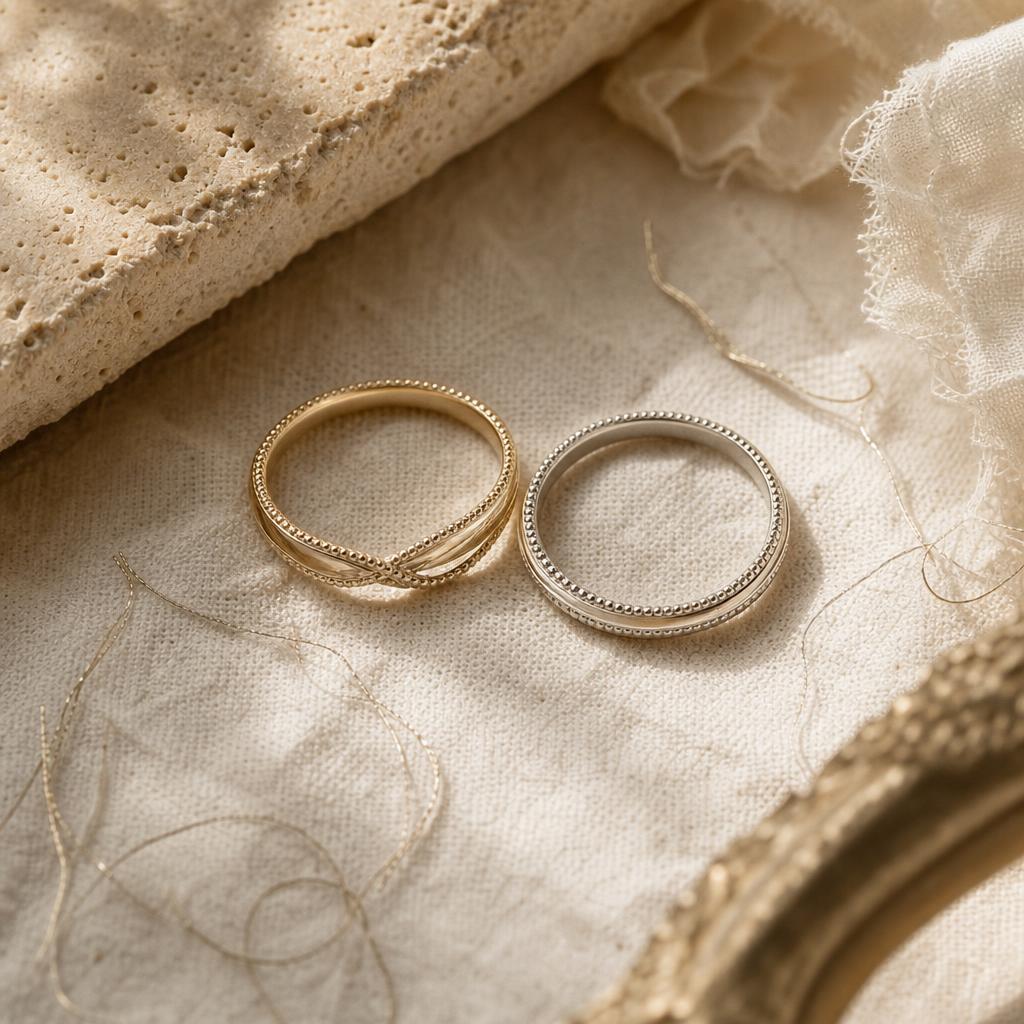
Wedding Bands for Vintage-Inspired Rings: Milgrain, Filigree and Finding a Period-Accurate Match
A ring with milgrain edging or a soft, worn-in vintage feel is not a neutral canvas. It has an era, a texture, a rhythm to its detail — and the wrong wedding band sitting next to it doesn't just fail to match. It makes the whole hand look like an accident instead of a decision.
Most guides to wedding band pairing treat every engagement ring the same: pick a shape, pick a metal, done. Vintage-inspired rings need a different conversation, because the detail is the point. Here's how to actually get the pairing right, ring by ring.


What "Vintage-Inspired" Actually Means on a Ring
The term gets used loosely, so it's worth being specific. On a ring listing, "vintage-inspired" usually points to one or more of a handful of real construction details: milgrain (the tiny beaded edging that traces a setting or shank), a halo that sits close to the center stone rather than floating above it, a twisted or braided band, or a shape like radiant or princess cut that reads as more architectural than a plain round solitaire. None of it requires an antique — it's a design language, borrowed and applied to a ring built today. Sterling silver takes milgrain and detail work exceptionally well; the metal is soft enough to hold a fine, hand-finished edge without the piece needing to actually be old to earn the label.
That distinction matters for wedding band shopping specifically. You're not trying to match a piece of history. You're trying to match a set of visible design choices — and those choices dictate the band, not the other way around.
Why the Wedding Band Actually Needs to Match
A plain, high-polish band next to a heavily detailed vintage-inspired setting doesn't read as minimalist restraint. It reads as two separate purchases that happened to end up on the same finger. The eye catches the mismatch faster than most people expect, because detail work creates a visual rhythm — beading, texture, a curve — and a flat band breaks that rhythm instead of continuing it.
The fix isn't complicated once you know what to look for. You're matching three things: the surface detail, the profile (straight or curved), and the metal tone. Get those three right and almost any band will sit comfortably next to a vintage-inspired ring.
Matching the Detail: Milgrain on Milgrain
If your center ring has milgrain edging — like the beaded border on The Regent Ring or the fine edging that frames the round-cut stone on The Beatrice Ring — a milgrain engagement ring pairs most naturally with a band that carries the same beaded texture along its own edge. It doesn't need to be an exact copy. Even a subtle line of milgrain on an otherwise plain band picks up the light the same way the original setting does, so the two pieces read as a single, considered look instead of two unrelated ones.
Worth knowing: Milgrain isn't a fragile detail. It's a finishing technique pressed or hand-applied into the metal's surface, not a separate piece attached to the band — worn daily, it holds its texture the same way the rest of the ring does.
Plain, high-polish bands aren't off-limits here. They just do a different job: instead of continuing the detail, they let it stand alone as the statement. That's a legitimate choice, but it's a choice — not a default.
Matching by Era, Not Just by Detail
Vintage design language roughly splits into a few recognizable moods: the geometric, symmetrical lines associated with Art Deco; the delicate, romantic detailing associated with Victorian and Edwardian pieces; and a softer mid-century look built around clean curves. You don't need to know the history to shop by it — you just need to notice which mood your ring is already speaking, and choose a band that speaks the same one. A radiant-cut, milgrain-edged ring like The Evangeline Ring leans architectural and geometric, so a band with clean lines and fine detailing reads as intentional. A rounder, halo-set vintage style engagement ring calls for something softer — curved, beaded, or gently textured rather than angular.
This is where a lot of pairings go wrong: not because the individual pieces are unattractive, but because they're pulling from two different visual eras at once. Consistency, not matching perfection, is what makes a stack look period-accurate rather than assembled.

The Cherish Ring
A bezel-set stacking band with a smooth, rounded edge — the kind of quiet, rounded profile that sits easily next to a beaded or halo-set vintage-inspired ring without competing with it.
Shop The Cherish Ring →When You Need a Curved Band Instead of a Straight One
Vintage-inspired settings — especially halos and hidden halos — tend to sit low and close to the finger, which is beautiful but leaves very little clearance for a straight band to slide in flush. If your ring has an oval or rounded silhouette, a curved wedding band for oval engagement ring pairings is usually the better call: the arc mirrors the outline of the setting instead of leaving a visible gap at the base. It's a fit decision as much as a style one — a curved profile lets the two rings sit close without one crowding the other.
Not every ring needs this. Higher-set solitaires, including plainer four- or six-prong mounts, generally clear a straight band without issue. Check the setting height before assuming you need a contour piece — it's the single biggest factor, more than shape or era.
Twisted Bands and Other Vintage-Adjacent Details
Twisted and braided bands sit in an interesting middle ground: they read as vintage-influenced without belonging to any one historical period specifically, which makes them one of the more flexible pairing options available. A ring like The Camilla Ring, with its twisted band and close-set halo, already carries movement in its own design — so a wedding band with a similar twist, or even a plain band that echoes the curve without competing with it, tends to work better than something rigid and geometric.
One practical note worth knowing before you buy: a twisted band engagement ring won't sit perfectly flush against a second ring the way a flat-edged band does, since the twist itself creates small gaps along the profile. That's not a flaw — it's simply a different kind of fit, and most people who choose a twisted design are choosing the movement over a seamless line anyway.
✦ Pro tip: Lay the two rings flat next to each other before deciding, rather than only trying them on stacked. It's the fastest way to see whether the detail, curve, and metal tone are actually speaking the same language.
Solitaire Vintage Rings Need Their Own Logic
A solitaire doesn't have a halo or side stones to match, so the pairing conversation shifts entirely to the band's edge detail and the shank's profile. A wedding band for solitaire engagement ring pairings works best when it either continues a detail already present in the setting — like the milgrain trim on The Beatrice Ring — or deliberately contrasts with a clean, unadorned line. What doesn't work as well is landing in the middle: a band with just enough texture to look unfinished next to a solitaire, but not enough to feel intentional.

The Eternity Ring
A full band of pavé stones that continues the sparkle of a solitaire without introducing a new, competing shape — a straightforward way to add detail to a plain center stone.
Shop The Eternity Ring →Metal tone is the last piece, and the easiest to get wrong by assumption rather than by looking. Platinum-finish milgrain reads noticeably cooler than the same detail in 18k gold or rose gold, and a band that's close but not exact in tone will show the difference the moment the light changes. Match the finish, not just the general "gold" or "silver" category — it's a five-second check that prevents the most common pairing mistake.
Quick Takeaways
- Match the surface detail first — milgrain pairs with milgrain, a twist pairs with movement, a plain solitaire can go either matched or deliberately contrasting.
- Check setting height before assuming a curved band is necessary; low-set halos usually need one, higher solitaires often don't.
- Stay within one design era — geometric Art Deco lines and soft, rounded vintage detailing rarely pair well together.
- Match metal finish exactly, not just the general tone — platinum, 18k gold, and rose gold milgrain all catch light differently.
- Lay bands flat next to the ring before deciding; stacking alone can hide a mismatch that's obvious from a different angle.
Frequently Asked Questions
What is milgrain on an engagement ring?
Milgrain is a finishing detail — a fine line of tiny beading pressed or hand-applied along the edge of a setting, halo, or band. It adds texture and catches light without changing the ring's overall shape, and it's a technique, not a separate attachment, so it holds up the same way the rest of the metal does.
What's the difference between milgrain and filigree?
Milgrain is a beaded edge treatment applied along a line — a border detail. Filigree is a more elaborate, open metalwork technique that forms scrollwork or lace-like patterns, often across the shoulders or gallery of a ring. Milgrain is a finishing touch; filigree is closer to structural ornamentation.
What wedding band works best with an oval or halo-set ring?
If the setting sits low on the finger, a curved or contoured band usually fits better than a straight one, since the arc follows the outline of the ring instead of leaving a gap at the base. Higher-set styles have more clearance and can often take a straight band without issue.
What is a curved wedding band called?
Curved bands go by a few names depending on the exact shape — contour bands, V-shaped or chevron bands, and enhancers or guards, which wrap around rather than sit flush against the center ring. All three solve the same problem: giving a low-set stone room to sit without a visible gap.
Does a wedding band have to match a solitaire engagement ring exactly?
No — a solitaire gives you more room to choose. Continuing a detail already on the ring, like milgrain trim, creates a cohesive look, while a plain band next to a detailed solitaire creates deliberate contrast. Both work; what doesn't work is landing in between with just enough texture to look unintentional.
None of this is about getting permission to buy a second ring — it's about making sure the two pieces you already love actually look like they belong together. Vintage-inspired detail is worth building around, not working around, and the right band makes that detail look considered instead of accidental every time you glance down at your hand.


