

Comparing Your Ring to Other Women's Rings: Why It Rarely Tells You Anything Useful
You see it before you can stop yourself: a stranger's hand on your feed, a ring catching the light just right, and a small, automatic calculation running somewhere behind your eyes. Bigger stone. Different setting. Hers looks like more. It takes about half a second, and it tells you almost nothing true about your own ring — or hers.
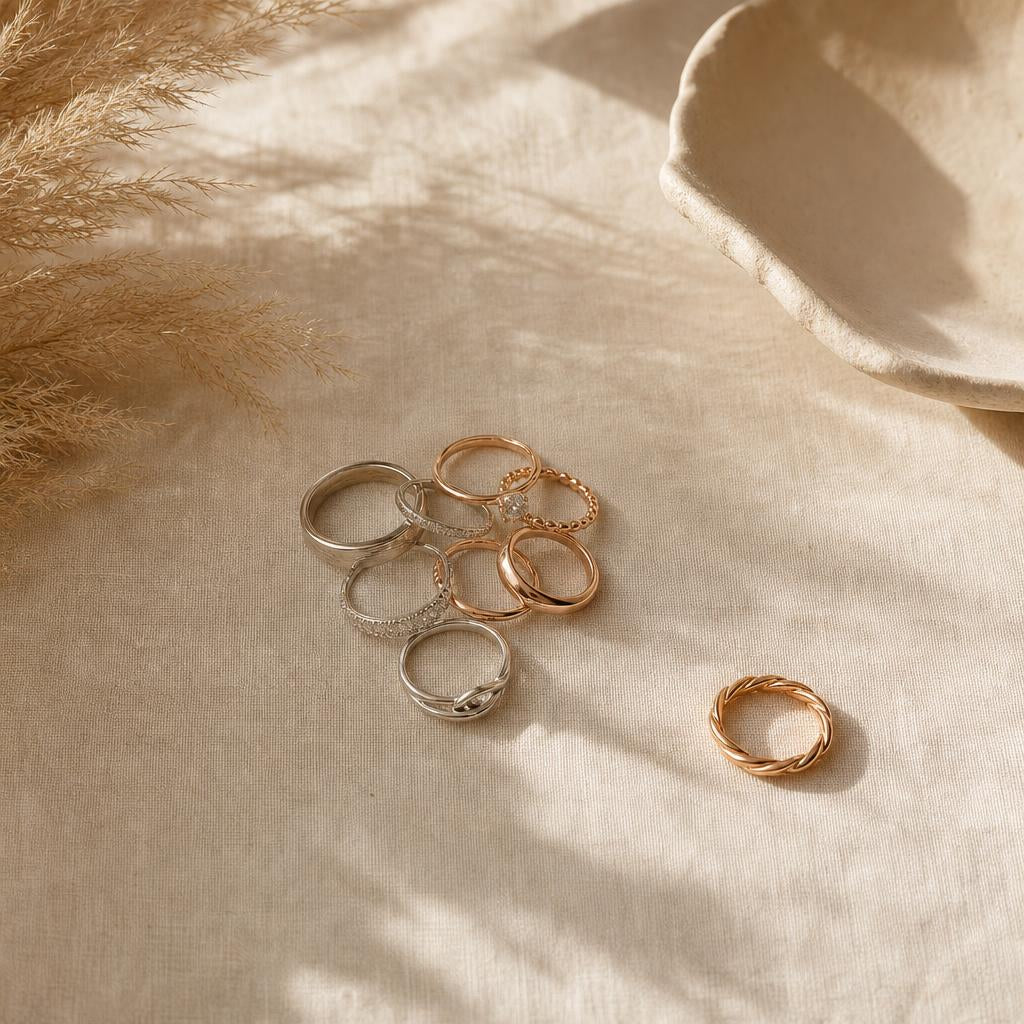
Comparison is a habit, not a fact-finding mission. It feels like information, but it's really just noise dressed up as judgment. Before we get into why that noise so rarely holds up, here's a look at four ring styles that make the case for choosing what's actually yours — not what photographs well next to someone else's.


Why the comparison instinct kicks in at all
It's not a character flaw. It's a byproduct of how you were shown rings for most of your life: as a single object meant to communicate something to other people. Size communicated commitment. Sparkle communicated success. And because rings have historically been given rather than chosen, a stranger's ring has always felt like it was reporting on a relationship, a budget, a life — not just describing a piece of jewelry someone happened to like.
Add an infinite scroll of other people's hands to that inherited logic, and the math gets worse. You're no longer comparing your ring to the two or three you might see in a week. You're comparing it to a curated, algorithmically boosted stream of the most photogenic rings on the internet, most of them lit, angled, and edited specifically to look larger and brighter than they are in person. That's not a fair comparison. It was never designed to be one.
Worth knowing: A ring photographed under studio lighting, at a macro angle, on a hand with the fingers deliberately spread, will always look larger and more dramatic than the same ring seen across a dinner table. You're not comparing rings when you scroll — you're comparing photography.
What comparison actually costs you
The immediate cost is obvious: a flicker of doubt about something you were, thirty seconds earlier, perfectly happy with. But the slower cost is the more interesting one. Comparison quietly moves the decision-making authority for your own jewelry out of your hands and into whoever happens to be on your screen that day. You stop asking "what do I actually want on my hand" and start asking "what would look competitive next to hers" — a much smaller, much less useful question.
It also flattens a genuinely personal decision into a single, one-dimensional metric: size. But a ring isn't one variable. It's a setting that either does or doesn't snag on your sweaters. A band width that either does or doesn't sit comfortably against how you naturally hold your hands. A stone shape that either does or doesn't suit your fingers. None of that shows up in a comparison. All of it shows up every single day you wear the thing.
The identity math nobody says out loud
Here's the part worth sitting with: the woman who's already figured out that jewelry-store markups are largely manufactured scarcity, not material value, has already made the smarter calculation. She's not the one who needs someone else's ring to validate her choice. Buying a ring that's indistinguishable from a diamond, passes diamond testers, and costs a fraction of what the "real thing" is priced at isn't a compromise she's making quietly — it's the informed decision, and everyone still paying the old-rule markup is the one working with incomplete information.
That reframes the whole comparison instinct. You're not behind. You're not under-ringed. You made a decision other women haven't caught up to yet.

The Juliette
A pear-cut center flanked by two heart-cut side stones — the kind of ring that reads as a considered choice, not a competitive one. Built to tell your story, not measure up to someone else's.
Shop The Juliette →The one question that actually matters
Not "is mine bigger," but "does this fit the life I actually live." A ring that snags on everything you own because it's oversized for your job isn't winning anything. A ring you're afraid to wear on a flight, at the gym, or in the pool isn't serving you — it's a liability you've agreed to manage. The women whose rings genuinely look effortless aren't the ones with the largest stone in the group chat. They're the ones wearing something that actually matches their hand, their routine, and their taste, with enough confidence that comparison never enters the frame.
That confidence is learnable, and it starts with a small shift: stop asking whether your ring measures up, and start asking whether it's actually right for you. Those are different questions with completely different answers.
Notice what you're actually reacting to
Next time you feel that flicker of comparison, get specific about it. Is it really the ring, or is it the moment — a wedding, a milestone birthday, a season where you're generally feeling behind on something? Comparison rarely stays contained to jewelry. It's often a stand-in for a bigger, less specific unease, and the ring just happens to be the object in frame when the feeling shows up. Naming that accurately tends to dissolve the urge faster than staring at the photo for another ten seconds ever will.
✦ Pro tip: If a specific account consistently triggers the comparison spiral, mute it. You don't owe your attention to content that makes you feel worse about a decision you were previously at peace with.
Choosing on your own terms
A ring bought for yourself, on your terms, doesn't need outside permission — and it definitely doesn't need to win an unspoken competition with a stranger's hand. The clean-girl minimalist wants a single stone that does its job quietly. The maximalist wants a cushion-cut halo that catches every bit of available light. Neither one is more correct than the other, and neither needs the other's approval.

The Camilla
A round-cut halo with a graceful twist through the band — a quiet detail most people won't clock immediately, and one you'll notice every single time you glance down. That's the point.
Shop The Camilla →If you want a second opinion on what actually flatters your hand before you buy — rather than what flatters someone else's feed — a guide to choosing a ring by finger shape and width is a far more useful starting point than another scroll through other people's hands.
A short reset, if you need one
The next time you catch yourself sizing up someone else's ring, run through this instead:
- Would I have chosen this exact style if I'd never seen anyone else's ring first?
- Does it work with how I actually live — my job, my hands, my routine?
- Am I comparing the ring, or comparing the photograph of the ring?
- Did I choose this because it's smart and it's mine, or because it needed to out-sparkle someone else's?
Most of the time, that short pause is enough to remember that the comparison was never really about the ring in the first place.
Quick Takeaways
- What you see on social media is curated and lit to look bigger than it is in person — it's not a fair comparison.
- A ring earns its keep by fitting your actual life, not by out-measuring someone else's.
- Choosing a ring that's indistinguishable from a diamond, at a fraction of the traditional markup, isn't a compromise — it's the informed decision.
- The fastest way out of a comparison spiral is naming what you're actually reacting to.
- Confidence in your own ring is learnable, and it makes comparison irrelevant.
Frequently Asked Questions
Why do I feel jealous when I see another woman's ring?
Usually it's less about the ring itself and more about what it's been trained to represent — commitment, success, being chosen. Once you separate the object from the story you've attached to it, the reaction tends to fade quickly.
Is it normal to compare engagement rings on social media?
Yes — it's an extremely common reaction, largely because platforms are built to surface the most dramatic, best-lit examples of anything, rings included. Recognizing that the comparison set is skewed is usually enough to take the sting out of it.
How do I stop comparing my ring to other people's?
Get specific about your own criteria before you scroll — comfort, how it fits your hand, how it holds up to your routine — so you have a clear standard that has nothing to do with anyone else's ring.
Does a bigger stone actually mean a better ring?
No. Fit, setting, and how well a ring suits your hand and lifestyle matter far more day-to-day than carat size alone — a ring you're comfortable wearing every day will always outperform one that only looks good in a single photo.
Your ring was never meant to be a scoreboard. It's a small, daily decision you get to keep making on your own terms — and the moment you stop measuring it against someone else's hand is usually the moment it starts feeling like yours again.


