

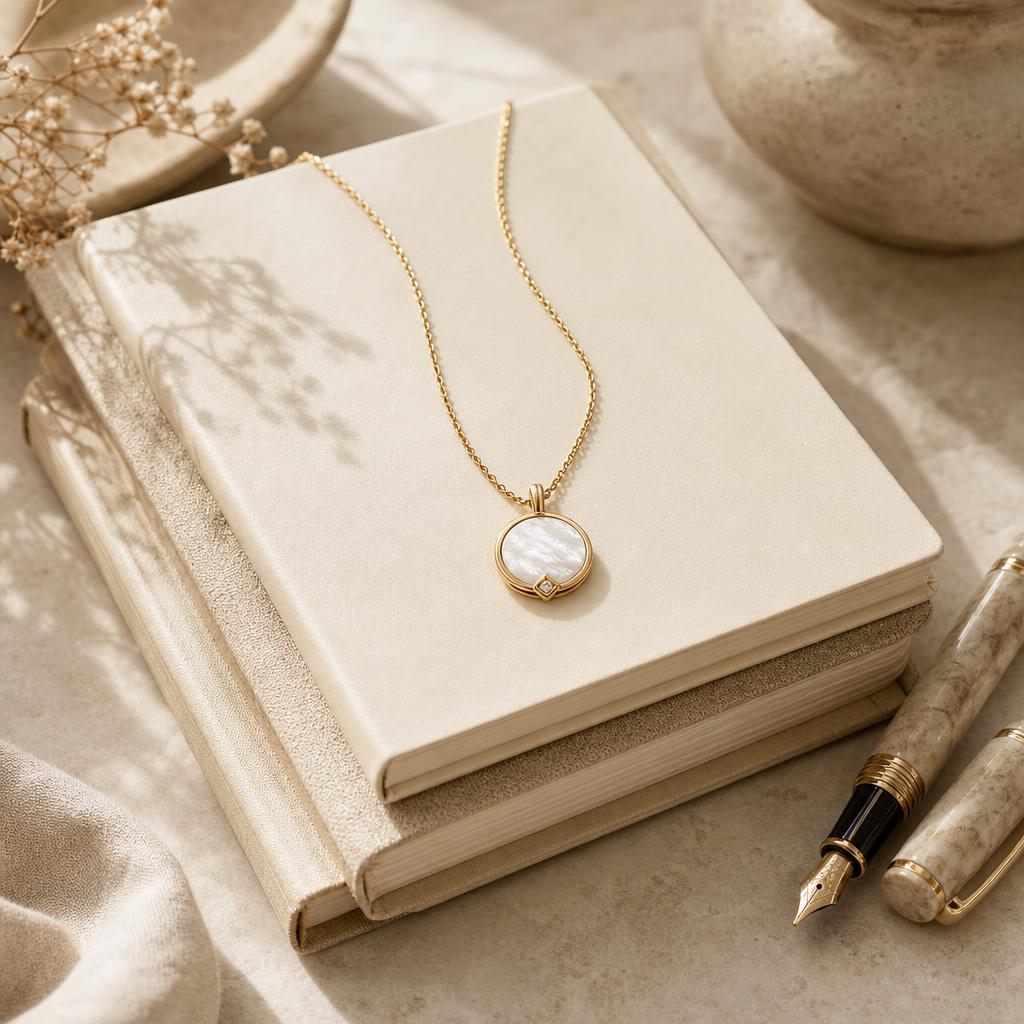
Company Anniversary Necklaces: A Personal Marker of Professional Growth
Nobody hands you a trophy for your fifth year at the same company. You get a calendar reminder from HR, maybe a mug, maybe a Slack message with a confetti emoji. The actual marker — the thing that tells you, every time you catch it in a mirror, that you built something — is up to you to choose.
That's the case for a company anniversary necklace: not a corporate token, but a piece you pick for yourself, on your own terms, because the growth was real even if nobody threw you a party for it. Here are four that were built to be worn daily, not saved for someday.


Why a Company Anniversary Deserves Its Own Symbol
Most workplace recognition is designed to be forgotten. The gift card gets spent on groceries. The plaque goes in a drawer. The branded tumbler ends up at the back of a cabinet behind three others exactly like it. None of it was ever meant to last, because none of it was chosen with you specifically in mind — it was chosen to be efficient, inoffensive, and easy to order in bulk.
A necklace works differently because you're the one making the choice. You know what three, five, or ten years actually cost you — the projects you carried, the versions of yourself you outgrew to get here, the days you weren't sure you'd make it to this one. A corporate gifting budget doesn't know any of that. You do. Choosing a piece that reflects it, instead of waiting for someone else to notice, is simply the more accurate response to what actually happened.
Self-Purchase Isn't a Consolation Prize
There's a quiet assumption that the meaningful gift is supposed to come from somewhere else — a manager, a partner, a milestone card from HR. Buying it for yourself can feel like settling, like you're supposed to wait for someone else's recognition to count. That's backward. You were there for every version of the work. Nobody has more standing to mark it than you do.
This is also, practically, the version that actually happens. A meaningful gift that depends on someone else remembering the exact date, understanding what the milestone meant, and having the taste to choose well is a gift that frequently doesn't arrive. A necklace you choose yourself arrives on schedule, every time, in exactly the style you actually wanted.

The Morgan Pendant Necklace
A 2-carat princess-cut simulated diamond in a crisp four-prong setting — sharp geometry that reads as deliberate, not decorative. The kind of piece that looks exactly as intentional as the years it's marking.
Shop The Morgan Pendant Necklace →Choosing a Necklace That Reads "Milestone," Not "Impulse"
The difference between a piece that marks something and a piece that just happened to get bought on the same week is almost entirely about how deliberately you choose it. A few things worth thinking through before you do:
- Will you actually wear it on a Tuesday? A piece that only comes out for special occasions turns into a piece you rarely see — which defeats the point of a daily marker. Look for something built for everyday wear, not just the anniversary dinner.
- Does the setting suit your actual job? If you're on video calls all day, a piece with clean, controlled sparkle photographs better than something that catches every studio light and blows out the frame. If you're hands-on, a low-profile pendant that sits close to the collarbone won't catch on anything.
- Does it mean something to you specifically, or just to the category? A starburst pendant reads differently to someone who thinks of this milestone as "finding my direction" than a plain solitaire does. Let the symbolism, not just the sparkle, do some of the work.
Worth knowing: Every Gemiros necklace is 925 sterling silver, nickel-free, and tarnish-resistant — built for daily wear from day one, not just the day you buy it.
What the Piece Actually Says About the Milestone
Different settings carry different weight, which is part of why it's worth choosing deliberately instead of grabbing whatever's first in the catalog. A solitaire on a fine chain, like a round-cut solitaire pendant, says the milestone speaks for itself — no embellishment needed. A bezel setting reads more understated and secure, the visual equivalent of someone who doesn't need to announce the win. A pendant with genuine symbolism, like a starburst or a directional shape, does something different again: it turns the necklace into a small private note to yourself about what the milestone actually meant, not just that it happened.
None of these are more "correct" than the others. The point isn't to pick the loudest option or the safest one — it's to pick the one that matches how this particular year actually felt.

The Belle Pendant Necklace
A 0.8-carat round-cut simulated diamond ringed in a full halo, floating on a fine chain. Enough sparkle to notice, still restrained enough for a Monday-morning meeting.
Shop The Belle Pendant Necklace →What Changes Between Year One and Year Ten
The first company anniversary rarely feels like a milestone worth marking — you're still learning where the good coffee is, still meeting people whose names you'll forget twice before it sticks. A first-year piece tends to work better simple: a plain solitaire or a delicate bezel, something that says "I'm still figuring out who I am here" without trying to say more than that.
By year five, the calculation changes. You've survived a reorg, maybe two. You've watched newer hires get the recognition you were once waiting on yourself, and you've made peace with the fact that the recognition was never really the point — staying, growing, and getting better at the work was. A piece with more presence, something like a symbolic pendant or a slightly larger stone, tends to suit that year better. It's not about being louder; it's about the piece finally matching the amount of ground you've actually covered.
Ten years in, most women aren't buying to prove anything anymore — to themselves or to anyone watching. The piece stops being about the milestone entirely and starts being about consistency: the necklace you'll still be wearing at year fifteen, the one that doesn't need updating because it was chosen well the first time. That's usually where a clean, well-made solitaire earns its keep — the kind of piece that ages into "the necklace you always wear" rather than "the necklace you bought that one year."
A Note for the Years That Didn't Feel Like Wins
Not every company anniversary lands on a year that felt like an obvious success. Some land in the middle of a stretch that was mostly about holding on — a team that shrank, a role that changed twice, a year you'd rather not relive in detail. Those years count too, arguably more than the easy ones, and they deserve a marker just as much.
If anything, a milestone piece bought during a harder stretch carries more weight over time, not less. It becomes a specific, physical reminder that you stayed through something difficult and came out the other side still wearing your own taste, still making your own choices about what you deserved to have. That's not a small thing to give yourself credit for.
Making the Day Actually Feel Like Something
The necklace does more work when it's attached to an actual moment, not just a checkout confirmation. A few ways people make the purchase itself feel like the marker it's meant to be:
- Order it to arrive on or near the actual anniversary date, rather than whenever you happen to remember — the timing is most of what makes it feel intentional.
- Write yourself a short note about what this specific year actually took, and keep it with the box. Milestones blur together after a few years; the note won't.
- Wear it on your first day back after the anniversary, deliberately, instead of saving it for "the right occasion." The right occasion was the day you decided to mark it.
None of this requires anyone else's involvement, which is exactly the point. A milestone you're waiting on someone else to notice is a milestone you don't fully control. One you mark yourself is finished the moment you decide it is.
Quick Takeaways
- A company anniversary necklace works because you're the one who actually knows what the year cost — no gifting budget can replicate that.
- Choose a piece you'll wear on an ordinary Tuesday, not one that's saved for special occasions and rarely seen.
- Let the setting match the meaning: a solitaire for quiet confidence, a symbolic pendant like a starburst for a more personal note to yourself.
- Every Gemiros necklace is 925 sterling silver, nickel-free, and tarnish-resistant — built to be worn daily, not saved for someday.
- Time the purchase to the actual date. The timing is most of what turns a purchase into a marker.
Frequently Asked Questions
Is it strange to buy yourself jewelry for a work anniversary?
No — it's simply the more reliable version of recognition. Waiting for a workplace to mark a personal milestone with the right gift, at the right moment, in a style you'd actually choose, asks a lot of a system that isn't built for that kind of specificity. Choosing it yourself just skips the part that was never guaranteed to happen anyway.
What necklace length works best for everyday office wear?
A pendant that sits around 16 to 18 inches, resting just above or at the collarbone, tends to work best for daily wear — it stays visible without competing with a blazer collar or dipping into a neckline that reads too casual for a desk.
Does a simulated diamond or moissanite pendant look appropriate for a professional setting?
Yes. Moissanite and simulated diamonds are indistinguishable from mined diamonds to the naked eye, so a solitaire or bezel-set pendant reads exactly as polished in a meeting room as any other fine jewelry — no one is clocking the difference, including your jeweler.
How do I know which setting fits my milestone?
Think about how the year actually felt rather than how loud you want the piece to be. A clean solitaire suits a year that was steady and quietly proven; a bezel setting suits one that felt more about staying grounded than standing out; a symbolic pendant, like a starburst, suits a milestone that was really about finding direction rather than simply logging time.
The plaque goes in a drawer. The necklace goes around your neck, every day, for years — which is really the only difference that matters. Choose the one that actually gets worn.


