

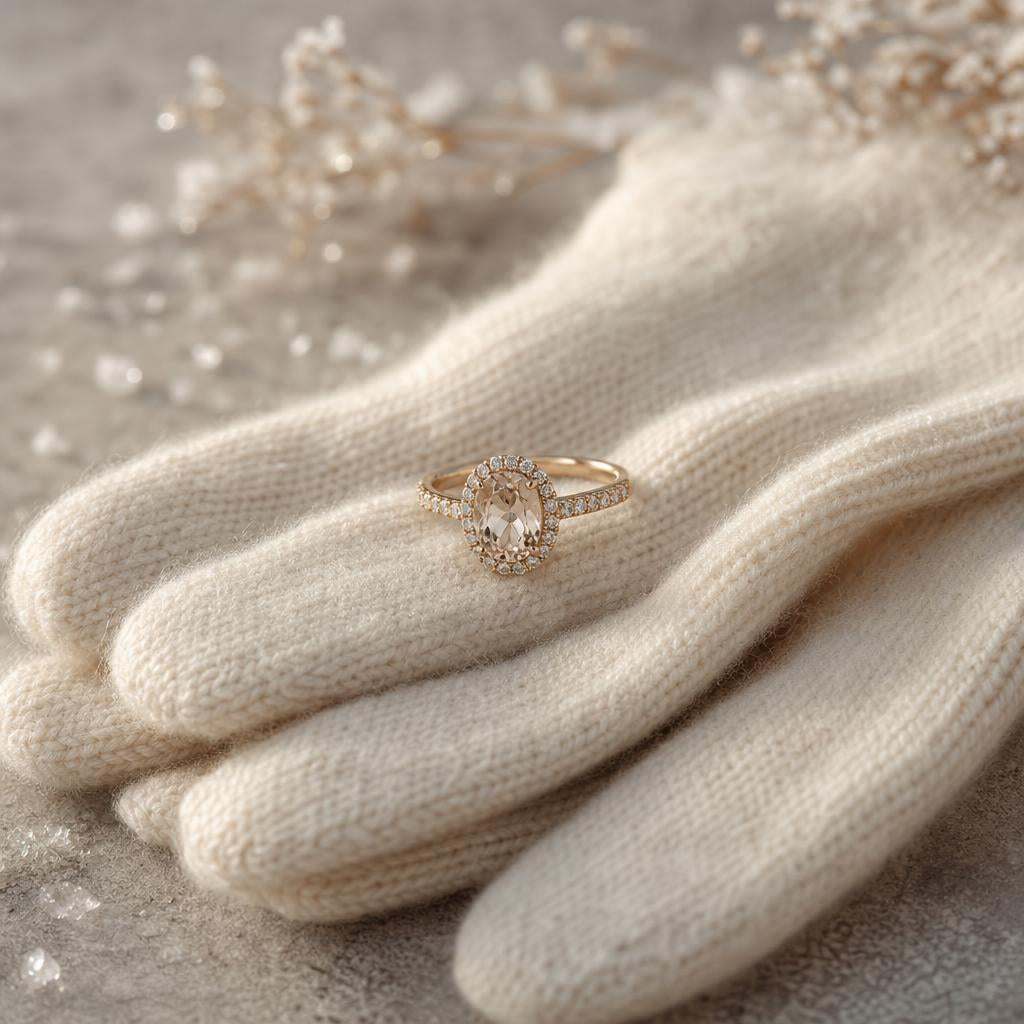
Cold Weather, Gloves, and Rings: What Actually Works When Your Hands Are Covered Half the Year
Somewhere between the first cold snap and the last thaw, most of us quietly stop wearing half our jewelry — not because we've decided to, but because gloves, dry skin, and constant layering make it feel like more trouble than it's worth. Your rings don't have to go into hibernation for four months of the year.
Cold weather doesn't ruin rings. It just exposes which ones were never built for the way you actually live in the winter — pulled on under a glove, tugged off at the door, worn through hand cream and static and dry indoor heat. The good news is that a handful of setting choices make all the difference, and once you know what to look for, winter stops being a reason to leave your rings in a drawer.


Why Cold Weather Is Actually Harder on Rings Than You'd Think
It's easy to assume winter is the gentler season for jewelry — no pool chlorine, no sunscreen, no sweat. But cold weather brings its own set of small, cumulative stresses that add up faster than most people expect.
Metal contracts slightly in the cold, and so do your fingers — knuckles included. That means a ring that fit perfectly in July can feel a touch looser in January, more prone to spinning or sliding toward the knuckle. At the same time, you're taking rings on and off far more often: gloves come off at the coffee shop, back on for the walk, off again at your desk, on again for the commute home. Every one of those cycles is a small opportunity for a setting to catch on wool, snag a thread, or get nudged out of alignment.
Then there's the dryness. Heated indoor air pulls moisture out of skin the same way it does out of houseplants, and dry skin plus friction from glove linings is a slower, quieter kind of wear than a single dramatic knock. None of this means you should stop wearing rings from November to March. It means the setting you choose matters more in winter than almost any other season.
The Setting Question: What Actually Slides On and Off Easily
If you're pulling a glove on and off multiple times a day, the shape of the setting is doing more work than the size of the stone. Anything with a high crown, sharp prong tips, or a lot of raised detail is going to catch on knit and fleece linings — sometimes just a gentle tug, sometimes enough to loosen a prong over a season of repeated snags.
A bezel setting solves this almost entirely. Because the metal wraps flush around the stone instead of holding it up on prongs, there's no edge for a glove to hook onto — the whole ring behaves more like a smooth, continuous band. It's part of why bezel styles have quietly become the ring winter commuters reach for without thinking about it.

The Cherish Ring
A modern take on the eternity band, with each round stone set into its own smooth bezel rather than shared prongs — the flush edge is exactly what makes a ring easy to live with under gloves.
Shop The Cherish Ring →That's not to say a prong solitaire is off the table for winter. A low-set, 4-prong solitaire with a rounded crown — nothing spiked or dramatically raised — still glides on under most glove linings without much resistance. The difference is in the details: shorter prongs, a gallery that sits close to the finger, and a stone cut without sharp, exposed points along the girdle.
Stacking Under a Glove: Yes, You Can Still Do It
The instinct in winter is often to simplify down to one ring, and for some people that's genuinely the right call. But if you love a stack, cold weather doesn't have to end it — it just changes which pieces make the cut.
Thicker, more dimensional stacking is the first thing to reconsider. Wide bands, raised halos, and anything with a lot of vertical build create more surface area for glove fabric to catch on, and more bulk under a glove that's already a tight fit. Thin, flush bands are the answer: a pavé eternity band or a delicate bezel stack sits low enough to disappear under most gloves rather than fighting for space.

The Devotion Ring
A continuous circle of baguette-cut stones set flush into the band — sharp and architectural, but low enough in profile to layer comfortably under a glove all winter.
Shop The Devotion Ring →If you're building a stack from scratch for the colder months, start with one flush anchor piece and add sparingly — two thin bands read as intentional layering, while four or five start to compete for the same narrow space a glove allows. This is also where good, honest layering habits for your wrist and hand carry over directly: the same restraint that keeps a bracelet stack from looking cluttered keeps a winter ring stack from feeling like a fight to get your gloves on.

The Forever Ring
A clean, continuous line of pavé stones in a slim band — one of the flattest profiles in the collection, and an easy first piece to build a cold-weather stack around.
Shop The Forever Ring →Metal, Static, and Dry Winter Air
Indoor heating drops humidity to levels closer to a desert than a home, and that dryness affects more than your skin. Static builds up faster on wool, fleece, and synthetic glove linings in winter, and a textured setting — pavé especially — is more likely to pick up lint and fine fibers from a charged glove than it would in summer. It's harmless, but it's also an easy fix: a quick wipe with a soft cloth before you leave the house keeps a pavé setting looking as sharp as the day you bought it.
The Cold-Metal Moment
There's also the simple physical reality that metal gets cold fast outdoors and takes a minute to warm back up against your skin. It's not damaging, but it's worth knowing before you reach for a ring straight off a cold windowsill or out of a bag that's been sitting in the car — a few seconds of warmth in your palm makes it comfortable again.
Does Your Ring Size Actually Change in Winter?
It can, and in the opposite direction most people expect. Fingers swell in heat, after exercise, and during pregnancy — cold does close to the reverse. Blood vessels constrict to conserve heat, fingers lose a small amount of volume, and a ring that fit snugly in summer can feel like it has just a little more room to move in January.
For most people this is barely noticeable. But if you already wear your ring on the looser end of comfortable, winter is when you're most likely to notice it spinning, sliding toward the knuckle, or feeling like it could come off more easily than you'd like — which matters most on the exact days you're wearing gloves and can't feel it happening. Ring guards and spacers are a genuinely useful temporary fix for this — a small, invisible adjustment rather than a full resizing, and easy to remove again once the weather turns.
✦ Pro tip: Apply hand cream after you take your ring off for the night, not right before you put it back on in the morning — a fresh layer of cream under a setting makes it easier for lint and residue to cling to prongs and pavé.
A Few Practical Habits for Cold-Weather Ring Wearing
None of this requires an overhaul of how you get dressed in the morning — just a few small adjustments that add up over a full winter of wear.
- Take gloves off by the cuff, not by pulling the fingers, to reduce the tug on rings underneath
- Keep a soft cloth by the door for a quick wipe-down before you head out
- Choose thinner glove linings on days you're wearing a fuller stack
- Let cold metal warm in your palm for a few seconds before putting it on
- Check looser rings for spinning or sliding more often in winter than in summer
If you spend your winter days at a desk, in meetings, or anywhere your hands are doing constant, repetitive work, it's also worth thinking about your everyday rings the same way you'd think about rings built for people who work with their hands — durability and a low profile matter just as much in a heated office in January as they do anywhere else.
Quick Takeaways
- Bezel settings and low-set solitaires slide on and off under gloves with the least resistance
- Thin, flush bands stack more comfortably under gloves than wide or high-profile pieces
- Cold weather can make fingers — and rings — feel slightly looser, not tighter
- Dry winter air and static from glove linings mean pavé settings benefit from a quick wipe-down
- Ring guards are an easy, reversible fix if a ring feels looser than usual this season
Frequently Asked Questions
Is it bad to wear a ring under gloves every day?
Not at all, as long as the setting is low-profile and smooth enough not to catch on the glove lining. Bezel settings and flush stacking bands are built for exactly this kind of daily wear.
Why does my ring feel looser in winter?
Cold temperatures cause blood vessels to constrict, which can slightly reduce finger size — the opposite of the swelling that happens in heat. A ring guard or spacer is an easy, temporary way to correct the fit until the weather warms up.
Do prong settings actually catch on gloves?
Higher prongs and sharply raised settings are more likely to snag knit or fleece glove linings over time. A low-set solitaire with short, rounded prongs is far less prone to this than a high-crown setting.
Can static from gloves damage a ring?
Static itself won't damage the metal or stone, but it can attract lint and fine fibers to textured settings like pavé. A quick wipe with a soft cloth before heading out keeps the setting looking clean.
Should I take my rings off before putting on gloves?
It's a personal choice rather than a necessity. If your rings have low, smooth settings, most people find they can leave them on comfortably all season without any extra wear.
Winter doesn't have to be the season your rings sit in a drawer. Choose settings that move the way your hands actually move under a glove, pay a little more attention to fit as the temperature drops, and the pieces you love in July are just as easy to wear in January.


