

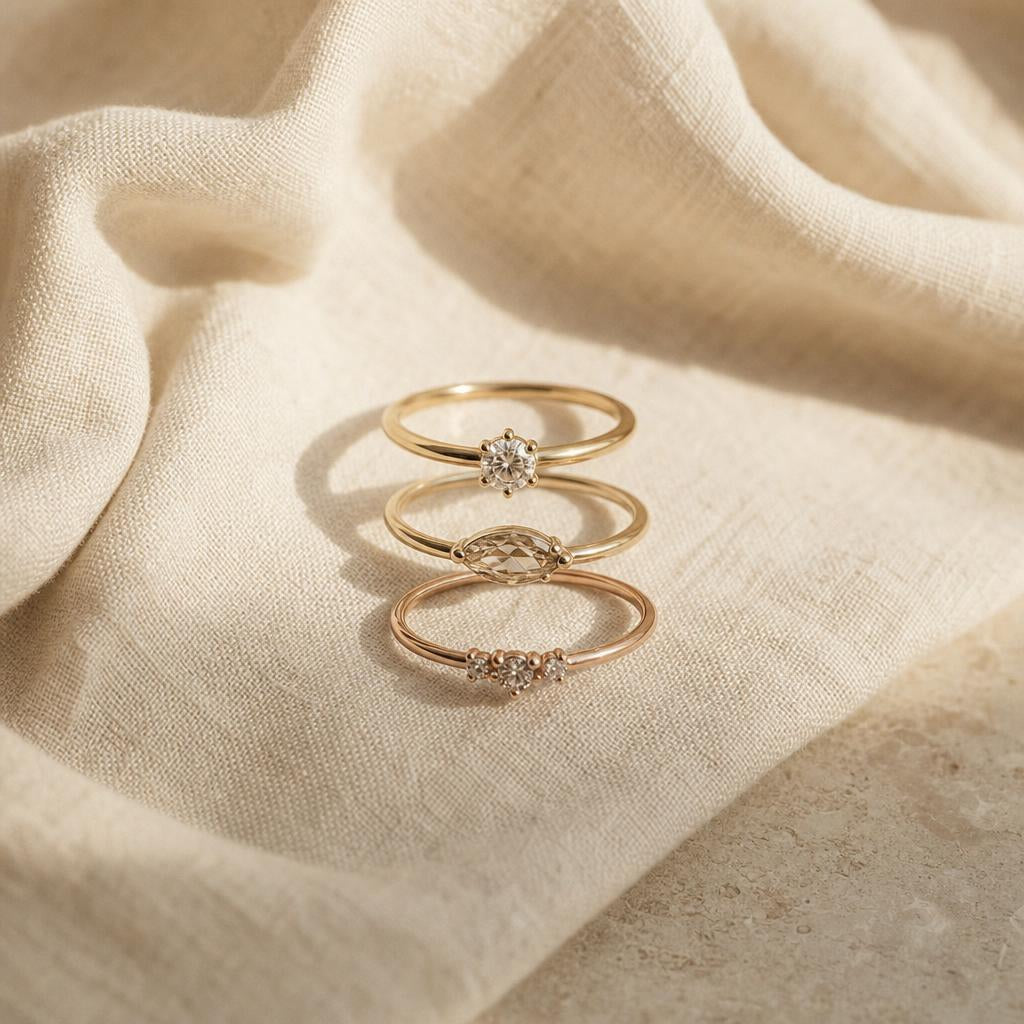
The Capsule Ring Wardrobe: Building the Only Stackable Rings Set You Need
You don't need twelve rings to look like you know exactly what you're doing. You need three — the right three — and the confidence to stop buying the rest.
Most women build a ring collection by accident: an impulse buy here, a gift there, a trend piece that looked better on someone else's hand. A capsule ring aesthetic is the opposite of that. It's three settings, chosen on purpose, that work together in every combination — so getting dressed stops being a negotiation.


What "Capsule" Actually Means for a Ring Collection
Borrow the logic from a capsule wardrobe and it holds up surprisingly well on your hands. A capsule wardrobe isn't about owning less for the sake of owning less — it's about every piece pulling its weight, so nothing sits in the back of the closet unworn. Apply that same standard to rings and the question changes from "what ring do I want next" to "what does this ring do that the others don't." That single question does more to sharpen a collection than any trend report. It's also, not coincidentally, the same instinct that led you to stop paying jewelry-store markup for a stone in the first place — you already know the difference between buying something because it's expected and buying something because it earns its place.
The Three Settings Every Capsule Needs
You don't need a ring for every mood. You need three settings that cover every mood between them — and layer cleanly when you want more.
The Solitaire — Your Anchor
Start here, always. A single stone, clean prongs, nothing competing for attention — the purest form of minimalist jewelry there is. This is the ring that works with a blazer on a Tuesday and a slip dress on a Saturday, because it isn't trying to match either one — it's just quietly correct. The Stella does this with a round-cut center stone set high enough to catch light without catching on everything else.
An anchor solitaire is also the piece that proves the rest of your instinct is right. Indistinguishable from a diamond, passes diamond testers, and priced so you can build the other two settings around it without a second thought — that's the entire point of an anchor piece.
The Halo or Pavé Statement — Your Focal Point
This is the one piece allowed to be loud. A hidden halo or a full pavé setting multiplies the light a single stone can throw, which is exactly what you want on the day the solitaire feels a little too quiet. The Ophelia is built for this — an oval center stone with a hidden halo that reads as significantly bigger than its actual footprint, without a single visible prong to break the sparkle.

The Belle Ring
If oval isn't your shape, the Belle covers the same "focal point" role with a round-cut center and a halo-and-pavé setting that catches light from every angle — a rounder, softer take on the same idea.
Shop The Belle Ring →A focal-point ring only needs to be worn alone. That's the tell of a genuinely good statement setting — it doesn't need three other rings propping it up to look finished.
The Stacking Band — Your Connective Tissue
The third setting is the one most women skip, and it's the one that makes the other two feel like a collection instead of two separate purchases. A stacking band — half eternity or full eternity, doesn't matter which — sits flush against a solitaire, layers under a statement ring without competing, and holds its own worn completely alone. The Eternity and the Forever both do this job; the difference is simply how much of the band is set with stones, half or full.
Worth knowing: A stacking band is the cheapest way to change how your entire hand reads, because it's the only one of the three settings designed to be worn with the other two, not instead of them.
How to Build Yours in Three Purchases, Not Ten
The order matters more than most guides admit. Buy the anchor solitaire first — it's the piece you'll wear on days you forget you're wearing rings at all, and it tells you the most about which metal tone and stone shape you actually reach for, versus which ones just photographed well. Add the focal-point ring second, once the anchor has proven itself for a few weeks. The stacking band comes last, because by then you'll know exactly how it needs to sit against the other two.
Resist the urge to buy all three from the same "set" listing. A pre-matched trio photographs well, but it locks you into someone else's idea of what belongs together before you've actually worn any of it. Building it piece by piece, in order is slower — and it's also the only way the final stack ends up looking like it's yours.

The Maxima Ring
For a focal-point ring with more visual weight, the Maxima pairs a cushion-cut center with a double halo — the boldest option in the lineup, for a woman who wants her statement piece to be unmistakably the statement.
Shop The Maxima Ring →Metal Consistency — Does It Actually Matter?
Less than the styling guides suggest. What actually matters is stone consistency and proportion, not whether every band is exactly the same shade of white metal. A capsule built on 925 sterling silver with rhodium plating reads as one cohesive collection even across a solitaire, a halo, and a stacking band, because the metal tone doesn't shift piece to piece the way it can with mixed vintage finds.
Where this trips people up is buying a silver stacking ring set off a generic marketplace listing, where the band width and finish are anyone's guess until it arrives. Every setting shown here is built to the same specifications on the same base metal, which is the entire reason a three-piece capsule is worth assembling deliberately instead of grabbing whatever's cheapest that week.
The Case for Stopping at Three
A capsule only works as a capsule if you actually stop. The temptation, once you own a solitaire, a halo, and a band, is to keep going — a fourth setting, a fifth, until the "capsule" is just a jewelry box again. The discipline is the whole point. Three settings, worn in every combination, will outlast a drawer full of pieces you bought once and never reached for twice.
It's also worth saying plainly: none of this requires spending what a single mined-diamond ring costs to build a complete, considered collection. Three simulated diamond settings, each doing a distinct job, cost less combined than what most stackable diamond rings for women run at a traditional jeweler for one piece alone — without asking you to compromise on how the finished stack actually looks.
Quick Takeaways
- A capsule ring collection needs exactly three settings: a solitaire anchor, a halo or pavé focal point, and a stacking band.
- Buy in that order — anchor first, statement second, band last — so each piece is chosen against what you already own, not a matched listing.
- Stone consistency matters more than matching metal exactly; a shared base metal keeps the whole stack cohesive.
- Stopping at three is the discipline that makes it a capsule instead of just another jewelry box.
Frequently Asked Questions
What is minimalist jewelry, exactly?
It favors clean lines, a single focal stone or subtle detail, and pieces built to be worn every day rather than saved for occasions. In ring terms, that usually means a solitaire or a slim stacking band — settings with nothing extra for the eye to sort through.
Are there real rules for stacking rings, or is it just personal preference?
There are a few that consistently work: keep proportions in mind so a delicate band doesn't disappear next to a large focal stone, let one setting be the clear focal point rather than competing pieces, and check that band widths actually sit flush against each other before committing to a combination. Past that, it's preference.
Do I need to buy a matched stackable rings set to make this work?
No — and it's usually better not to. A pre-matched set is designed to look good in a single product photo, not necessarily on your specific hand. Choosing each setting individually, in the anchor-focal-band order, tends to produce a stack that actually gets worn.
Is a three-ring capsule still "in style," or is stacking on the way out?
Stacking has moved from trend to standard practice at this point — the shift now is toward fewer, more deliberate pieces instead of maximal layering. A tight three-setting capsule is, if anything, the more current approach.
Can I wear all three settings on the same finger?
You can, and it's the classic way to wear a capsule — anchor first, band next to it, focal piece on the outside or on an adjacent finger if the combined width starts to feel like too much. There's no rule requiring all three on one finger; plenty of women split the stack across two fingers for comfort.
None of this has to happen in a single order or in a single week. The point of a capsule isn't speed — it's that three settings, chosen with intention, will do more for how your hands actually look than a drawer of pieces bought on impulse ever will. Start with the anchor. The rest follows.


