
Best Time to Buy Jewelry: Is January Actually the Moment for a Necklace?
Every January, the same email lands in her inbox: everything must go. The holiday rush is over, the stores are quiet, and suddenly that pendant she has been watching since October has a banner across it. It feels like a secret window. Most of the time, it is simply a retailer correcting a number it set too high in the first place.
If you are weighing a necklace right now, the smarter question is not "when is the sale?" but "what is this piece worth to me on any day of the year?" Here are four necklaces that make that question easy to answer, followed by a plain look at what the calendar actually does to jewelry pricing.


What January Actually Does to Jewelry Prices
The pattern is real, and it is worth understanding. After the Christmas and Valentine's rush, traditional jewelers face quiet showrooms and unsold holiday inventory. Clearance banners go up, and some pieces do get marked down. Ask a store owner about the best time to buy jewelry and you will hear a short list: Black Friday, the weeks after the holidays, and the slow stretch of midsummer.
Look closer and the logic is about the seller, not the buyer. A store marks a piece up to cover rent, staff, and a showroom of insured inventory, then marks it down when the calendar forces its hand. The "sale" is the store handing back a slice of a margin it added in the first place. We looked at the same question for rings in our breakdown of whether Black Friday is the best time to buy an engagement ring, and the answer held: the discount is only meaningful if the starting price was fair.
Worth knowing: A markdown tells you how much room a seller had to spare. It tells you nothing about whether the piece suits you, holds up to daily wear, or is made of what the listing implies.
The Real Cost of Waiting for a Sale
Waiting has a price of its own, and it is rarely counted. Three things quietly erode the savings.
- The sale stock is the leftover stock. Clearance leans toward what did not sell in November and December. The length, metal, or stone size you wanted may be the first thing gone.
- Time is wear. A necklace you would have worn every day from October is a necklace you wear from February instead. That is four months of the thing you actually bought it for.
- A discount on the wrong piece is still the wrong piece. A pendant that sits oddly on your neckline, or a chain that tangles, is no bargain at any percentage.
The cleaner approach is the one the best-informed shoppers already use: decide what you want first, check that the price is fair against the materials, then buy when you are ready. That is the same logic behind self-gifting a necklace: no occasion, no waiting for permission, no calendar required.
Best Time to Buy Jewelry: A Calendar With Honest Caveats
If you do like working with a calendar, here is how the usual windows break down, and what each one is really good for.
| Window | What retailers do | What to watch for |
|---|---|---|
| Black Friday and Cyber Monday | Site-wide promotions and bundles | Heavy traffic, picked-over sizes, and urgency designed to rush you |
| January to March | Clearance of unsold holiday stock | Limited selection, final-sale terms on some items |
| Late May | Post-Mother's Day markdowns | Spring inventory only |
| July and August | Slow-season promotions | Fewer new arrivals, so less to choose from |
Notice the pattern in the right-hand column. Every window trades selection or certainty for a discount. If you shop somewhere with a straightforward, fixed price, you skip the trade entirely and keep the full range to choose from.
What to Check Before You Buy Any Necklace
A markdown is only worth chasing once the piece passes the checks that actually predict whether you will love it in a year. The checklist is short.
Know what the listing is telling you
Setting terms, metal descriptions, and stone claims vary wildly between sellers. Our guide to how to read a pendant listing before you buy walks through the vocabulary, and the explainer on what plated, vermeil and gold-filled actually mean covers the metal side. A sale price on a vague listing is a risk, not a deal.
Match the piece to how you will really wear it
The best necklace is the one you reach for without thinking. If that is the goal, start with the qualities that make a piece everyday-wearable rather than special-occasion only: a secure setting, a chain weight that does not fight your collar, and a size of stone that suits your daily wardrobe.
Think in years, not weeks
The pieces that earn their keep are the ones that still feel right long after the sale emails stop. That is the idea behind a pendant worth wearing in ten years: clean proportions, a classic stone shape, and nothing that dates the moment you buy it.

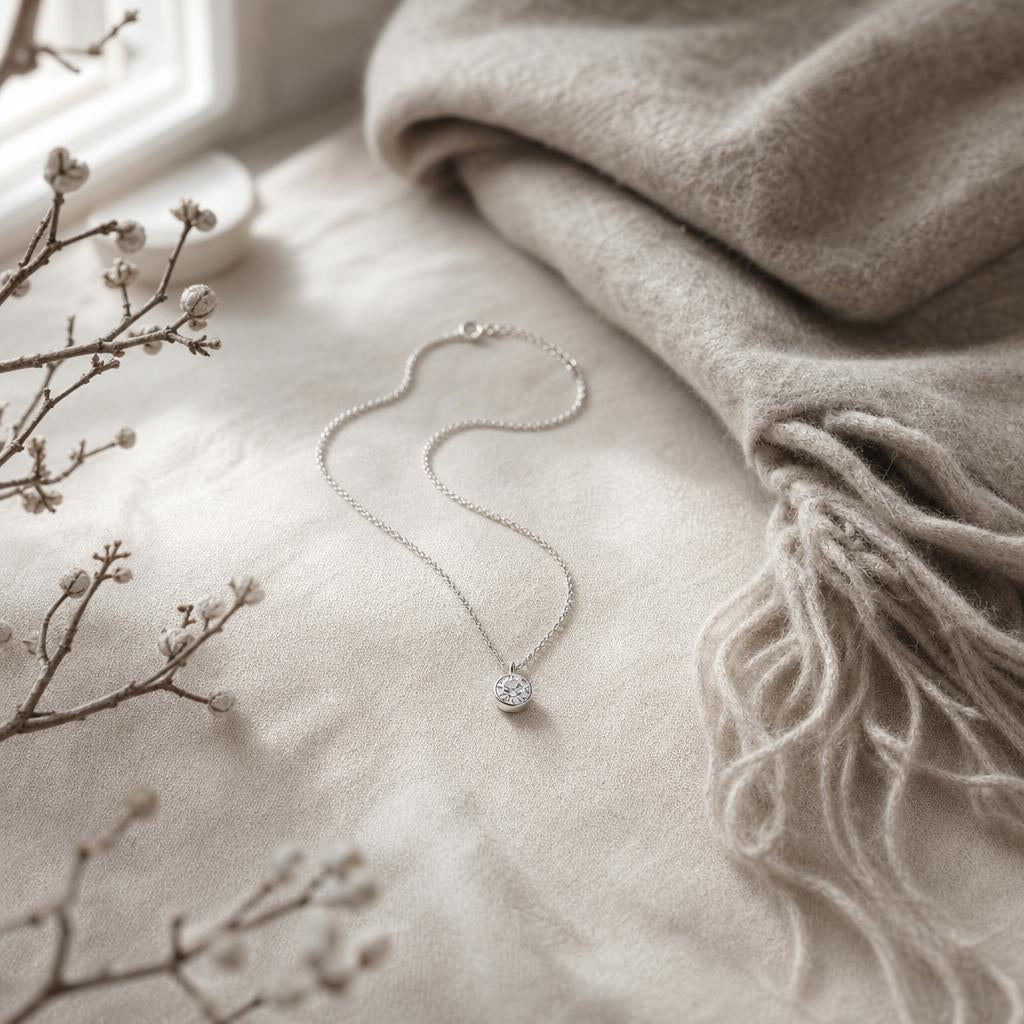
The North Star Moissanite Necklace
A radiant moissanite at the center of a sleek starburst pendant in sterling silver. A piece with a point of view, priced under $200, so the decision does not hinge on a clearance banner.
Shop The North Star →A Fair Price Beats a Perfect Moment
The Gemiros necklaces featured here are 925 sterling silver set with moissanite or simulated diamond, finished in rhodium or gold plating, nickel-free, and priced under $200. They pass diamond testers and look the part on a bare collarbone. The point of that pricing is that you are not paying for a showroom, a middleman, or a markup that has to be unwound in January. There is no moment you will regret missing.
That is the quieter version of being a smart shopper. You do not need to time the market; you need to refuse to overpay for it. It is the reason a considered buyer in October is no worse off than a patient one in February, and why the first one has had the necklace on for four months.

The Ophelia Necklace
A 5.5-carat oval-cut simulated diamond, elongated for elegance. If you are going to buy one piece that turns heads, this is the one worth buying on any day of the year.
Shop The Ophelia →✦ Pro tip: If you are buying as a gift, check delivery timing and the return terms before you check the discount. Earrings are final sale, so a pendant is the safer pick when you cannot be sure of her taste.
Quick Takeaways
- January clearance is real, but it mostly corrects an inflated starting price rather than handing you a windfall.
- Sale stock is leftover stock: expect narrower choice of length, metal, and stone size.
- Every traditional sale window trades selection or certainty for a markdown.
- Decide on the piece first, confirm the materials, then buy when you are ready.
- A fairly priced necklace has no bad month to buy it in.
Frequently Asked Questions
Is jewelry more expensive right now?
It depends on the metal and the seller. Gold and diamond prices move with the market, and traditional jewelers pass those moves along. Sterling silver pieces set with moissanite or simulated diamond sit outside most of that volatility, which is part of why the price you see today is a reasonable guide to the price in a few months.
Will jewelry stores negotiate?
Many independent jewelers have room to move, especially on higher-ticket pieces or during slow weeks, so asking is reasonable in person. Online brands with set pricing generally do not negotiate, which means the listed price is the price for everyone. That consistency is a feature: no one gets a better deal for being a better haggler.
Which day is good to buy jewelry?
For in-store shopping, quieter weekdays tend to mean more attention from staff and a calmer decision. Online, the day of the week makes very little difference. What matters far more is whether the listing is clear about materials, size, and return terms.
Is January a good time to buy a necklace as a gift?
It can be, particularly for Valentine's Day, since you have the whole month to choose and ship without a deadline panic. Just treat any January markdown as a bonus rather than the reason to buy, and pick the piece for her, not for the percentage.
The best time to buy a necklace is the moment you have found the right one. Choose the piece, confirm what it is made of, and let it start earning its place on your neckline. The sale email can wait; you already know what you are worth.


