

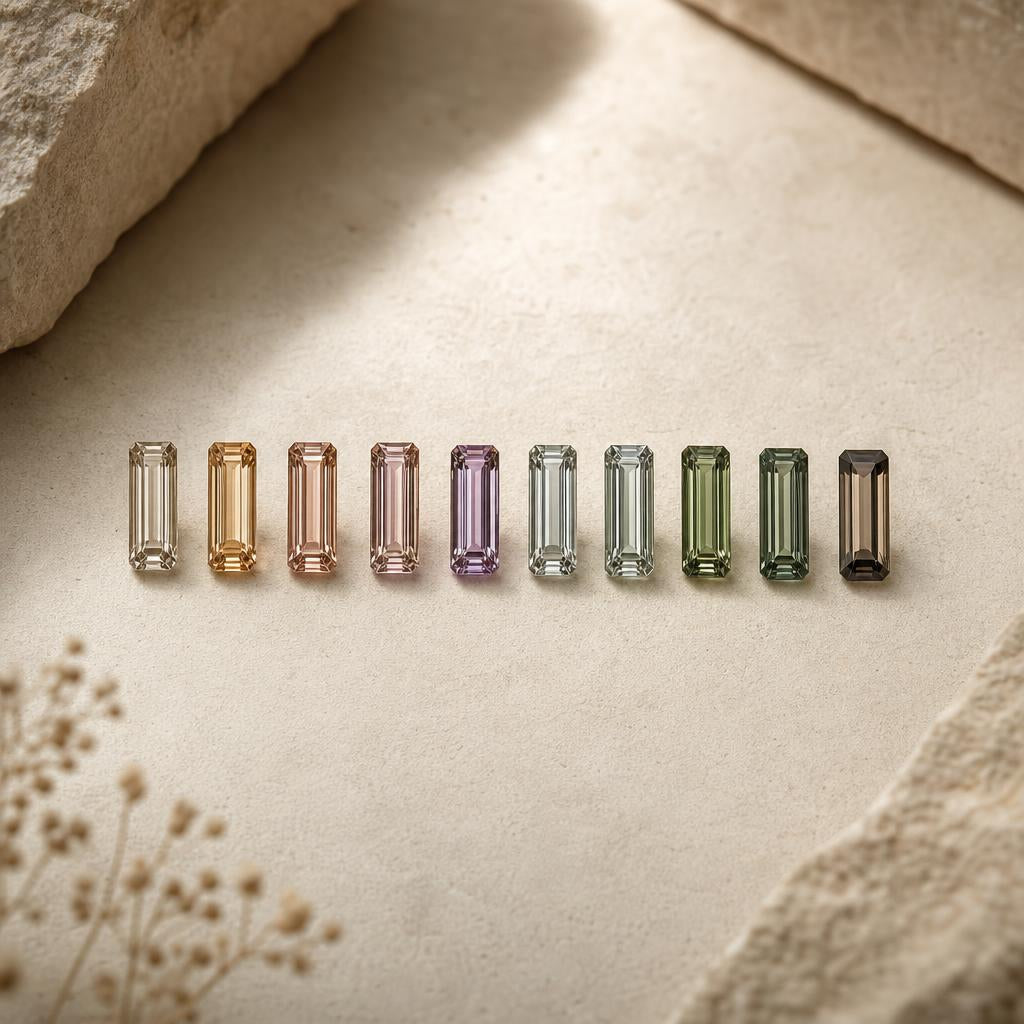
Baguette Accents: The Architectural Detail Behind the Best Baguette Engagement Bands
Round stones ask for nothing. They just sparkle. Baguette stones make you look twice — the sharp, rectangular step-cut catches light in flat planes instead of a scatter of fire, and on a ring it reads as intentional in a way a plain pavé band never quite manages. It's the detail an editor's eye goes to first.
That architectural edge is exactly why baguette accents keep showing up on eternity bands, stacking pieces, and side-stone settings this season. Before the how-and-why, here's where to see it in the Gemiros collection right now.


What Actually Makes a Baguette Cut Different
A baguette is a step cut, not a brilliant cut. Instead of dozens of triangular facets angled to scatter light in every direction, a baguette has long, flat, parallel facets running the length of a rectangle. The effect is less "sparkle" and more "flash" — a cleaner, more architectural kind of shine that reads as considered rather than loud. It's the same cut language you'll recognize from Art Deco jewelry, which is exactly why baguette accents keep getting called "architectural": the facets behave more like glass panes than gemstones, catching light in geometric sheets instead of scattered points.
On its own, a baguette-cut stone is quieter than a round brilliant of the same size. Which is precisely why it works so well as an accent rather than a center stone — it doesn't compete with whatever it's paired with, it frames it. That's the whole logic behind a baguette engagement band: a row of step-cut stones doing structural, not attention-grabbing, work.
Worth knowing: "Tapered" baguettes narrow at one end instead of staying a uniform rectangle. A tapered baguette engagement ring uses this shape specifically so the stones can follow the curve of a finger or flank a center stone without leaving gaps — it's a small detail that makes a three-stone or channel setting sit noticeably flatter and more comfortable day to day.
Three Places Baguette Accents Show Up
1. The full channel-set band
This is the purest expression of the cut: a continuous row of baguette stones set flush into the metal, edge to edge, with no visible prongs interrupting the line. The Devotion Ring below is built this way — every stone sits in a sleek channel, so the whole band reads as one unbroken strip of geometry rather than a collection of individual stones. It's the closest thing to wearing a piece of architecture on your finger.
2. Side stones on a three-stone setting
Baguettes also do quiet, structural work as side stones — long rectangles flanking an oval, cushion, or round center stone to add length and visual weight without pulling focus. This is where a baguette diamond band approach gets used on engagement-style settings specifically: the center stone still does the talking, the baguettes just give it a frame.
3. Vertical versus horizontal placement
This is the detail most buyers never think to ask about, and it changes the whole look of a piece. A vertical baguette wedding band sets each rectangle running up-and-down across the band's width, which reads narrower, more delicate, and slightly more modern — the eye travels around the finger in short, quick segments.
Neither orientation is objectively better, and the difference is easy to miss in a listing photo shot straight-on — it's worth studying a close-up or side angle before deciding which one actually suits your hand.
The opposite approach sets each stone running lengthwise around the finger instead, so the rectangles read wider and the whole piece feels more substantial and continuous, closer to the classic Art Deco look a horizontal baguette eternity band is named for.

The Devotion Ring
A continuous circle of baguette-cut simulated diamonds set in a sleek channel — architectural precision built to stack or wear alone.
Shop The Devotion Ring →Building a Stack Around a Baguette Piece
Baguette accents are some of the easiest architectural pieces to stack next to a round or oval engagement ring, precisely because they don't compete for attention — the flat facets sit quietly next to a brilliant-cut center stone instead of fighting it for sparkle. A single channel-set baguette band, worn alone against a solitaire, adds a clean geometric line without crowding the hand.
✦ Pro tip: If you're new to stacking, start with one baguette piece and one plain band before adding a third. The straight lines of a baguette row already read as a strong visual statement — you don't need three architectural pieces competing on one finger to make the point.
If bezel settings are more your speed, bezel-set bands solve for a different kind of durability — each stone held individually rather than channel-set — and pair just as easily with a baguette row for contrast. The Cherish Ring above uses that approach, with each simulated diamond held in its own rubbed-edge setting instead of a shared channel. For more mix-and-match ideas, a few stacking combinations that read as intentional rather than accidental are worth a look before you commit to a full lineup.

The Everlasting Ring
A continuous line of 3mm round simulated diamonds on a substantial 3mm band — a bolder, rounder counterpoint to a baguette row.
Shop The Everlasting Ring →Vintage Roots, Modern Wear
Because the step cut has been around since the 1920s, a vintage baguette ring and a brand-new one can look nearly identical in silhouette — the cut itself hasn't changed, only what surrounds it has. What reads as "vintage" today is usually the setting, not the stone: milgrain edges, a symmetrical three-stone layout, a slightly heavier gallery underneath the band. Strip those details away and a channel-set baguette row is just as much a modern minimalist statement as it is an Art Deco callback, which is part of why the shape has never really gone out of circulation.
It also means you don't have to choose a side. A clean, unadorned baguette channel band reads contemporary. Add milgrain detailing or pair it with an emerald or asscher cut center stone and the same ring leans period-accurate. Same cut, two completely different moods.
| Setting Style | How Stones Sit | Best For |
|---|---|---|
| Channel-set baguette | Flush, edge to edge, no visible prongs | A clean architectural line, worn solo or stacked |
| Baguette side stones | Flanking a center stone, tapered to fit | Adding length to an oval or cushion center |
| Bezel-set round | Each stone individually rubbed in | Durability plus a rounder, softer texture |
| Pavé eternity | Small stones set close together, all around | Maximum sparkle, minimal geometry |
Quick Takeaways
- Baguette stones are step-cut, not brilliant-cut — they flash in flat planes instead of scattering light.
- Tapered baguettes narrow at one end so they can flank a center stone or follow the curve of a finger without gaps.
- Vertical settings read narrower and more modern; horizontal settings read wider and closer to classic Art Deco.
- A single baguette piece pairs easily with a round or oval solitaire without competing for attention.
- Setting details — not the cut itself — are what make a baguette ring read as vintage or modern.
Frequently Asked Questions
What does "baguette" actually mean on a ring listing?
It refers to the stone's cut, not its setting. A baguette is a rectangular, step-cut stone with long parallel facets — the same shape whether it's the center stone or a small accent along a channel-set band.
Are baguette-cut stones less brilliant than round ones?
They catch light differently, not less of it. A round brilliant scatters light into a scintillating sparkle; a baguette flashes in broader, flatter planes. Set with Gemiros Signature Simulated Diamonds or moissanite, a baguette row still reads as diamond-bright — it's a different kind of shine, not a dimmer one.
What pairs well with a baguette diamond eternity band?
Almost any solitaire or halo center stone. Because the flat facets don't compete with a brilliant-cut center, it works as a stacking piece next to nearly any engagement ring style — round, oval, cushion, or emerald.
Are baguette rings still considered fashionable, or do they read as dated?
They're having a genuine moment right now, driven by the same appetite for clean, geometric jewelry that's brought back Art Deco styling generally. Worn as a plain channel band, a baguette row is one of the more contemporary things you can put on your hand.
Should I choose a vertical or horizontal baguette setting?
It comes down to how wide you want the band to visually read. Vertical settings look narrower and more delicate; horizontal settings look wider and more substantial. Neither is more correct — try both against your hand shape before deciding.
The straight-lined confidence of a baguette accent is easy to underestimate until you see it next to a round stack — suddenly everything else looks a little softer by comparison. Whether you land on a full channel-set baguette engagement band or just a few tapered stones flanking your center stone, it's a detail that photographs as intentional every single time, because it is.


