

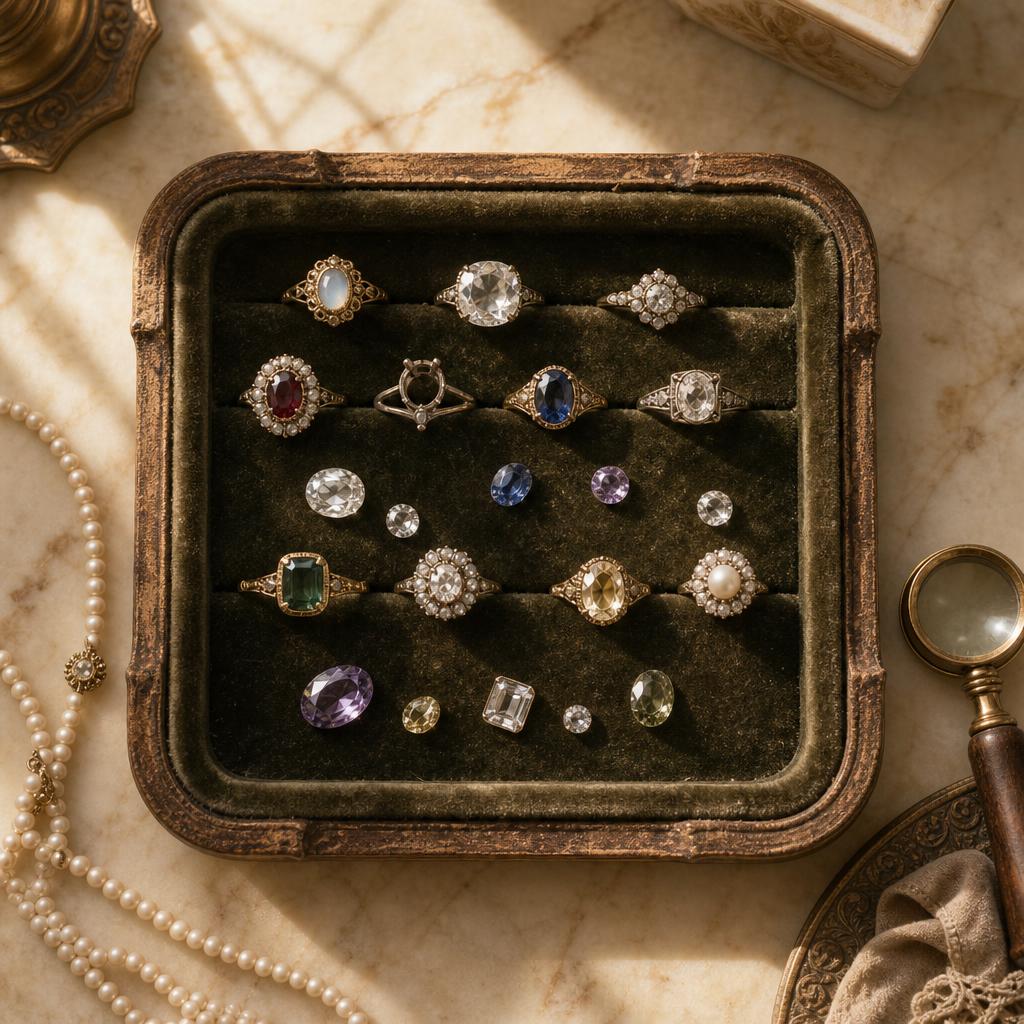
Antique-Inspired vs. Vintage Style Engagement Rings: What the Difference Actually Means
Somewhere between "I want a ring that looks like it has a history" and the checkout page, most women hit the same fork in the road: buy something genuinely old, or buy something new that borrows the old look. The internet calls both of these things "vintage," which is exactly why the search results are so confusing.
They are not the same purchase, and they do not solve the same problem. One is a piece with a prior owner, an uncertain past, and a price tag that reflects scarcity. The other is a newly made ring, built today, that references the design language of an earlier era on purpose. Here is what actually separates them — and which one makes more sense for the ring you plan to wear every day.


What "True Vintage" Actually Means
A true vintage or antique ring is a physical object that already existed before you found it — made decades or a century ago, worn by someone else, sold and resold through estate sales, auction houses, or dealers who specialize in period jewelry. Genuine antique pieces are typically sorted by era: Georgian, Victorian, Edwardian, Art Deco, Retro. Each era has its own hallmarks — literally, in the case of metal stamps — and its own set of construction techniques that a trained eye can date almost on sight.
That history is the entire appeal. It is also the entire complication. A true antique ring is one of one. If it fits, it fits; if it doesn't, resizing a century-old shank can be delicate work that not every jeweler will take on, and it can alter a piece's value. Stones may be old mine or old European cut — cut by hand, by eye, decades before modern proportioning existed — which changes how they read next to a modern round brilliant. Condition varies piece to piece. And because no two are alike, comparison shopping in the way you'd shop a modern catalog isn't really possible.
What "Antique-Inspired" or Vintage-Style Actually Means
An antique-inspired ring — often called a vintage style engagement ring — is a newly made piece, built this year with current manufacturing and current metals, that intentionally borrows the visual grammar of an earlier era: fine beaded edging, lace-like open metalwork, floral motifs, elongated silhouettes. It is not pretending to be from 1925. It is using the design language of 1925 on purpose, the same way a new building can borrow columns and cornices from classical architecture without claiming to be two thousand years old.
This is where Gemiros lives. Rings like the milgrain, floral, and art-deco detailing found across the collection are built from scratch in 925 sterling silver and moissanite, sized consistently, and covered by a warranty — the opposite of buying a one-off piece with an unknown history. Every size runs the same, every stone reads the same, and every ring you see online is the ring that arrives.
Worth knowing: "Antique," "vintage," and "vintage-inspired" get used interchangeably online, but only "antique" and "vintage" describe an object's actual age. "Vintage-inspired" and "vintage style" describe a new object's design language. If a listing doesn't specify which one you're looking at, the price is usually the tell — genuinely old pieces are priced for scarcity, not just craftsmanship.
The Techniques That Actually Define the Look
Most of what reads as "old" in a ring comes down to a handful of specific techniques, not the ring's actual birth year:
- Milgrain — a row of tiny beaded texture along a metal edge, originally applied by hand with a small toothed wheel. It's the detail that makes a plain band edge look finished rather than flat.
- Filigree — delicate, lace-like open metalwork, usually along the shoulders or gallery of a ring, built from thin twisted or scrolled wire.
- Hidden halo — a ring of small stones set beneath the center stone rather than around it, visible only from the side. It adds sparkle and perceived size without changing the ring's silhouette from above.
- Elongated, architectural silhouettes — the geometric, symmetrical lines associated with Art Deco design, distinct from the softer floral curves of Victorian and Edwardian work.
None of these are proprietary to old rings. They're construction choices, and a newly made ring can use every one of them with the same precision as a ring made a hundred years ago — often more precision, since modern setting equipment is more consistent than a hand tool from 1920.

Regent Ring
A 1.25-carat princess cut framed by a halo, with intricate milgrain tracing every edge — the kind of detailing that used to mean tracking down a hundred-year-old piece and hoping it fit.
Shop Regent Ring →Why a Vintage-Style Ring Makes More Sense for Everyday Wear
An antique ring's fragility isn't a flaw — it's a natural consequence of being genuinely old. Prong settings from the 1920s were built for a lifestyle without keyboards, gym bags, or daily hand-washing at the frequency we do now. A newly made ring in 925 sterling silver is built for exactly the life you're actually living: it's indistinguishable from a diamond, it passes diamond testers, and it's engineered to hold up to daily wear without the caution a true antique demands.
Sizing is the other quiet advantage. A vintage-style ring comes in a full run of current sizes, made to spec, every time — there's no waiting to find the one existing example of a design in your size, and no resizing risk to a piece that can't be replaced. And because it's newly made, a hidden accent stone or a rhodium-plated edge looks the same on the day it ships as it did in the photo — no guessing at condition, no relying on a seller's description of "estate wear."
✦ Pro tip: If you love the look of milgrain engagement ring detailing but want to protect the finish long-term, ask about the plating. Rhodium plating keeps fine beaded edges and open metalwork looking crisp instead of dulling into the softened look genuine antique pieces develop over decades.

Fleur Ring
A 3.5-carat radiant cut wrapped in a floral-inspired halo — vintage glamour built new, sized to fit, and covered by warranty from day one.
Shop Fleur Ring →The "Modern Vintage" Middle Ground
There's a third category worth naming: rings that pair old-world detailing with an unmistakably current setting — a clean, elevated band with a single line of milgrain, or a hidden halo under an otherwise minimal solitaire. This is often what people mean when they search for modern vintage engagement rings: not a full period reproduction, and not a plain contemporary band, but a deliberate blend of both. It's a useful category to know, because it's usually the easiest to wear daily — recognizably detailed, without tipping into over-the-top ornamentation.
How to Tell Which One You're Actually Looking At
The same logic that applies to milgrain and filigree applies to a full period style, too. Genuine 1920s pieces are angular, symmetrical, and often set with baguette or step-cut stones — a distinct enough look that a lot of buyers searching for art deco inspired engagement rings aren't actually looking for a hundred-year-old original. They're looking for the geometry: the clean lines, the symmetry, the confidence of the era, built into a ring that's sized correctly and ready to wear now.
A few questions clear this up faster than any listing copy will:
- Is there a size range? Genuine antiques come in one size — the size they were made in. If a listing offers a full range of standard sizes, you're looking at a newly made piece.
- Is the price scaled to rarity or to materials? A one-of-a-kind antique's price reflects scarcity as much as craftsmanship. A vintage-style ring's price reflects its materials and construction — which is why it can offer the same detailing at a fraction of the cost.
- Does the listing use the word "authentic," "estate," or "original"? That's a genuine-age claim. "Vintage-inspired," "vintage-style," or "antique-style" is a design description, not an age claim.
- Is there a warranty? New pieces can be warrantied. A hundred-year-old ring generally can't be — there's no manufacturer standing behind construction from a century ago.
Quick Takeaways
- True vintage and antique rings are physically old objects with a prior owner, one-of-a-kind sizing, and pricing driven by scarcity.
- Antique-inspired or vintage-style rings are newly made pieces that borrow old-world techniques like milgrain, filigree, and hidden halos on purpose.
- Milgrain, filigree, and hidden halos are construction choices — not proof of age — and a new ring can execute them with more precision than a hundred-year-old original.
- New-made vintage-style rings offer consistent sizing, warranty coverage, and daily-wear durability that genuine antiques can't guarantee.
- "Modern vintage" and Art Deco-inspired styles blend old detailing with current, wearable settings.
Frequently Asked Questions
What's the actual difference between an antique ring and a vintage-inspired ring?
An antique ring is a physically old object, typically over 50–100 years old depending on how strictly the term is used, with a prior owner and a one-of-a-kind size. A vintage-inspired or vintage-style ring is newly made this year, built to reference the design details of an earlier era — like milgrain edging or filigree — without claiming any actual age.
What is the difference between milgrain and filigree?
Milgrain is a fine beaded texture applied along the edge of a metal band or setting. Filigree is delicate, lace-like open metalwork, usually built from twisted or scrolled wire along the shoulders or gallery of a ring. Many vintage-style rings use both together — milgrain along the edges, filigree in the open spaces.
Is milgrain more expensive than a plain band?
On a newly made ring, milgrain is a construction detail, not a rarity premium — it doesn't carry the scarcity pricing that comes with an actual antique. It's a technique a ring either includes or doesn't, priced like any other design choice.
Are true antique engagement rings more expensive than vintage-style ones?
Often, yes — a genuine antique's price reflects rarity, provenance, and the fact that no two pieces are identical, on top of the materials themselves. A vintage-style ring built new can offer the same visual detailing — milgrain, filigree, hidden halos — without that scarcity premium, since it's a current, repeatable design rather than a one-of-a-kind object.
Does milgrain wear off over time?
On a well-made ring, milgrain is set into the metal itself, not applied on top, so it holds up to normal daily wear. Rhodium plating over the detailing helps keep the edges looking crisp and bright rather than dulling with age.
Are vintage-style engagement rings still in style right now?
Yes — vintage-inspired detailing has stayed a consistent, in-demand category rather than a passing trend, because milgrain, hidden halos, and floral motifs read as intentional and considered rather than tied to a specific year.
The real question isn't whether "vintage" beats "new" — it's whether you want the story of an inherited object or a ring built for the life you're actually living now. Antique-inspired pieces let you wear that old-world detailing today, in your size, without the compromises that come with buying something a century old. That's not a lesser version of the look. It's the same look, built to actually work.


