

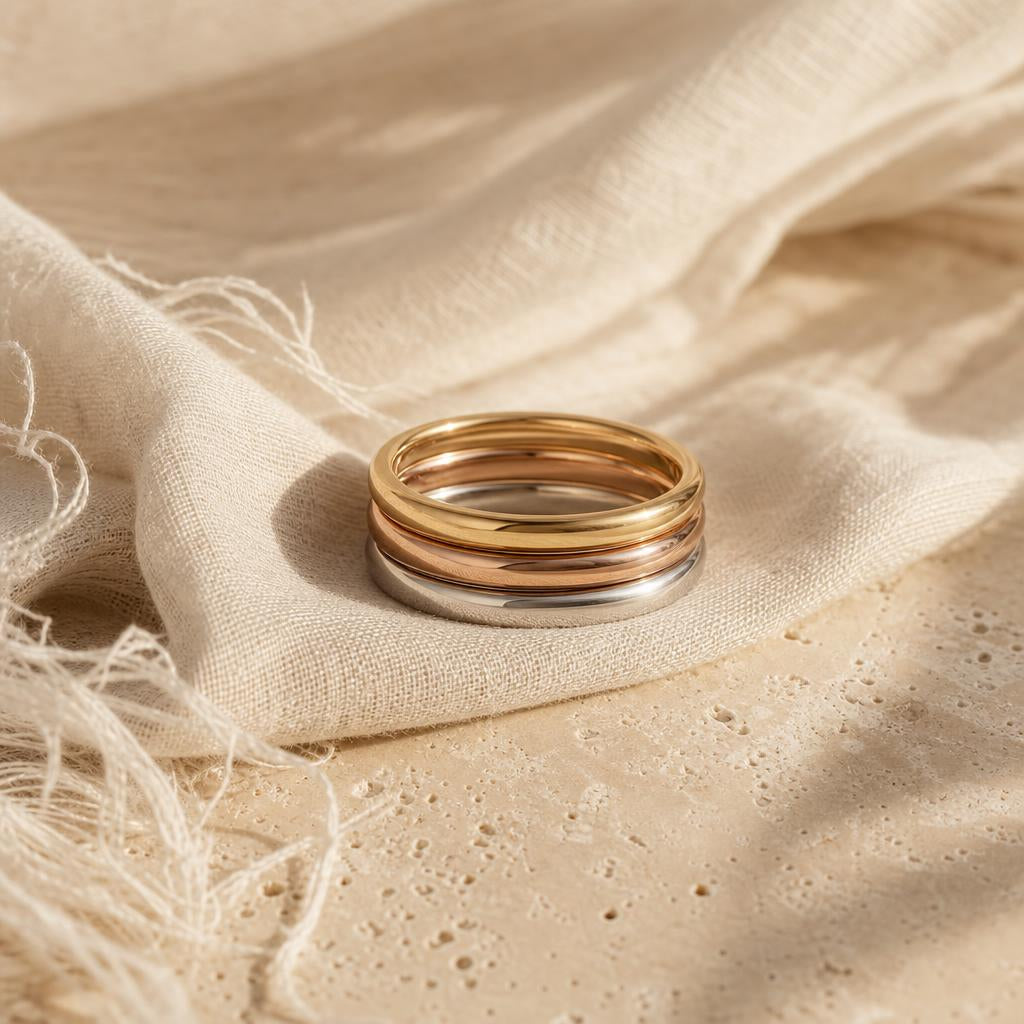
Anniversary Bands: When to Add One and How to Choose Your Style
No one hands you a permission slip for an anniversary band. There's no card that arrives in the mail on year five telling you it's time, no rulebook that says your hand has to wait for a date on the calendar before it's allowed to hold more than one ring. If you've been eyeing a second ring and wondering whether you've "earned" it yet, the honest answer is: you decide that, not a milestone.
That said, there are real reasons women add one — some tied to a specific year, some tied to nothing but wanting more sparkle on their hand. Before you shop, it helps to see what's actually built for stacking.


What Is an Anniversary Band?
It's any ring added to an existing set — usually a slim, continuous style meant to sit alongside a wedding band or solitaire rather than compete with it. Unlike an engagement ring or a wedding band, there's no fixed occasion attached to it. It's the piece you choose to add, on your own timeline, because you want more brilliance on your hand than you started with.
That distinction matters more than it sounds like it should. A wedding band marks a specific day. This one marks nothing in particular unless you decide it does. It can commemorate a year, or it can simply be the ring you bought yourself on an ordinary Tuesday because you wanted it.
When Do Most Women Actually Add One?
Tradition points to certain years — a fifth anniversary, a tenth, and especially the twenty-fifth, which carries enough symbolic weight that entire collections of 25th anniversary rings exist to mark it. Silver has historically been the theme for that milestone, which is part of why so many pieces built for it lean toward white metals and platinum-tone settings.
But treating those years as a requirement gets the logic backward. The women who build the best stacks aren't waiting for a number to tell them they're allowed. They're adding a ring when the moment feels right, or when the piece in their cart has been sitting in their wishlist long enough that "later" stopped making sense. If you're weighing a purchase against a specific year because it feels like the only legitimate reason, it's worth asking whether that's actually the rule you want to live by.
Choosing a Style That Complements What You Already Wear
The mistake worth avoiding isn't picking the wrong metal or the wrong width — it's picking a ring that fights with what's already on your hand instead of finishing it. Before you shop, look at three things on your current ring: the band width, the setting height, and the metal tone. A new piece that's noticeably thicker or thinner than your existing rings will look like an afterthought instead of a set.
This is also where it's worth resisting the pull toward whatever's trending and shopping instead for what actually sits flush. Some of the most unique anniversary rings aren't unique because of a dramatic design — they're unique because the stone shapes, prong style, and proportions were chosen specifically to disappear seamlessly into a stack rather than announce themselves as a separate ring.

The Everlasting Ring
A continuous line of pavé stones in a slim, low profile — built to sit flush against a solitaire without adding height or bulk to the stack.
Shop The Everlasting Ring →Metal Choices: Gold, Rose Gold, or Platinum-Toned Silver
Matching metals exactly isn't a rule you have to follow, but it does simplify the decision. A gold anniversary band next to an existing gold set reads as intentional; a warm gold piece dropped next to a cool white-metal solitaire can read as mismatched unless the contrast is clearly deliberate. If your existing ring leans cool — platinum, white gold, or rhodium-plated silver — a rose gold or yellow gold piece can still work beautifully, but it works best when you commit to the mix rather than accidentally landing on it.
925 sterling silver with rhodium or 18k gold plating gives you that flexibility without the commitment of solid gold. Because the base metal is consistent across the Gemiros collection, you can build out a stack in more than one tone — a platinum-finish piece here, a rose gold piece there — without worrying about the metals visibly aging at different rates or reacting differently to your skin.
Five-Stone Bands and Other Symbolic Styles
If you want a style with more meaning built in, a five-stone band is worth knowing about. The format — five stones set across the top of the band — traditionally stands in for five pillars of a lasting relationship: love, commitment, communication, empathy, and trust. It's a specific enough idea that a five-stone design reads as intentional rather than decorative, which is part of why the style has stayed popular even as trends around it shift.
A continuous eternity style tells a different, simpler story — an unbroken circle instead of five distinct moments. Neither is more "correct." One says continuity; the other says milestones. Choosing between them is really a question of which story matches how you think about the relationship, or the version of yourself, the ring is meant to represent.

The Devotion Ring
A continuous circle of baguette-cut stones in a channel setting — a sharper, more architectural take on the eternity band for anyone who wants clean lines over rounded pavé.
Shop The Devotion Ring →How to Wear It
Most women wear it on the same finger as their existing set, stacked directly against the wedding band or solitaire so the pieces read as one continuous look rather than two separate rings competing for space. Anniversary bands for women don't need to be dramatic to make an impact — if your hand already feels full, a slim style that sits low and tight to the finger will add sparkle without adding visible bulk, which is usually the difference between a stack that looks curated and one that looks cluttered.
There's no requirement to stack at all, either. Plenty of women wear a new ring on the opposite hand, or save it for occasions when they want more presence on their hand than an everyday look calls for. The piece doesn't need to justify itself by fitting into a specific system — it just needs to be one you reach for.
Quick Takeaways
- There's no required year for adding one — 5th, 10th, and 25th are traditional trigger points, but plenty of women add a ring whenever they choose.
- Match width and setting height to your existing ring first; metal tone matters, but proportion is what actually keeps a stack looking intentional.
- A five-stone band carries specific symbolism (love, commitment, communication, empathy, trust); a full eternity style tells a simpler, continuous story.
- 925 sterling silver with rhodium, gold, or rose gold plating lets you mix metal tones across a stack without worrying about mismatched wear over time.
Frequently Asked Questions
Is there a "right" anniversary for adding one?
Not really. The 5th, 10th, and 25th anniversaries are the traditional trigger points, and the 25th in particular carries a strong silver-and-diamond association. But there's no rule requiring you to wait for a specific year — it works just as well as a self-purchase with no occasion attached at all.
What's the difference between a wedding band and this kind of ring?
A wedding band is exchanged on your wedding day and typically worn as part of a fixed set. This kind of ring is added later, on your own timeline, usually to build out or refresh a stack rather than mark a single ceremony.
Which finger do you wear it on?
Most women wear it on the same finger as their existing wedding band or solitaire, stacked directly against it. Wearing it on the opposite hand or right hand is equally common and simply changes the effect from a continuous stack to a standalone statement.
Does adding one replace your wedding band?
No. It's meant to be added alongside your existing rings, not swapped in for them. Think of it as building on your set rather than starting over.
What does a five-stone band symbolize?
The five stones traditionally represent five pillars of a lasting relationship — love, commitment, communication, empathy, and trust. It's one of the more specific, story-driven styles available, which is part of why it's stayed popular even as broader ring trends shift.
None of this needs to justify itself with a date. Whether you're marking a real milestone or simply ready for more sparkle than you started with, the only requirement that actually matters is that the ring sits well next to what you already wear — and that you're the one who decided it was time.


