

Why a Ring Feels Different After the First Week of Wearing It
Somewhere around day four, you'll catch yourself staring at your hand for no reason. The ring feels heavier than you remember, or lighter — you're not sure which. It rotates slightly when you make a fist. It's cold against your skin first thing in the morning in a way it wasn't in the store. None of this means anything is wrong. It means you're in the adjustment week, and almost nobody warns you about it.
Every ring — no matter how perfectly sized — goes through a short settling-in period before it stops announcing itself and starts just belonging to your hand. Here's what's actually happening during that first week, which sensations are completely normal, and which ones are worth paying attention to.


The Physical Adjustment: What's Actually Changing
A ring is one of the only pieces of jewelry that moves with you constantly. Earrings sit still. Necklaces hang and settle. A ring, on the other hand, is in near-continuous contact with your hand — through typing, cooking, gripping a steering wheel, washing dishes, holding someone else's hand. It's not surprising that your nervous system needs a few days to stop flagging it as a new sensation.
Occupational therapists who study sensory adaptation call this habituation — the brain's tendency to stop registering a constant, low-level stimulus once it decides the stimulus isn't a threat. It's the same reason you stop noticing your glasses on your face or your watch on your wrist after a few days. A ring is no different, except that its weight, temperature, and rotation are more variable than a watch strapped snugly to your wrist, so the adjustment period tends to feel more noticeable.
Worth knowing: Most jewelers consider one to two weeks a completely normal settling-in window for a new ring — even one that's the exact correct size. If it still feels foreign after a month, that's a fit question worth revisiting, not a sensory one.
Weight and Rotation: The Two Sensations You'll Notice Most
The two most common "is this normal?" questions in the first week both come down to the same two variables: weight and rotation.
Weight is relative to what you're used to. If you've never worn a ring before, even a lightweight sterling silver band will feel like it's announcing itself every time your hand moves. If you're used to wearing thin stacking rings and switch to a ring with a halo or side stones, the added metal and stone weight sits differently — usually higher off the finger, which changes how the ring's center of gravity feels when your hand is at rest versus in motion.
Rotation is almost universal in the first week, even on a well-sized ring. New rings haven't yet settled into the natural contours of your finger, and your finger itself has micro-variations in width along its length that a brand-new band hasn't "learned" yet. A little spin when your hand is loose and cold is expected. What's not expected is a ring that spins so far the stone ends up on your palm — that's a sizing conversation, not a settling-in one.

The Camilla Ring
A round halo with a classic pavé band — the kind of familiar silhouette that tends to settle in fastest, since the eye and the hand both already know what to expect from it.
Shop The Camilla Ring →Why Your Ring Feels Tighter in the Morning and Looser by Night (Or the Reverse)
If you've noticed your ring feels snug when you first wake up and slightly looser by afternoon, you're not imagining it — you're feeling ordinary fluid shifts. Fingers tend to be smaller in the early morning after a night of lying flat, then gradually swell slightly through the day as you're upright, moving, and retaining a bit more fluid in your extremities. Heat, salt intake, and physical activity all nudge that swelling further. This daily fluctuation is completely normal and isn't specific to a new ring — it's just that you notice it more in the first week because you're paying closer attention than you will in month three.
This is also where setting height and band design matter more than people expect. A ring that sits low and close to the finger will telegraph these small size changes less than a ring with a tall setting, because there's less leverage for the ring to shift or catch. If you already know you run warm or your hands swell in the afternoon, it's worth understanding why fingers swell in heat, after exercise, and during pregnancy before you assume your ring is the wrong size — the timing of when you measured, and when you're evaluating fit, changes the answer.
Setting Height and the Break-In Period
Not all ring styles adjust to at the same pace. A thin, low-profile band with a smaller stone tends to disappear into daily life within a few days, simply because there's less surface area and less height for your hand to register. A ring with a raised halo, a cathedral setting, or a larger center stone takes longer — not because anything is wrong with the fit, but because there's genuinely more ring for your hand to get used to navigating around door handles, phone cases, and keyboard edges.
If you're someone who values a ring that recedes into the background of your day rather than one that constantly reminds you it's there, it's worth understanding what makes low-profile, no-snag settings feel different from the moment you put them on, rather than after a two-week adjustment.

The Odette Ring
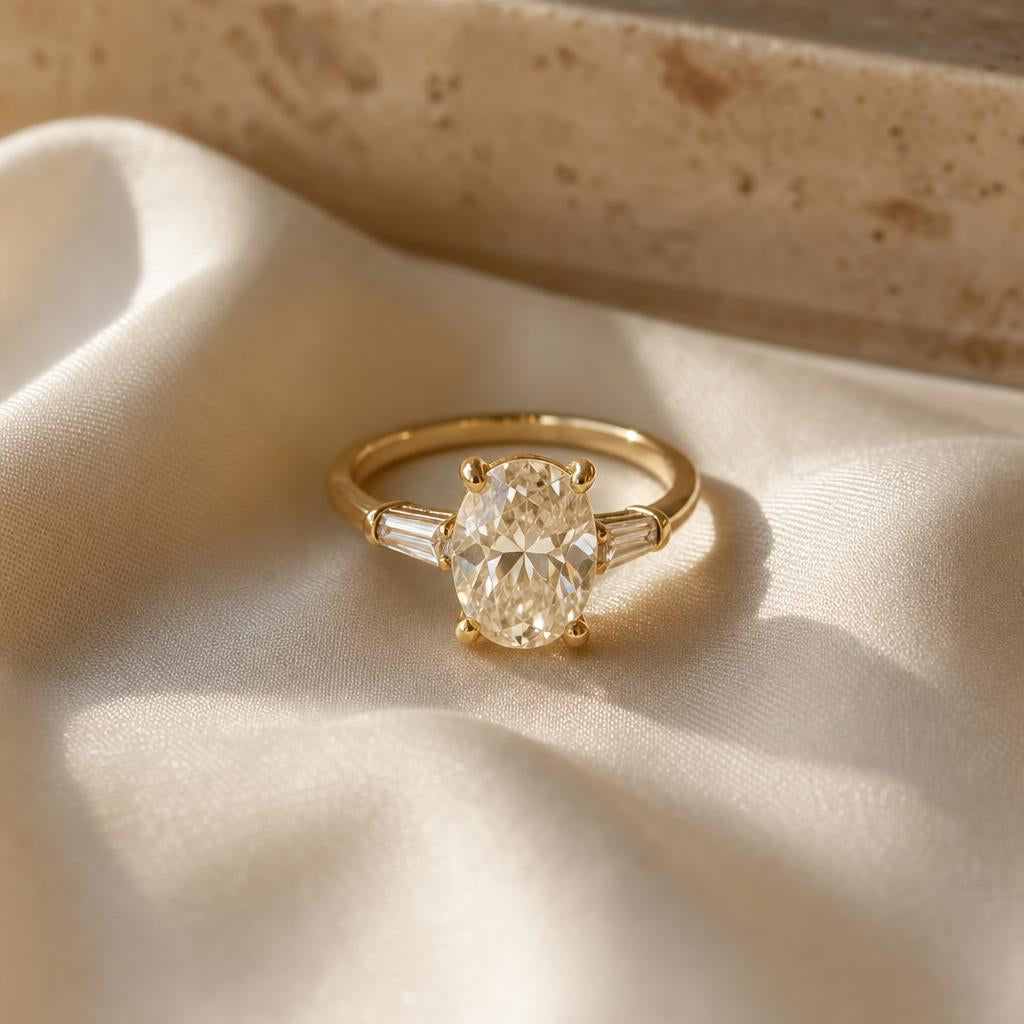
An oval solitaire with a clean, low profile — one of the faster styles to stop noticing, since there's no raised halo catching on gloves, pockets, or blankets while your hand adjusts.
Shop The Odette Ring →The Skin Underneath: A Different Kind of Adjustment
There's a second, quieter adjustment happening that has nothing to do with sizing: the skin under your ring. A patch of skin that's rarely covered suddenly has metal resting against it for most of the day. It's common to notice slight temporary indentation, a faint tan line forming, or a bit more oil and lint collecting under the band than you'd expect. None of this is cause for concern on its own — it's simply skin adjusting to constant, gentle contact, the same way a new pair of shoes leaves a faint mark before your foot and the shoe find their shape together.
What is worth paying attention to is any redness, itching, or irritation that doesn't resolve within a few days. That's rarely about size and much more often about metal sensitivity, residual soap or lotion trapped under the band, or a ring that hasn't been dried properly after washing your hands. Simulated stones set in nickel-free sterling silver, gold vermeil, or rose gold tend to be far gentler on sensitive skin than costume jewelry, but even the most skin-friendly metal needs a day or two of normal wear before you can tell whether irritation is happening at all.
✦ Pro tip: Dry your ring — and the skin underneath it — thoroughly after washing your hands during the first week. Trapped moisture is one of the most common (and most avoidable) causes of early irritation that people mistake for a sizing problem.
Signs You're Just Adjusting vs. Signs Something's Actually Off
Most first-week sensations are simply your hand and your brain doing what they're supposed to do: cataloguing something new and then, gradually, filing it under "normal." But it helps to know the difference between settling in and an actual fit issue.
Normal and expected
- Noticing the ring's weight when your hand is still, especially at night
- A small amount of rotation when your hand is cold, relaxed, or freshly washed
- Feeling snugger in the morning and slightly looser by evening
- Catching the ring on gloves, blankets, or pockets a few times before you adjust your habits
- A faint temporary line or slightly different skin tone under the band
Worth a closer look
- The ring leaves a deep groove or your finger looks puffy on either side of the band after removal
- Numbness, tingling, or discoloration in the fingertip — a sign the ring is genuinely too tight
- The ring slides off past the knuckle with barely any resistance, or spins the stone to your palm regularly
- Redness or itching that persists more than three or four days despite proper drying
If you're seeing anything in that second list, it's worth revisiting fit rather than waiting it out — and it's genuinely useful to understand how tight a ring should actually fit before deciding whether what you're feeling is a comfort issue or a safety one. A surprising number of "my ring doesn't fit" conversations turn out to be neither — they're common sizing myths that sound authoritative but don't hold up against how fingers and rings actually behave together.
What Actually Speeds Up the Adjustment
You can't skip the settling-in period entirely, but a few habits shorten it meaningfully. Wearing the ring continuously — rather than taking it on and off throughout the day — helps your brain habituate faster, since inconsistent exposure resets some of that sensory adaptation. Doing ordinary hand-heavy tasks (typing, cooking, folding laundry) with it on, rather than avoiding activities out of caution, helps you learn quickly which motions the ring catches on and which it doesn't. And if the band itself is the issue rather than the sensation, a comfort fit band — with its gently rounded interior edge — tends to feel settled noticeably faster than a flat-inside band, because there's less edge for your finger to register at all.
Quick Takeaways
- One to two weeks of noticing your ring's weight, rotation, and temperature is completely normal — even at the correct size.
- Feeling snugger in the morning and looser later in the day is fluid fluctuation, not a fit problem.
- Low-profile settings and comfort fit bands tend to settle in faster than tall halos or statement stones.
- Mild temporary skin marks are normal; redness or numbness that persists past a few days isn't.
- Wearing the ring consistently — rather than on and off — speeds up how quickly it stops feeling new.
Frequently Asked Questions
How long should it take before I stop noticing my ring?
Most people stop consciously noticing a new ring somewhere between one and two weeks in, though it can vary depending on the setting height and how much daily hand-heavy activity you do. A thin, low-profile band often disappears into daily life within a few days; a taller halo or statement setting can take closer to two weeks.
Is it normal for a new ring to feel tighter than it did when I tried it on?
Yes, within reason. Store lighting, the time of day you tried it on, and your activity level right before trying it can all shift how a ring feels by a small margin. If it consistently feels noticeably tighter across several days rather than just at certain times, that's worth having checked rather than waiting out.
Why does my ring spin more in the first week than it does now?
New rings haven't yet settled into the specific contours of your finger, and cold or freshly washed hands temporarily shrink slightly, which allows more movement. A small amount of spin when your hand is relaxed and cool is expected; it typically becomes less noticeable as both the ring and your habits adjust.
Should I take my ring off at night during the adjustment period?
There's no requirement to, and continuous wear actually tends to speed up the habituation process. The exception is if you're noticing any tightness, numbness, or irritation — in that case, giving your finger a break overnight is a reasonable precaution while you figure out whether it's a settling-in issue or an actual fit issue.
My ring still feels foreign after a month — is that normal?
Not typically. By the four-week mark, most rings have fully settled into the background of daily wear. If yours still feels like a constant presence, it's worth reassessing whether the size, weight, or setting height is actually right for how you use your hands day to day, rather than assuming more time will resolve it.
The first week of a new ring is really just your hand learning a new habit — and like most new habits, it announces itself loudly at first and then, almost without you noticing the exact moment, stops announcing itself at all. Pay attention to the difference between "new" and "wrong," give it the two weeks it genuinely needs, and trust that the ring that feels like a stranger on day one is very likely the same ring you'll reach for without thinking by day fourteen.


