

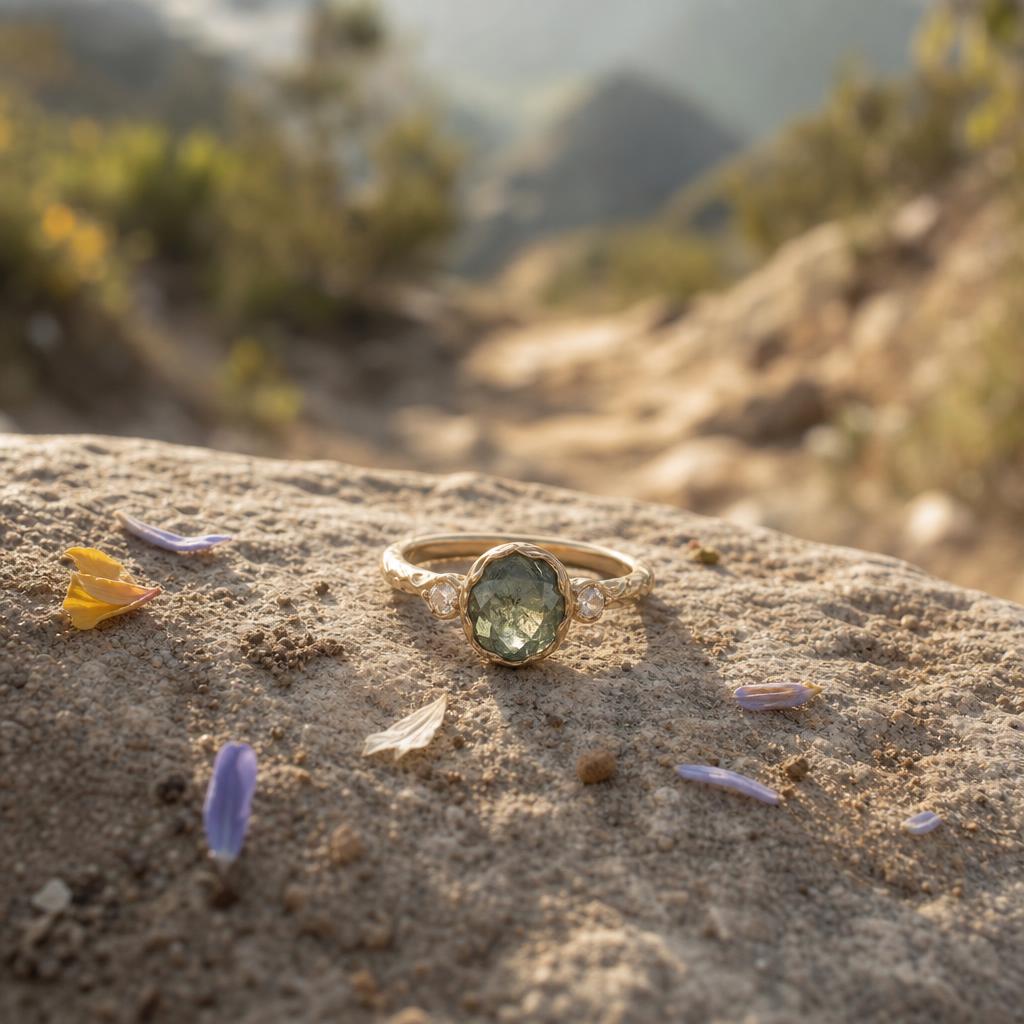
Wearing a Ring on the Trail: When It's Fine, and When to Use a Travel Ring
Somewhere around mile four, the light hits your hand a certain way and you notice it: your ring, catching the sun on a granite ledge, and a small, nagging thought right behind it — should this even be out here?
It's a fair question, and most ring-care guides answer it with a flat "just take it off," which is true exactly some of the time and unhelpfully vague the rest. Here's the honest, specific version — plus four rings built for exactly this kind of life.


Hiking is harder on a ring than most activities give it credit for
Hiking doesn't look dangerous for jewelry the way, say, rock climbing obviously does. There's no single dramatic moment where you'd think to take a ring off. Instead there's a slow accumulation of small stressors: gripping trekking poles and rock scrambles that press a band into hard surfaces, sunscreen and bug spray that build up a film around a setting, sweat and heat that make fingers swell on a climb and shrink again on the descent, stream crossings and sudden rain that leave a ring wet inside a glove for hours. None of it is catastrophic on its own. All of it adds up over a full-day trail.
The other factor is distance from help. Losing a ring in a parking lot is annoying. Losing one three miles into a backcountry loop, off-trail, with no cell signal, is a genuinely different problem — you're searching loose gravel and leaf litter with your hands, not calling a jeweler. That distance is really what should shape the decision, more than the hike's difficulty rating.
When you shouldn't wear a ring on the trail
There's a short, specific list where the answer is simply: leave it at home. Bouldering, scrambling, or any route where you're grabbing rock with bare hands — a ring can catch on an edge before you even register the movement. Glacier or snow travel where gloves come on and off constantly, since a ring is one of the easiest things to drop while stripping a glove at altitude. Anything involving deep water crossings or swimming holes, where cold water causes fingers to shrink fast. And multi-day backcountry trips with no reliable way to search if something slips off in the dark at camp.
None of this is really about the ring being fragile. A well-made ring in a secure setting can survive plenty. It's about the odds of it coming off unnoticed, and how hard it would be to get back if it did.
When it's actually fine to wear a ring hiking
For an established day-hike trail, moderate difficulty, no scrambling — most rings are genuinely fine. The setting matters more than the activity. A bezel setting, where a thin rim of metal wraps the stone's edge instead of thin prongs holding it up, is the most trail-friendly option available: nothing proud of the band to snag on a branch or a pack strap, and the stone itself is protected on all sides rather than exposed at the top.

Cherish Ring
A full band of bezel-set stones, each one sitting flush and fully rimmed in sterling silver. No exposed prongs, nothing to catch — just secure, low-profile sparkle built for a full day of movement.
Shop Cherish Ring →A classic four-prong solitaire is the next best option — fewer contact points than a pavé or halo setting means fewer places for dirt and grit to collect, and a well-set center stone sits securely without extra metalwork around it to bend or loosen. If your everyday ring is heavily pavéd or has a raised halo, that's the style worth reconsidering for trail days specifically, not retiring altogether — just maybe not the one you reach for on a scramble-heavy route.
The smarter move: a second ring built for the trail
Here's the part most guides skip: you don't actually have to choose between "wear your good ring and worry" and "leave your hand bare." The simplest fix is keeping a travel ring — a second ring, set in the same sterling silver and simulated diamond or moissanite Gemiros uses everywhere, that you wear specifically for hiking, travel, and anything with real risk of loss or damage.
The logic is straightforward. If your engagement ring or heirloom piece represents real irreplaceable value — sentimental or otherwise — there's no upside to exposing it to granite, sunscreen residue, and a six-mile round trip. A dedicated ring for the trail looks every bit as sharp in every photo, passes a glance from anyone on the trail with you, and if it does get scratched on a rock scramble or slips off during a stream crossing, it's a shrug instead of a crisis. That's the entire point of building a small hiking-and-travel rotation into your jewelry box: it removes the anxiety from the equation without removing the sparkle.

Eternity Ring
A full circle of pavé brilliance in a flush, low-profile band — nothing raised to catch on a pack strap or trekking pole grip. Easy to wear alone or stacked, and easy to not think twice about on a trail.
Shop Eternity Ring →Does the sparkle actually hold up outdoors?
This is usually the real hesitation underneath the practical question: will a simulated diamond or moissanite ring start looking dull or cheap after a season of actual outdoor wear? The honest answer is that the stones are the least of your worries. Moissanite in particular ranks just below diamond on the Mohs hardness scale, which means everyday trail contact — rock, dust, pack straps, trekking poles — has essentially nothing on it that can scratch the surface. The one thing that scratches moissanite is another diamond, not granite.
The metal is the part that actually experiences a hike. Every Gemiros ring is built on a 925 sterling silver base with rhodium, 18k gold, or rose gold plating, and it's hypoallergenic and nickel-free — meaning sweat and heat won't irritate skin the way some cheaper alloys do on a long, hot climb. Sterling silver doesn't tarnish from sun or trail dust the way it can from certain lotions or chlorinated water, so a rinse and a soft cloth after a dusty hike is genuinely enough maintenance. None of this is a hedge or a caveat — it's simply what the materials are built to do, on a trail or anywhere else.
Trail-tested habits, not paranoia
A few small habits do more for a ring's longevity than any setting choice ever will:
- Apply sunscreen and bug spray before putting the ring on, not after — both leave a film that dulls sparkle over a full day.
- If your hands swell noticeably on a hot climb, take the ring off before it gets tight rather than after — a zippered pocket or a small carabiner pouch works better than a pants pocket.
- Rinse with plain water and pat dry after a sweaty or dusty hike; save the deeper clean for when you're home.
- Know your size before you buy — Gemiros rings run in whole US sizes with no resizing service, so getting it right up front matters more for a ring you'll actually wear on the move.
- For anything involving bare-hand rock contact, gloves coming on and off, or open water, take it off and clip it somewhere secure. Every time, no exceptions.
Quick Takeaways
- Most day hikes are genuinely fine for a well-set ring — the setting matters more than the trail difficulty.
- Bezel and simple four-prong solitaires are the most trail-friendly settings; heavy pavé and raised halos are the ones to reconsider for scramble-heavy days.
- Skip the ring entirely for bouldering, glacier travel, deep water crossings, or remote backcountry trips.
- A dedicated travel ring removes the anxiety from hiking with jewelry without removing the sparkle.
- Moissanite and simulated diamonds are more than hard enough for trail wear — sterling silver, not the stone, is what actually needs the light care.
Frequently Asked Questions
What's the actual point of keeping a separate travel ring?
It lets you wear something that looks and photographs exactly like your everyday ring without exposing the one with real sentimental or financial weight to trail conditions, airport security lines, or hotel bathroom sinks. If it gets scuffed on a granite scramble, it's a non-event.
When should you actually take your ring off before a hike?
Before anything involving bare-hand rock contact (bouldering, scrambling), glacier or snow travel where gloves come on and off, deep water crossings, or a remote multi-day route with no realistic way to search if it slips off. For a standard day hike on a maintained trail, most secure settings are fine to leave on.
Can you wear your engagement ring 24/7, including on trips like this?
Plenty of people do, and a secure setting in sterling silver holds up to daily life well. The exceptions are activities with a real, specific risk — heavy manual work, swimming, contact sports, and higher-risk hikes — where taking it off for a few hours is a small trade for peace of mind.
Will a ring cause problems at airport security on the way to the trailhead?
No — rings, including metal bands, do not typically trigger walk-through metal detectors or require removal at TSA checkpoints. It's jewelry with bulk or an underwire-style construction that occasionally draws a second look, not a standard band.
Does moissanite scratch or get damaged from regular outdoor wear?
Not from anything you'll encounter on a trail. Moissanite sits just below diamond in hardness, so dust, rock, and pack straps don't leave a mark. The only material hard enough to scratch it is another diamond — trail conditions simply aren't in that category.
The short version: most hikes don't require you to choose between wearing your ring and protecting it. Know the handful of situations where it's genuinely safer to leave it behind, pick a setting built for movement on the days you do wear it, and keep a dedicated second ring in rotation for the trips where the stakes feel a little higher. That's not a compromise — it's just a smarter way to wear what you already love.


