

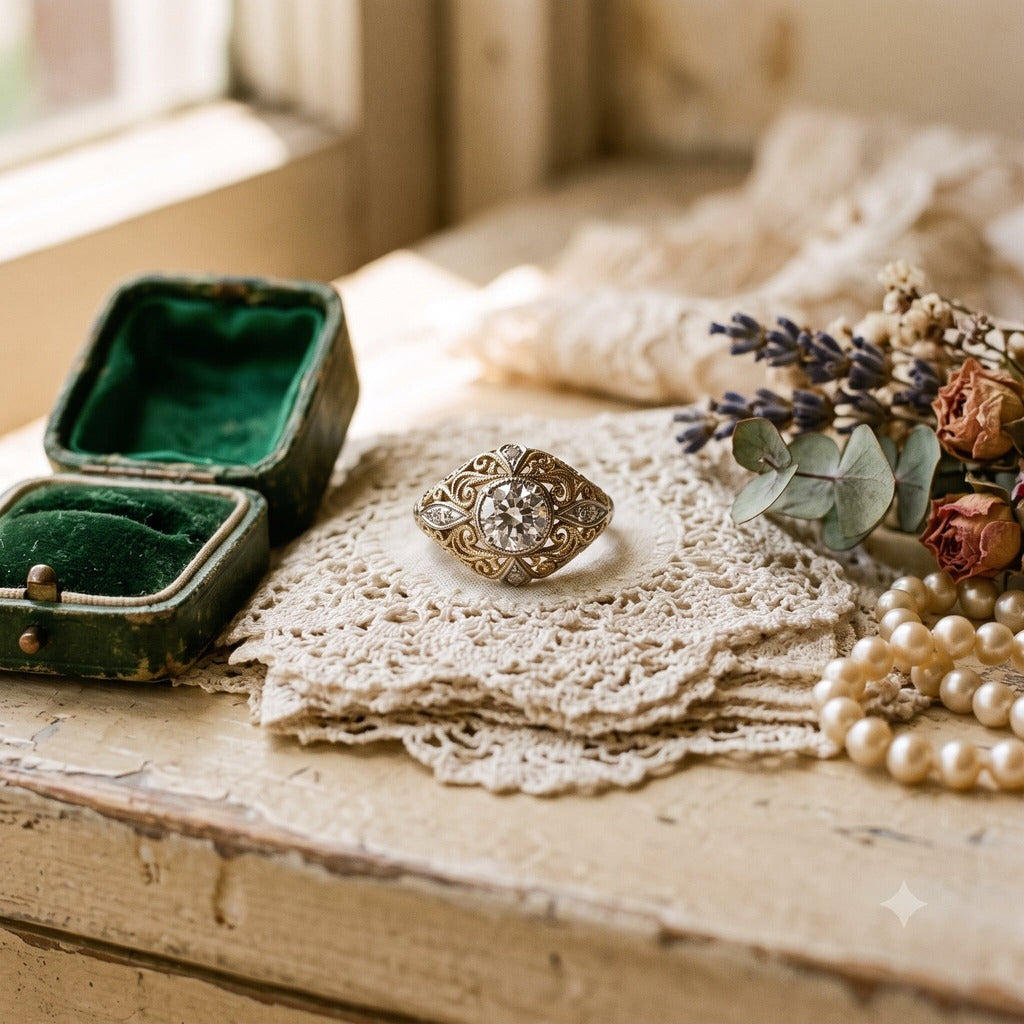
Vintage Inspired Engagement Rings: What the Label Actually Means
Search "vintage inspired engagement rings" and you'll get thousands of results — filigree bands, hidden halos, dainty milgrain edges. Search "vintage engagement rings" without the word "inspired," and you land somewhere else entirely: estate listings, appraisals, a ring that already belonged to someone else. Two words apart, and the products aren't even in the same category. If you've been shopping either term without knowing which one you actually want, that confusion is worth clearing up before you spend anything.
The distinction isn't a marketing technicality. It's a real difference in what you're buying, what it costs to make, and what you can reasonably expect from it. Once you know what separates the two, the label on a ring listing stops being confusing and starts being useful.


What "Vintage Inspired" Actually Means
A vintage inspired ring is built new, today, using design details borrowed from a specific era — usually Victorian, Edwardian, or Art Deco. Milgrain edging, filigree scrollwork, cushion and marquise cuts, a halo of smaller stones framing a center stone: these are the visual signatures of periods that ended decades before the ring in front of you was ever made. The construction, the materials, and the sizing are entirely modern. Only the styling looks backward.
That's a meaningful difference from an actually vintage ring, which is a genuine antique or estate piece — an object that was made, worn, and often resized more than once before it reached a resale listing. Its condition, its history, and its price all trace back to that single, non-repeatable ring.
Why the Two Get Confused
Part of the confusion is deliberate: plenty of sellers use "vintage" loosely to describe anything with an old-world look, whether or not the piece is actually old. Part of it is genuine ambiguity in how the word works in English — vintage can describe an era, or it can describe an object that literally comes from one. A vintage-inspired engagement ring built around milgrain, floral details, and Art Deco lines is doing the first. An estate jeweler's inventory is doing the second. Neither one is lying to you — but only one of them is telling you the ring's actual age.
The Design Details That Signal "Vintage" — Without Being Old
If a ring reads as vintage inspired, it's almost always because of a handful of repeatable design choices, not because of its actual age:
- Milgrain edging — a row of tiny beaded detail along the edge of a band or setting, originally a hand-engraving technique now reproduced with precision tooling.
- Filigree and scrollwork — open, lace-like metalwork that references Edwardian and Art Deco design without requiring hand-forging.
- Halo settings — a ring of smaller stones surrounding a center stone, a style that became iconic in the 1920s and has never really left.
- Twisted and split-shank bands — a band that curves or divides around the center stone, a detail with roots in early-20th-century design.
None of these require the ring to actually be old. They're a visual vocabulary — and once you can read it, you can tell at a glance whether a listing is selling you the look or selling you the object.

The Harlow Ring
An emerald-cut center stone set inside a halo — the kind of elevated, old-world silhouette that reads as vintage the moment you see it, built new in 925 sterling silver.
Shop The Harlow Ring →Worth knowing: "Old European cut" and "old mine cut" are two of the stone cuts most associated with genuine antique rings. Reproducing that exact facet pattern is possible, but most vintage inspired rings use a modern brilliant or step cut instead — the setting carries the vintage cues, not the cut of the stone itself.
Vintage Inspired vs. Actually Vintage: A Side-by-Side Look
| Detail | Vintage Inspired | Actually Vintage |
|---|---|---|
| Age | Made new, today | Decades old, often 50–100+ years |
| Sizing | Standard modern sizing | Fixed to its original size; resizing can be limited |
| Condition | Consistent, unworn | Variable — prior wear, repairs, resizing |
| Stone cut | Modern brilliant or step cut | Often an old European or old mine cut |
| Price logic | Tied to materials and craftsmanship | Tied to rarity, provenance, and condition |
| Warranty | Manufacturer-backed | Rarely applicable — sold as is |
Why a Vintage Inspired Ring Often Makes More Sense
An actually vintage ring comes with real romance — a genuine sense of history that a new ring can't manufacture. But it also comes with real limits. You're buying one specific, non-repeatable object, sized for one specific person, in whatever condition a century of wear left it in. If it's a half size too small, that's not a quick exchange; it's a resizing job on a ring that may not tolerate one gracefully.
A vintage inspired ring sidesteps all of that. It's made to order in standard sizing, in consistent condition, backed by an actual warranty. You get the milgrain, the halo, the twisted band — the entire visual language of a bygone era — without inheriting the fragility, the guesswork, or the one-of-one sizing problem that comes with the genuine article.
Reading a Vintage Inspired Listing Correctly
A simple vintage engagement ring — clean lines, a single row of milgrain, no elaborate scrollwork — reads as effortless rather than overdone, which is exactly the point: the goal was never to convince anyone the ring is a century old. It's to borrow a design language that's stood the test of time and wear it on a modern hand. That's a different promise than an antique dealer is making, and it's worth knowing which promise you're actually buying before the ring shows up.
Look for how a listing describes its stones. Gemiros' own moissanite and simulated diamonds are indistinguishable from a diamond to the naked eye and pass diamond testers — a claim that stands on its own regardless of the setting around it. That's a separate question from whether the style is vintage inspired or true antique, and a listing that's honest about one should be just as honest about the other.

The Beloved Ring
A pavé eternity band with an old-world sense of detail, built for daily stacking rather than careful, once-a-year wear.
Shop The Beloved Ring →For the Woman Choosing Between the Two
If what you actually want is a specific, one-of-a-kind object with a documented past, an antique dealer is the right place to look — that's a genuine category, and it isn't what this article is arguing against. But if what you want is the look of that era on a ring you can wear every day without worrying about its history or its structural limits, a newly made ring in that style is the more rational choice, not a lesser one. You're choosing the version of "vintage" that was actually built for the life you're going to live in it.
For a dainty vintage engagement ring, look for narrow bands with restrained milgrain rather than a wide, heavily ornamented setting — the detail should read as intentional, not busy.
That's the version of the style that suits a self-purchasing buyer best: noticeable up close, understated from across the room, and built for a hand that wears it daily rather than a display case.
The look of a century-old design language, made with today's materials, today's sizing, and today's warranty — that's exactly what vintage modern engagement rings were invented to be. It isn't a compromise between old and new. It's the more useful version of both.
Quick Takeaways
- "Vintage inspired" means new construction with old-era design details — not an old ring.
- Milgrain, filigree, halo settings, and twisted bands are the visual cues that signal the style.
- Actually vintage rings are one-of-a-kind, fixed to their original size, and sold with no warranty.
- A vintage inspired ring gets you the aesthetic with modern sizing, consistent condition, and manufacturer backing.
Frequently Asked Questions
What does "vintage inspired" actually mean on a ring listing?
It means the ring was made recently using design details — milgrain, filigree, halo settings, period-style cuts — associated with an earlier era. The ring itself is new; only the aesthetic references the past.
Is a vintage inspired ring cheaper than an actually vintage one?
Usually, yes, though the comparison isn't quite apples to apples. A genuine antique's price is driven by rarity, condition, and provenance — factors that have nothing to do with how the ring looks and everything to do with the fact that only one of it exists. A vintage inspired ring is priced on its materials and craftsmanship instead, which tends to land far lower for a comparable look. It's also why affordable vintage engagement rings almost always turn out to mean the vintage-inspired kind — the genuinely old alternative is priced on scarcity, not on what it actually costs to make.
What's the most popular vintage-inspired style right now?
Art Deco detailing — clean geometric lines, milgrain edges, and elongated shapes like marquise and radiant cuts — remains the most requested vintage-inspired look, alongside the halo settings that trace back to the same period.
Can a vintage inspired ring be resized later?
Because it's made in standard sizing rather than as a single fixed object, ordering the correct size upfront matters — a benefit an antique piece, with its own resizing limits, usually can't offer to begin with.
Are simple, vintage-inspired rings a good choice for everyday wear?
Yes — a restrained vintage-inspired design (a single row of milgrain, a modest halo) tends to hold up better to daily wear than an elaborate antique setting, simply because it was engineered with modern daily use in mind rather than a century of careful, occasional wear.
The word "vintage" was never going to stop doing double duty — it's too useful a shorthand for a look everyone recognizes. But now that you know which promise each listing is actually making, you can shop the aesthetic you want without confusing it for a different product entirely. That's not a technicality. That's the whole difference between getting exactly what you wanted and being surprised by what showed up.


