

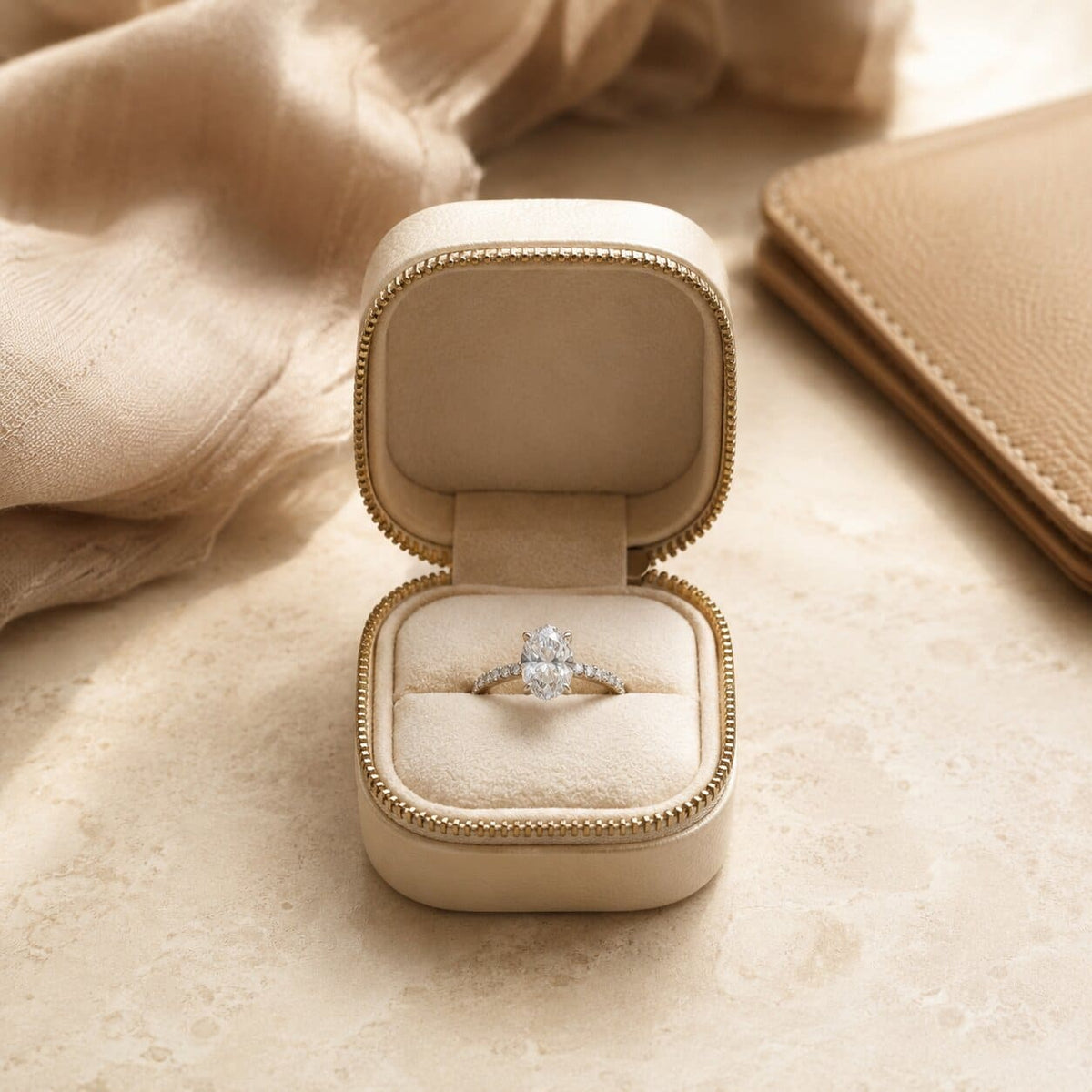
The Travel Ring Is One of the Smartest Jewelry Decisions You Can Make
There's a particular kind of dread that comes with realizing you have to decide, again, whether your real ring is coming with you. To the beach. To the trailhead. To the country whose customs forms you haven't quite finished reading. Most women make this decision by instinct — leave it in the safe, wear nothing, and spend the trip feeling slightly undressed. There's a third option, and it's the one nobody explains clearly enough: bring a ring that looks exactly like the one you love, and let the real one stay home where it belongs.
That's the entire idea behind a travel ring — a simulated diamond stand-in, cut and set to match the silhouette you already wear, so the switch is invisible to everyone except you. It sounds like a small trick. In practice, it quietly removes one of the more persistent low-grade anxieties of travel.


What a Travel Ring Actually Is (and Isn't)
A travel ring is not a lesser ring. That distinction matters, because the word "dupe" tends to carry a whiff of compromise, and there's nothing compromised about a well-cut simulated diamond in the same shape, size, and setting style as the ring it's standing in for. The goal isn't to fool a jeweler with a loupe. It's to fool a casual glance — a hotel housekeeper, a stranger on a beach, a pickpocket sizing up easy marks — into seeing exactly what they'd see on your hand at home.
The best travel rings are chosen deliberately: same general cut, same approximate size, same metal tone, sometimes even the same setting style, so the ring reads as "your ring" rather than "a ring." Get that matching right and the switch becomes something only you know about. Get it wrong — a completely different silhouette, an obviously costume-grade stone — and it stops doing its job.
The Case for Owning One
It's insurance you never have to file a claim for
Every frequent traveler eventually has the same realization: insurance covers a ring after it's gone, not before. A travel ring works differently. It removes the loss from the list of things that can happen in the first place. No claim, no waiting period, no arguing with an adjuster about sentimental value — because the ring that's actually at risk was never in the room.
Worth knowing: Hotel safes are convenient, but they're not vaults — a determined thief with time and a hotel's default code list can open a surprising number of them. A travel ring makes that scenario a non-event.
One less decision at security, at the pool, at the trailhead
Airport security, beach sand, chlorine, sunscreen, a sudden hike up something steeper than expected — a real engagement ring interacts badly with almost all of it. Prongs catch on gear. Cold metal detectors flag rings that should probably have come off anyway. A travel ring lets you stop mentally tracking the ring through every activity of the day, because if it slips off in the ocean, comes loose on a rock scramble, or gets left behind at a spa, it's a genuinely replaceable loss instead of an irreplaceable one.
Sparkle without the stress
There's a specific kind of vacation photo where a woman is smiling at the camera while some part of her brain is doing an inventory check on her left hand. A travel ring quiets that. You can wear something that photographs beautifully, catches the light at dinner, and looks exactly like your engagement ring in every picture — without spending the trip in low-grade vigilance mode.

The Morgan Ring
A princess-cut simulated diamond set on a pavé band — sharp, architectural lines that photograph beautifully and read as unmistakably "real" from across a room.
Shop The Morgan Ring →It's not a downgrade — it's a strategy
The women who travel with a dupe ring aren't settling. They've simply run the math: a ring that costs a fraction of the original, that looks convincingly like the real thing in every practical setting, is a smarter travel companion than the one piece of jewelry you'd genuinely mourn losing. Frame it that way and the decision stops feeling like a concession and starts feeling like the obviously correct call it actually is.
When a Travel Ring Actually Earns Its Keep
Not every trip needs one — a weekend an hour from home with your ring rarely leaving your hand is a different situation than the ones below, where a travel ring consistently proves its worth:
- Beach and pool vacations — sand, saltwater, sunscreen, and constant removal-and-reapplication of a ring you're not tracking
- Honeymoons and destination weddings — high visibility, high photo count, unfamiliar hotel rooms and safes
- Backpacking and budget travel — hostels, shared rooms, less predictable security than a hotel
- Business trips — packed schedules, unfamiliar cities, less attention to spare for jewelry logistics
- Outdoor and adventure travel — hiking, water sports, anything where a ring might need to come off entirely and get set down somewhere
- Any trip through multiple countries — more transit points, more hotel rooms, more chances for something to go missing
The common thread isn't the destination — it's the amount of unfamiliar handling, movement, and exposure the ring goes through. The more variables in a trip, the stronger the case for a stand-in.
How to Choose the Right Travel Ring for You
The matching is what makes a travel ring convincing, and it's worth doing properly rather than grabbing whatever's closest in price. A few things to get right:
Match the silhouette, not just the carat look
If your engagement ring is an oval solitaire, the closest convincing stand-in is another oval solitaire — not a halo, not a cushion cut, not a completely different setting that happens to be roughly the same size. The shape of the stone is what people register first, even at a glance.
Match the metal tone
A rose gold original next to a stark white travel ring reads as obviously different, even to someone not looking closely. Rose gold, yellow gold, or classic white metal — keep the tone consistent with what you actually wear.
Size it properly
A travel ring that's loose enough to spin or tight enough to leave a mark defeats the purpose within the first hour. Size it the same way you'd size any ring you plan to wear daily for the length of a trip.

The Astrid Ring
An asscher-cut center stone flanked by baguette side stones — a step-cut silhouette with clean architectural lines that reads as distinctly high-end, even from across a beach club.
Shop The Astrid Ring →Caring for a Travel Ring on the Road
Part of what makes a travel ring so low-stress is that it needs far less babying than the real thing. A quick rinse after saltwater or pool exposure, a soft cloth wipe before it goes back in its case, and keeping it away from harsh chemicals like chlorine tablets or perfume sprayed directly onto it will keep it looking sharp for the length of any trip — and for plenty of trips after that.
✦ Pro tip: Pack it in a small, padded case rather than loose in a toiletry bag — the same habit that protects fine jewelry works just as well here, and it means you'll actually know where it is at 6am on checkout day.
Quick Takeaways
- A travel ring is a matched simulated diamond stand-in — same silhouette, same metal tone, same approximate size as your real ring
- It removes the risk of loss or theft before it can happen, rather than covering it after the fact
- It's most useful on beach trips, honeymoons, backpacking, business travel, and any multi-stop itinerary
- Matching the shape and metal tone closely is what makes the switch convincing
- Care is minimal — a rinse, a soft cloth, and a padded case are usually all it needs
Frequently Asked Questions
Will people be able to tell my travel ring isn't my real engagement ring?
Not at a casual glance, which is the point. A well-matched simulated diamond in the same cut, setting style, and metal tone reads as "your ring" to anyone not examining it under a loupe — which covers essentially every situation a travel ring is designed for.
Do I need to buy a travel ring that's an exact replica of my engagement ring?
It doesn't need to be identical — it needs to be close enough in shape, size, and metal tone that it reads as the same ring from a normal viewing distance. Matching the general silhouette matters more than matching every design detail.
Is it worth buying a travel ring if I only travel once or twice a year?
Even occasional travelers benefit — the risk a travel ring is protecting against (loss, theft, damage) doesn't scale down with frequency. One beach vacation is enough exposure to make the case for a stand-in.
Can I wear my travel ring for everyday occasions too, not just trips?
Many women do. A convincing travel ring works just as well for the gym, swimming, or any day-to-day activity where you'd rather not risk the real thing — the "travel" label just describes its main use case, not its only one.
None of this is about pretending your real ring doesn't matter — if anything, it's the opposite. A travel ring is what you buy because the original is worth protecting properly, and the smartest way to protect something is to stop putting it in situations where protecting it is even a question. Pack it, wear it, forget about it for the length of the trip. That's the entire promise, and it's a good one.


