

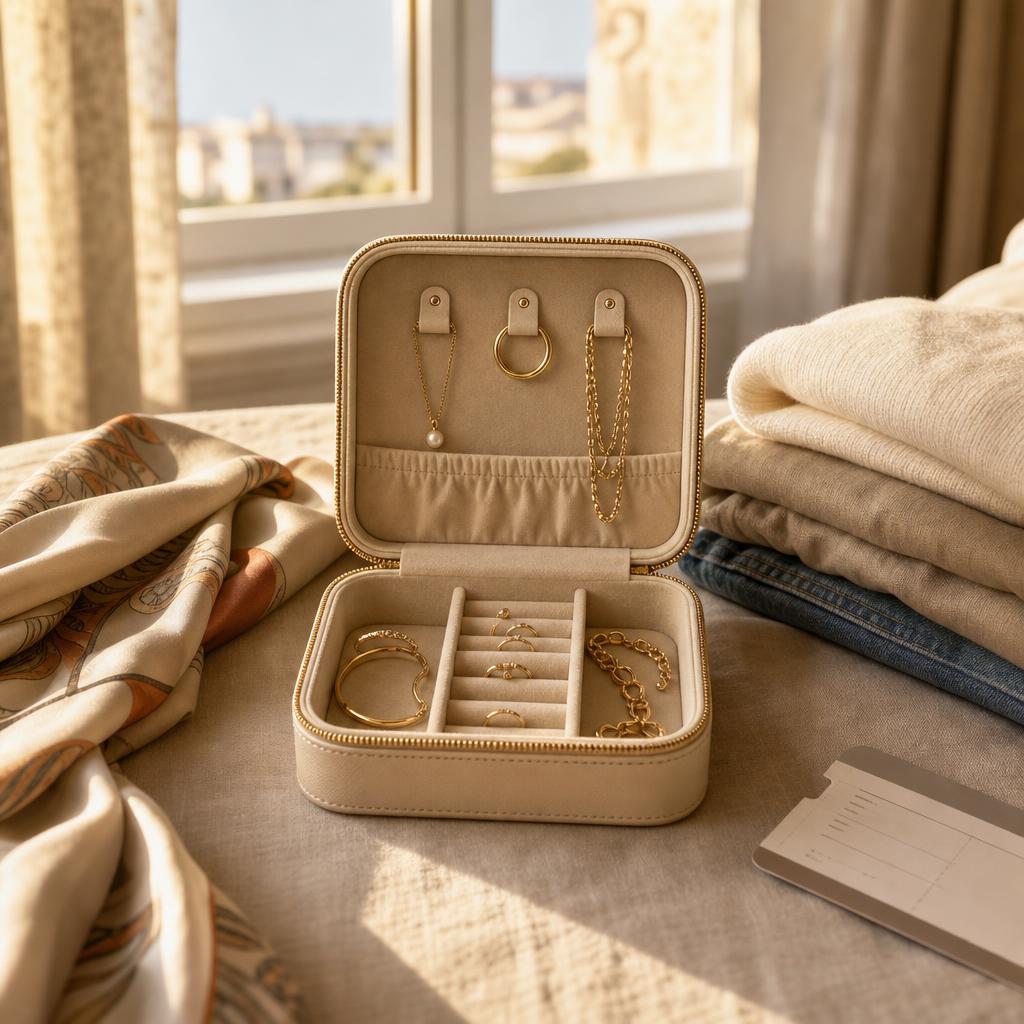
The Woman Who Wears a Travel Ring: A Profile in Smart, Intentional Style
She has two rings for one relationship with jewelry: the one she wears every day, and the one she packs. Not because the first isn't precious — because it is, and precious things don't belong in a hotel safe she has to trust a stranger cleaned around. The woman who travels with a second ring isn't downgrading anything. She's the one who already did the math the rest of the room hasn't gotten to yet.
That math is simple: a beach, a pool, a cobblestone street in a country where she doesn't speak the language, and one ring she'd never forgive herself for losing. So she doesn't bring it. She brings this instead — and she doesn't think twice about it once she's packed.


What Is a Travel Ring, Really?
A travel ring is exactly what it sounds like: a second ring, built to look like the one you actually wear, that comes with you when the real one shouldn't. It's 925 sterling silver set with moissanite or cubic zirconia, cut and set to read exactly like the ring it's standing in for — indistinguishable at a glance, and to most jewelers too. Same silhouette, same shine, same reaction from the stranger at the pool bar who compliments it. The only difference is what happens if it goes missing, which — because it costs a fraction of the real thing — is nothing more than a bad afternoon instead of a five-figure loss.
The idea isn't new. It's just newly named. Women have been leaving good jewelry at home for decades; this just gives that instinct a shape you can actually shop for.
The Smart Woman's Case for a Second Ring
Here's what actually separates the women who own one from the women who still travel with their real ring and just quietly worry the whole trip: she's decided her enjoyment of the vacation matters more than proving a point about what her ring "really" is. She's not less attached to her jewelry. She's more clear-eyed about it. She knows a ring sitting in a hotel safe isn't doing its job anyway — a ring's job is to be worn — so she'd rather wear something built for the version of her life that involves saltwater, sunscreen, and airport security lines, and save the original for the version that doesn't.
This is the same instinct that makes her check three prices before she checks out and ask why a markup exists before she pays it. She isn't unsentimental. She's just refused to let sentiment talk her into a bad decision twice in one week — once at the jewelry counter, once at baggage claim.

The Soleil Ring
A 6-prong round solitaire with a half pavé band — the kind of clean, classic silhouette that reads as "your ring" from across a restaurant table, without a single detail that needs babying on the road.
Shop The Soleil Ring →What It's Actually Made Of — And Why That Matters
Most options built for travel lean on the same two materials for a reason: cubic zirconia and moissanite are the only ones that hold up to what a trip actually involves. Moissanite sits just below diamond on the hardness scale, which means pool chemicals, sand, and sunscreen residue don't degrade it the way they'd degrade a softer stone. Cubic zirconia won't cloud or dull with normal wear either. Both are cut to the same proportions as a mined diamond, which is why they catch light the same way and why, to the eye — and to a diamond tester — there's nothing "almost" about the sparkle.
The metal matters just as much as the stone. A sterling silver travel engagement ring holds its polish through humidity, chlorine, and the kind of temperature swings a single day of travel can put a ring through, and it does it without the coating wearing thin the way a cheap plate does after one beach week. It's hypoallergenic and nickel-free, so it's one less thing to think about on a trip where you're already thinking about everything else. This isn't a compromise version of fine jewelry. It's a different, smarter set of materials, chosen on purpose for a life that leaves the house.
Worth knowing: A well-made second ring isn't sized differently from your everyday one — order your true size, since heat and humidity can make fingers swell slightly on a trip, the same way they would with any ring you already own.

The Stella Ring
A round solitaire in a secure 4-prong setting, sterling silver throughout — the kind of quiet, confident ring that doesn't ask to be noticed and doesn't flinch at a full week of wear.
Shop The Stella Ring →Getting It Through Security, Instead of Guessing
Part of what makes this decision "smart" rather than just "practical" is that it removes an entire category of low-grade anxiety from a trip. Wondering how to travel with an engagement ring — whether to wear it through the metal detector, whether to bury it in a carry-on, whether the hotel safe is really secure — is a small tax on every vacation a real ring goes on. A second ring erases the question entirely. There's no TSA concern (precious metals don't set off detectors either way, but she's not thinking about that anymore), no hotel-safe calculation, and no version of the trip where a missing ring turns into a missing five figures.
It also solves a quieter problem: the version of a vacation where you spend it not fully present because part of your brain is doing inventory. She'd rather be looking at the view.
How She Chooses Hers
The woman who does this well isn't buying the first cheap ring she finds — she's choosing one that actually looks like hers, in a setting and cut close enough to her real ring that the swap is invisible to everyone but her. That's the difference between a second ring that earns its place and one that just sits in a drawer after the first trip: it has to look like something she'd actually choose, not just something cheap enough to risk losing. She checks the setting, the metal, the way the stone is cut — the same instincts she used the first time, applied to a second, smarter purchase.
And once she owns one, something interesting happens: she starts reaching for it on days that have nothing to do with travel at all. Gym days. Gardening days. The days she'd rather not think about her ring at all. The habit stops being a trip accessory and becomes a second, entirely legitimate way of wearing what she loves — proof that the "real" ring was never the only ring allowed to matter.
Quick Takeaways
- A second ring, done right, matches your real one's silhouette exactly — 925 sterling silver, moissanite or cubic zirconia — not a lesser version of fine jewelry.
- Moissanite and CZ are cut to diamond proportions and hold up to sand, chlorine, and sunscreen — nothing about the sparkle reads as "almost."
- Order your true size; heat and humidity can cause the same mild swelling any ring would experience while traveling.
- Precious metals don't trigger metal detectors, so there's no security hurdle either way — but wearing a second ring removes the anxiety of the question entirely.
- The best ones get worn well beyond the trip — on gym days, errands, and anywhere the real ring would rather stay home.
Frequently Asked Questions
What is the point of a travel ring?
It lets you keep wearing something that looks and feels like your real ring during activities and environments — beaches, pools, unfamiliar cities — where losing or damaging the original would be a real financial and emotional cost. It's a second ring built for a different set of situations, not a lesser version of the first.
Is a second ring actually cheaper than the one it's replacing?
Yes, significantly — that's the entire point. A moissanite or cubic zirconia ring in sterling silver costs a fraction of a mined-diamond piece while matching its look and proportions closely enough that the difference is invisible to anyone but you.
Will a ring set off metal detectors at airport security?
No. Precious metals and simulated stones don't trigger metal detectors, so you can wear any ring through security without removing it. The bigger reason travelers switch to a second ring is peace of mind around loss and theft during the trip itself, not airport screening.
Is sterling silver good enough for a ring you'll wear daily on a trip?
Yes. 925 sterling silver is hypoallergenic, nickel-free, and holds its polish well through humidity and temperature changes. It's a genuinely durable, everyday-appropriate metal — not a placeholder until you can afford something "real."
How does wearing a second ring actually work day to day?
You wear it in place of your regular ring for the length of the trip, then switch back once you're home — the same way you might wear a different pair of shoes for a hike than you would for dinner. It's not a permanent swap, just the right tool for a specific set of days.
She isn't apologizing for any of it — not the second ring, not the reason she bought it, not the version of herself that would rather enjoy a vacation than babysit a safe. She figured out the smarter way to travel with something she loves a long time ago. Everyone else is still catching up.


