

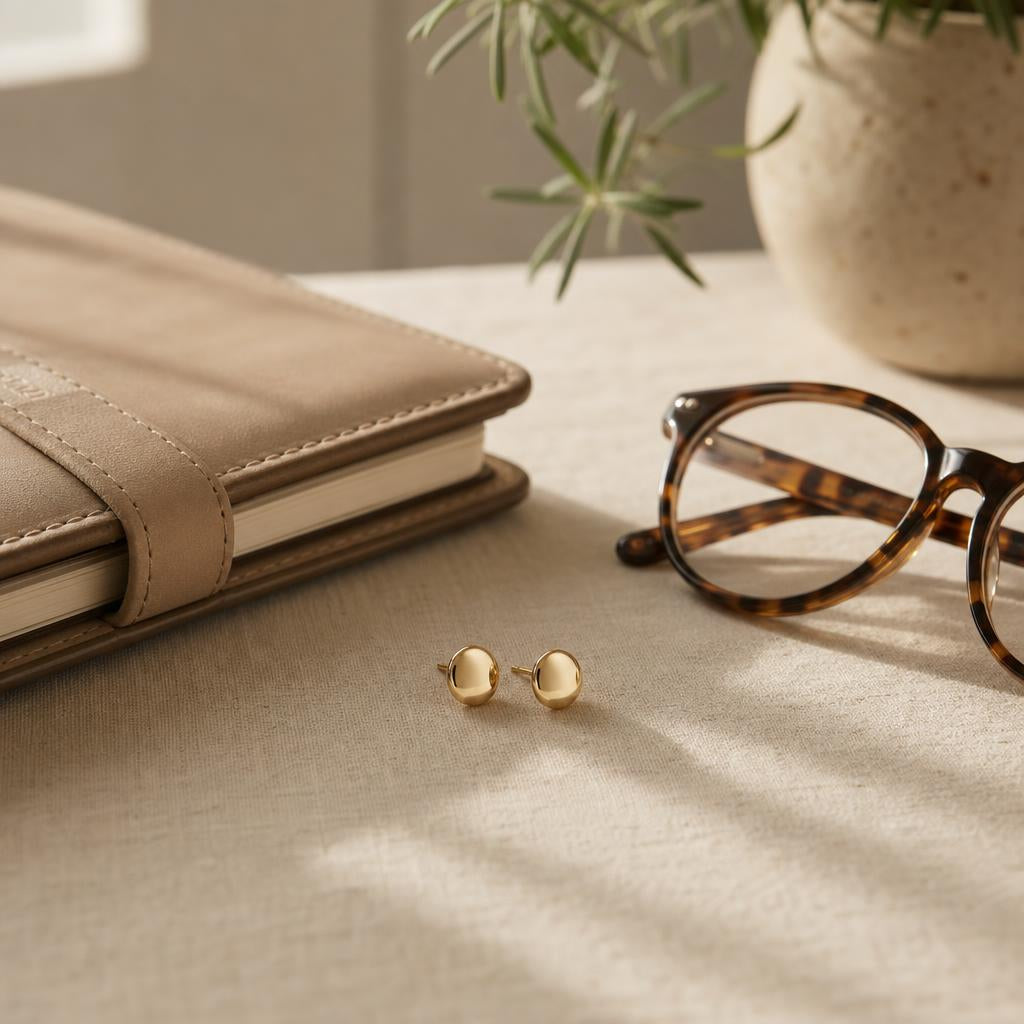
Stud Earrings for Work: What Actually Reads as Polished, Not Distracting
There is a version of you that shows up to the 9am stand-up, the client call, the performance review — and she is not wearing the earrings you save for dinner. She is not wearing nothing, either. She has figured out the narrow, specific category of jewelry that reads as put-together without asking anyone in the room to think about it twice, and she got there by trial, error, and one too many earrings that looked delicate on the hanger and enormous under fluorescent light.
That category is smaller than most style guides admit. It is not "anything gold" or "anything small." It is a short list of shapes, sizes, and settings that hold up across a full day of meetings, a laptop camera, and a walk from the parking garage — and it starts, almost always, with a stud.


What "Work-Appropriate" Actually Means in an Earring
Most advice about office jewelry stops at "keep it simple," which is true and also not particularly useful. Simple doesn't tell you what to buy. What actually separates a pair of stud earrings for work from a pair that reads as evening wear comes down to three specific things: size, setting, and how the stone catches light.
Size is the obvious one. Studs sitting between 4mm and 7mm read as intentional rather than accidental — small enough that no one in a video call is distracted by them, large enough that they don't disappear entirely. Anything past that starts moving into statement territory, which has its place, just not usually on a Tuesday.
Setting matters more than most people expect. A prong setting like the Stella's lets light hit the stone from every angle, so it reads as brilliant rather than flashy — the sparkle looks like it belongs there, not like it's trying to announce something. A bezel setting, where a rim of metal wraps the stone, does the opposite: it mutes the sparkle into something closer to a soft glow. That's the entire idea behind the Aria — same brilliance underneath, dialed down for a room that rewards understatement.
And then there's how the stone actually catches light, which is where the fear usually lives. A stone that flashes rainbow color under office fluorescents can pull focus from across a conference table — not because it's lower quality, but because uncontrolled fire draws the eye in a way that feels loud. A well-cut simulated diamond or moissanite stud does the opposite: it throws clean, white brilliance rather than scattered color, which is exactly why it holds up under the worst lighting a building has to offer.
Worth knowing: Moissanite is famous for a rainbow flash in direct sunlight, but that effect is far less pronounced under indoor fluorescent lighting — which is one reason a well-cut moissanite stud, like the Éclat, reads as clean and professional at a desk rather than "look at me."
The Fear Nobody Says Out Loud
Underneath every question about office-appropriate jewelry is a smaller, more specific worry: will someone notice, and will it matter if they do. It's not really about the earrings. It's about being asked a question you don't want to answer at your desk.
Here's the actual answer: a well-made stud in 925 sterling silver with a properly cut moissanite or simulated diamond center is indistinguishable from a diamond stud to the naked eye — including to the colleague standing three feet away at the coffee machine. It passes diamond testers. No one is going to clock it, because there's nothing to clock. The stone does exactly what a diamond does under office light: it sparkles clean, sits flush, and holds its shape through a ten-hour day.
That's a different promise than "it looks close enough." It's the difference between hoping no one looks too hard and knowing it doesn't matter if they do.
Building a Small Rotation, Not One Perfect Pair
The woman who has this figured out rarely owns just one pair of work studs. She owns two or three, each doing a slightly different job, and she stops thinking about which one to grab because the decision was already made months ago.

Leighton Stud Earrings
A round-cut center stone wrapped in a cushion-shaped halo — more sparkle than a plain solitaire, but still small enough to read as professional earrings for work, not a statement piece. Built for the day that runs straight from a client meeting into dinner.
Shop Leighton →The first pair is the everyday default — something like the Ophelia or the Stella, a shape you don't have to think about, on repeat until it becomes part of how people picture you. The second is something with slightly more presence for the days that call for it: a client pitch, a review, the meeting where you want to feel one notch more finished than usual. The Leighton above is built for exactly that gap — enough halo to catch the eye without tipping into distracting.
If your workplace runs more expressive — creative agencies, client-facing retail, industries where personal style is part of the job — there's more room to play. A slightly larger, more architectural stud can work as one of the more interesting business casual earrings on the floor rather than a liability, as long as it's still a stud and still sits close to the ear.

Astraea Stud Earrings
A starburst of accent stones around a larger center stone — noticeably more sparkle, built for a workplace with room for personal style. Still a stud, still close to the ear, just louder in the best way.
Shop Astraea →Reading the Room Before You Buy
The honest truth is that "work-appropriate" isn't a fixed standard — it's a read on the specific room you sit in every day. A law firm and a design studio are not solving the same problem, even though both would technically call themselves professional. Before buying, it's worth being specific about what your actual office rewards, not what a generic style guide assumes it does.
- Conservative, client-facing environments (law, finance, healthcare) tend to reward the smallest, quietest option — think 4mm to 5mm, prong or bezel-set, in silver or white metal.
- Standard corporate offices have more room, usually up to about 6mm, and can handle a halo or slightly warmer metal tone without anyone blinking.
- Creative and client-facing retail roles often reward personality — a larger stud, an unexpected shape, or a warmer gold tone can actually work in your favor.
None of this is really about earrings. It's about reading the room accurately enough that you stop second-guessing the choice every morning — which is, in a roundabout way, its own kind of confidence.
What to Actually Look For When You Shop
A few concrete things to check before adding anything to cart, beyond size:
The closure. A secure, comfortable back matters more for daily office wear than almost anything else — you're putting these on and taking them off five days a week, sometimes at a desk, sometimes half-asleep. Look for a back that stays snug without pinching.
The metal. 925 sterling silver, properly plated, is nickel-free and won't discolor your skin — a real consideration when you're wearing the same pair against your neck and jaw eight hours a day, every day, for months.
The setting height. A stud that sits too high off the ear can catch on headphones, hair, or a phone during calls. Low-profile settings are almost always the more practical choice for daily wear, even before you factor in style.
If you're shopping for a slightly larger collection rather than one pair, it's worth understanding how different closures actually work before you commit — flat-back, screw-back, and push-back all wear differently over a full day, and the difference matters more than most product pages let on.
Quick Takeaways
- Stick to studs between 4mm and 7mm for daily office wear — small enough for video calls, present enough to register
- Prong settings read as brilliant; bezel settings read as quieter and more understated
- A well-cut moissanite or simulated diamond stud is indistinguishable from a diamond under office lighting — there's nothing to explain
- Build a small rotation: one everyday default, one with slightly more presence for bigger meetings
- Match the earring to the actual room you work in, not a generic style rule
Frequently Asked Questions
Is it professional to wear earrings at work?
Yes — in nearly every professional environment, a simple stud earring is considered standard and appropriate, including in conservative, client-facing industries. The size and setting matter more than whether you wear earrings at all; a small, well-set stud reads as polished in virtually any office.
What kind of earrings are appropriate for wearing at work?
Studs between 4mm and 7mm in a prong or bezel setting are the safest, most versatile choice for stud earrings for work. Round and oval shapes tend to read as the most classic, while heavily faceted or oversized styles are better saved for evenings.
What jewelry is considered business casual?
Small stud earrings, thin chain necklaces, and a simple ring or two are the core of a business casual jewelry wardrobe. The common thread is scale — pieces that add polish without pulling focus during a meeting or a call.
What are the best stud earrings to wear every day?
A round or oval solitaire in a secure, low-profile setting is the most practical everyday choice — comfortable enough for a full workday, classic enough to pair with anything, and small enough to wear on repeat without anyone noticing it's the same pair.
The point of all of this was never really about finding the "right" earring. It's about removing one more small decision from your morning, and trusting that the pair you reach for actually holds up to the day you're about to have — the meeting, the camera, the coffee run, all of it. Once you find that pair, or that small rotation, the question stops being what to wear and starts being simply: which one today.


