

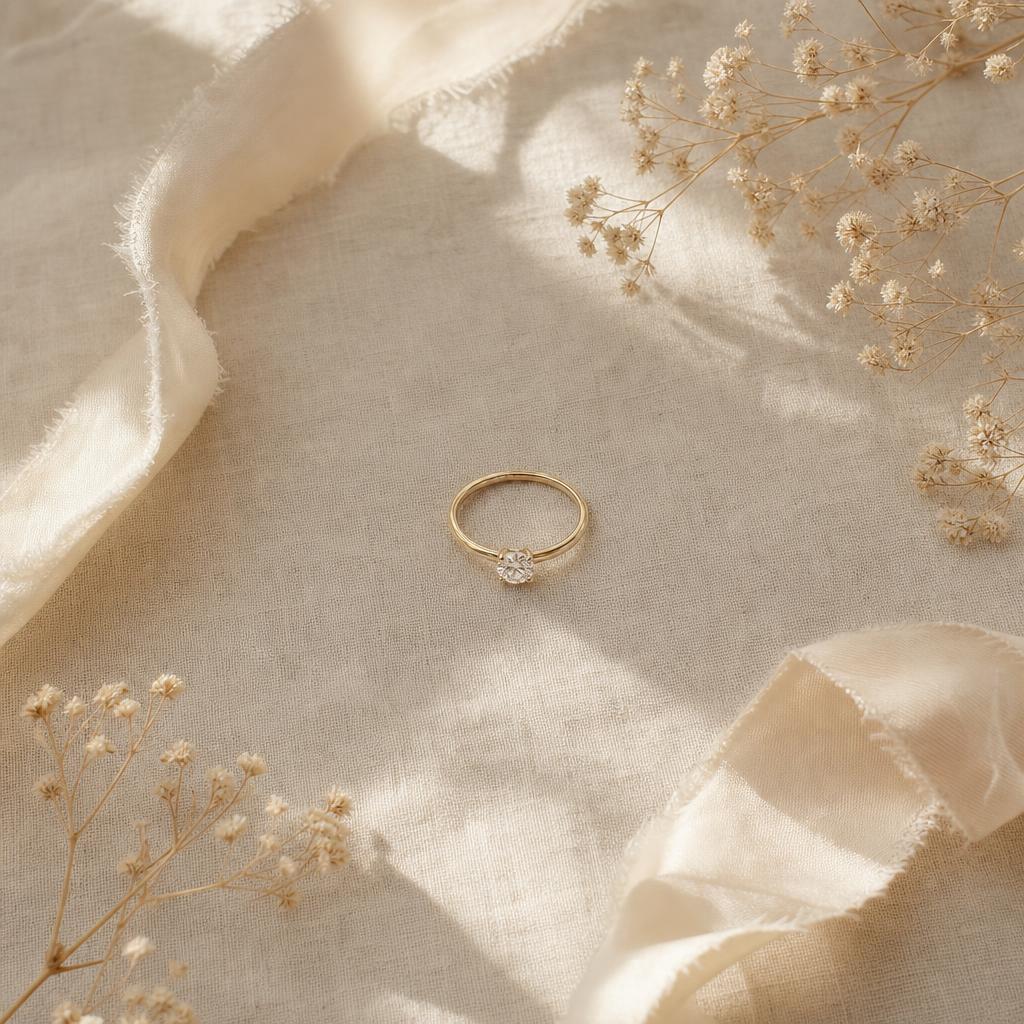
Small and Quiet: The Case for a Tiny Engagement Ring
There is a particular kind of confidence in choosing less. Not because you have to — because you looked at the alternative and decided it wasn't actually the point.
A tiny engagement ring has quietly become one of the most requested looks in the Gemiros catalog, and it isn't a consolation prize for a bigger budget. It's a deliberate style decision, made by women who know exactly what they want their hand to say.


Why the smaller stone is having a moment
For years, the unspoken rule of engagement ring shopping was that bigger equaled better — that the size of the center stone was a scoreboard other people were quietly keeping. That rule was never really about the ring. It was about what other people might think of you for wearing it. Once you stop shopping for other people's opinions, the math changes completely.
Minimalist engagement rings didn't become popular because women started wanting less. They became popular because women started noticing what they actually wanted, once the noise of "impressive" was removed from the decision. A slimmer profile. A single, clean stone. A ring that disappears into your hand instead of announcing itself before you've said a word. That's not settling. That's editing.
It also tracks with a broader shift in how women are shopping for jewelry in general. The same buyer who's grown skeptical of paying a premium for a name on a box is often the one who's rethinking the assumption that a ring has to be large to be meaningful. Both instincts come from the same place: reading past the markup and the marketing to ask what the piece actually does for her, day to day, on her own hand.
What actually counts as a "small" engagement ring?
There's no single agreed-upon line, but most jewelers put the "small" range somewhere under one carat, with a lot of the most photographed, most-loved rings on the smaller end of that — closer to half a carat than a full one. A small diamond engagement ring in that range isn't about compromise on brilliance; cut quality, not carat weight, is what actually determines how much a stone sparkles at a glance. A smaller stone with a precise cut will out-shine a larger, poorly cut one every time, and it will do it while sitting flatter, catching less on sweaters and gloves, and drawing the eye to the whole hand instead of one spot on it.
Worth knowing: Every Gemiros ring is 925 sterling silver set with a precision-cut simulated diamond or moissanite — indistinguishable from a diamond to the eye, and it passes diamond testers. Going smaller doesn't mean going quieter on quality. It means choosing where the attention goes.
The thin-band question
If you've typed "engagement ring thin band" into a search bar at some point, you already know the silhouette you're picturing: a slim, almost weightless profile that lets the stone do the talking instead of the metal around it. A thinner band reads as more delicate, sits lower on the finger, and pairs more easily with a stack later on, if that's where you eventually want to go. The tradeoff worth knowing before you buy: a band under about 1.8mm can feel noticeably more delicate against daily wear than a slightly wider one, so a band closer to 1.8–2mm keeps that same slim look with sturdier daily performance.

Leighton Ring
A round center stone framed in a cushion-shaped halo — the extra outline of pavé makes a smaller center carat read larger at a glance, without changing its actual size.
Shop Leighton Ring →Does a smaller stone still sparkle?
This is usually the real question underneath "will it look cheap" — and it deserves a direct answer instead of a reassuring one. A well-cut simulated diamond or moissanite at three-quarters of a carat throws just as much fire as a larger stone with a mediocre cut. Sparkle is a function of facets and light return, not size. Every Gemiros stone is cut for exactly that: maximum brilliance, not maximum carat weight. Nobody clocking your ring across a dinner table is measuring millimeters. They're registering how much it catches the light — and a precision-cut small stone catches plenty.
The other part of that question is usually unspoken: will anyone be able to tell it isn't a natural diamond? They won't. Gemiros stones are set in genuine 925 sterling silver and cut to pass diamond testers, the same instrument jewelers use to check authenticity. Nothing about choosing a smaller stone changes that. If anything, it removes the one thing people are more likely to scrutinize on a large stone — a smaller, cleaner setting draws less forensic attention, not more.
There's also a practical case for a smaller stone that rarely makes it into the conversation: everyday wearability. A lower-profile setting catches less on gloves, sweaters, and hair, which matters more than most people expect once a ring becomes something worn every single day rather than saved for occasions. Hands do a lot of physical work — typing, cooking, carrying bags, gripping a steering wheel — and a setting that sits close to the finger simply survives that better over years of wear. It's a quiet, unglamorous reason to size down, but it's often the one that matters most once the ring stops being new.
Styling a dainty ring so it still makes a statement
Dainty engagement rings read as more, not less, when they're styled with intention. A single quiet ring on a hand with nothing else competing for attention has real presence — the kind that makes people lean in rather than glance and move on. The most common mistake is trying to make a small ring "louder" by pairing it with something equally busy. The better move is the opposite: let it be the only detail, and let a clean manicure or a single delicate stack piece do the rest of the talking.
Shape does some of this work for you. A marquise or oval silhouette elongates the finger and reads larger than its actual carat weight, purely through the geometry of the cut. An asscher or emerald cut leans architectural and cool, which tends to photograph beautifully even at a modest size because of its clean lines and open table.

Victoria Ring
A marquise center stone in a vintage-inspired halo — the elongated cut reads larger on the hand than its actual carat size, a favorite for buyers who want quiet drama.
Shop Victoria Ring →✦ Pro tip: If you're deciding between two sizes, try both on and look at your hand from an arm's length away — the distance everyone else actually sees it from — rather than close up, where every ring looks smaller than it reads in real life.
Why this is a self-purchase decision, not a settling one
The women choosing to size down on purpose tend to be the same ones who've already done the math on the traditional jewelry store markup and decided it isn't a math problem they need to solve with a bigger stone. A ring is a daily object, not a one-time performance, and it has to survive typing, lifting groceries, and every ordinary hour in between the special ones. Choosing the size that actually fits your hands, your job, and your life — instead of the size you think you're supposed to want — is its own kind of confidence. It's the same logic that makes going small and buying for yourself so often the same decision: both come from choosing what actually works for the person wearing it, not the room around her.
None of this means bigger is wrong, either — it means the size question deserves to be answered honestly instead of by default. A ring you chose on purpose, in the size that fits how you actually live, will always look more confident than one you picked because it was expected. That confidence is the part that photographs, the part strangers register, and the part that has nothing to do with carats at all.
Quick Takeaways
- Cut quality, not carat weight, is what actually determines sparkle
- A band closer to 1.8–2mm keeps a thin-band look with sturdier daily wear
- Halo settings and elongated shapes (marquise, oval) make a smaller center stone read larger
- Every Gemiros ring is 925 sterling silver, cut to pass diamond testers, regardless of carat size
- Styling a dainty ring with a clean hand — not more jewelry — is what makes it read as intentional
Frequently Asked Questions
Is it okay to have a small engagement ring?
Completely. There's no rule, written or otherwise, that ties ring size to how much a relationship or a purchase means. A smaller ring chosen deliberately — for its comfort, its style, or simply because it's what you love — is exactly as "right" as any other size.
What is considered a small engagement ring?
Most jewelers consider anything under one carat on the smaller end, with roughly a quarter to three-quarter carat covering the most popular range for daintier styles. Hand size, finger length, and setting style all affect how a given carat weight actually reads, so the number matters less than how it looks on you.
Are thin-band engagement rings durable enough for everyday wear?
Yes, within reason. A band around 1.8–2mm holds up well to daily wear while still reading as delicate. Bands thinner than that — closer to 1.5mm — are more prone to bending over years of wear, so if you want the thin-band look for the long haul, aim for the slightly sturdier end of that range.
Does a smaller center stone look cheap up close?
No — cut quality is what reads as cheap or expensive, not size. A precision-cut small stone throws more visible sparkle than a larger, poorly cut one. Every Gemiros stone is cut specifically for maximum light return, so a smaller carat weight never means a duller ring.
A tiny engagement ring isn't a smaller version of what you were supposed to want. It's its own complete decision — one that photographs beautifully, wears comfortably, and says exactly as much as you want it to say, no louder and no quieter. That's not a compromise. That's just good taste, worn daily.


