

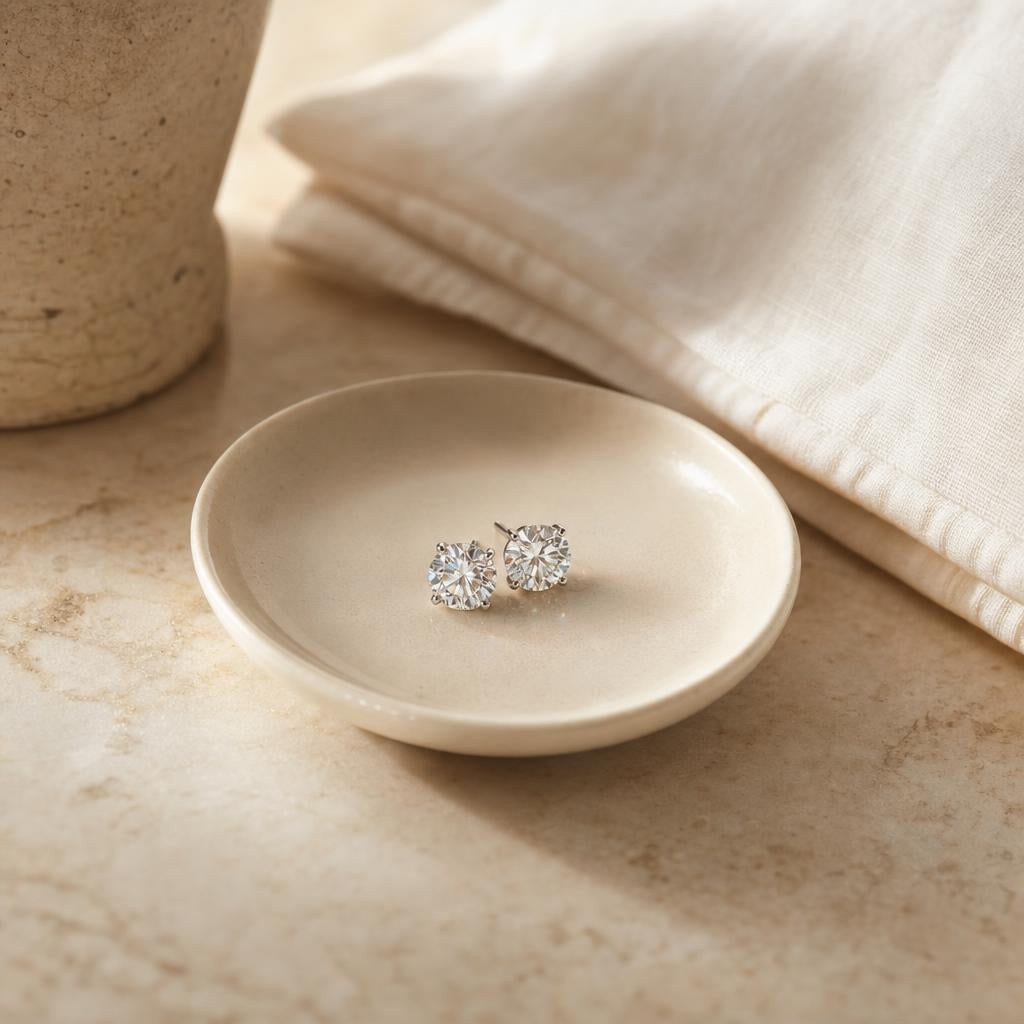
Sleeping in Earrings: Which Pairs Can Stay In and Which Should Come Out
You put them in at 8 a.m. and forgot about them by 8:05. Now it is midnight, the pillow is calling, and the question lands: do the earrings stay in or come out? Most women never decide on purpose. They just fall asleep and find out in the morning.
Here is the answer that actually holds up: a healed piercing and a good pair of studs can tolerate a night or two of sleep, but a nightly habit of taking them out is the smarter default. Below, the rules by earring type, the one exception where you must leave them in, and the pairs worth reaching for first.


The Honest Answer on Sleeping in Earrings
Search for this question and you will find two camps shouting at each other. One says never, under any circumstances. The other says they have slept in the same studs for ten years and their ears are fine. Both are partly right, because the answer depends on two things: whether your piercing is new or healed, and what is actually in your ear.
For a healed lobe piercing, a small, smooth, low-profile stud is generally low risk for the occasional night. The trouble is not one night. It is the thousandth night. Pressure against a pillow, repeated for months, is what some dermatologists point to when they talk about piercing holes slowly stretching, and it is also when buildup, friction and tangled hair add up quietly.
Worth knowing: A new piercing is the one exception to everything below. Do not take starter earrings out to sleep. A fresh hole can start closing within hours, so the jewelry your piercer put in stays in until they tell you it has healed.
If the Piercing Is New: Leave Them In
If you are in the first weeks after piercing, nothing here applies to you yet. Lobes typically need at least six to eight weeks, and cartilage can take many months, before a piercer will clear you to change anything. Our guide to how long ear piercings take to heal walks through the timeline by location, and your piercer's advice always outranks a blog post, ours included.
Once your piercer gives the all-clear, you are in the rest of this guide. And this is where the question gets interesting, because the type of earring matters far more than most people realize.
Sleep Verdict by Earring Type
Not every earring is equal on a pillow. This is the quick sort most women wish someone had handed them years ago.
| Earring type | Overnight verdict | Why |
|---|---|---|
| Small, flat-profile studs | Occasional night is fine | Low on the ear, little to snag, but the back can still press against skin |
| Large or heavy studs | Take them out | Weight and size press into the lobe when you lie on your side |
| Halo or cluster studs | Take them out | More facets and edges to catch hair and fabric |
| Hoops and huggies | Take them out | The open shape catches on bedding, hair and sweaters |
| Drops and dangles | Always out | They swing, snag and pull on the lobe |
Why Taking Them Out Is the Smarter Habit
The back is the problem, not the front
Most of the discomfort comes from the earring back, not the stone. Standard butterfly backs press into the skin behind the lobe, trap moisture, and leave a small ridge in the morning. The back also sits exactly where your head meets the pillow, which is why a pair that feels weightless at noon can be irritating at 3 a.m.
Hair, fabric and snagging
A post-and-back pair has more surface to catch a stray strand than you would think. Tossing and turning pulls on that strand, and the pull lands on your piercing. Hoops are the worst offenders, because the opening is the perfect size for a sleeve, a blanket thread or a lock of hair. If you love huggie earrings, treat them as daytime pieces and let them rest at night.
Buildup you do not see
Sweat, night cream, hair products and skin oils all collect around the post and the back overnight. That residue is what leaves a pair looking dull and what irritates sensitive lobes. If your ears have ever flared up for no obvious reason, buildup is a common suspect, along with the metal itself. We unpack the second cause in why some earrings irritate your ears and others don't.
Your earrings last longer too
This is the part nobody mentions. Skin moisture and products are what dull sterling silver over time, so wearing a pair around the clock is the fastest way to age it. Gemiros studs are 925 sterling silver and tarnish-resistant, and a nightly rest only helps them keep their shine. If you want the full chemistry, read what actually causes sterling silver earrings to tarnish.
✦ Pro tip: Keep a small dish on your nightstand. Take your earrings out the moment you get into bed, not the moment you are about to fall asleep. Ten seconds, and they never end up lost in the sheets.
Can You Sleep With Stud Earrings In? The Practical Rules
Real life is not always tidy. You fall asleep on the couch, you are traveling, you are exhausted. If a night in your studs is going to happen, a few rules keep it low risk:
- Healed piercing only. Never skip the healing window.
- Small and smooth. Choose the smallest, flattest stud you own, not the showstopper.
- Secure back, not a tight one. A back that sits snug but not squeezed prevents the post from digging in.
- Clean on both ends. Wipe the post and back with a soft cloth the next morning. Our moissanite and sterling silver cleaning guide covers the gentle method.
- Give your ears a break. If a sleep-in becomes a pattern, take a few nights off and see how the lobe feels.
How to Build a Pair You Wear Hard, Then Retire Nightly
The women who get the most from their jewelry treat it like a good watch or a good pair of shoes: worn with intent, put away with care. A pair you wear daily becomes part of your look, which is exactly what we explore in why some women wear the exact same pair every day. The ritual that keeps that pair in shape is simple: out at night, wiped down, back in the dish.
Below are two studs that suit that rhythm. Both are nickel-free, backed by a one-year warranty, and set with simulated diamonds that pass diamond testers and are indistinguishable from the real thing in any light, including the 7 a.m. bathroom mirror.

The Isabella Stud Earrings
A pear-shaped simulated diamond framed by a delicate halo. This is an evening-into-night pair, so it earns its place in the nightstand dish.
Shop The Isabella Stud Earrings →
The Sweetheart Stud Earrings
Heart-shaped simulated diamonds with precise faceting, a small romantic detail that works from coffee run to dinner out.
Shop The Sweetheart Stud Earrings →What to Do When You Wake Up With a Sore Ear
A little redness after sleeping in earrings usually settles on its own once you take them out and give the area a day. Keep the skin clean and dry, skip the pair that caused it, and switch to a lighter one. If the soreness comes with swelling, heat, discharge or pain that does not ease, that is a conversation for your piercer or a doctor, not for a jewelry blog.
Quick Takeaways
- New piercing: leave the starter jewelry in until your piercer clears you.
- Healed piercing: an occasional night in small, smooth studs is low risk. A nightly habit is not the best one.
- Hoops, halos, heavy studs and dangles come out at night, every night.
- Taking earrings out also protects the finish on sterling silver.
- A nightstand dish turns the whole thing into a ten-second ritual.
Frequently Asked Questions
Should I take my earrings out when I sleep?
If your piercing is healed, yes, that is the better default. It spares the lobe from overnight pressure, keeps buildup off the post and protects the finish on your jewelry. The exception is a new piercing, which should stay in until your piercer says otherwise.
Is it okay to wear stud earrings to sleep?
An occasional night in small, smooth studs on a healed piercing is generally fine. Skip large, halo and heavy styles, and avoid making it a nightly routine.
What are some comfortable earrings to sleep in?
The most comfortable pairs are tiny, low-profile studs with a flat or smooth back. Anything with edges, weight or an open shape, like hoops, is better left on the dish.
Can I sleep without earrings after six months or a year?
Healing varies by person and by placement, so there is no single date. Lobes are often stable by the six-month mark, but some holes still tighten if left empty for a day. Test it gradually, and ask your piercer when you are unsure.
Will earring holes close up after six weeks?
Holes in a new piercing can start to close within hours, and six weeks is usually still too early to go without. A fully healed piercing is more forgiving, though it can still narrow over time.
You paid for earrings that look like a fortune. A ten-second nightly ritual keeps them, and your ears, looking that way. Out at night, back on in the morning, and nobody, including your jeweler, will know how often you wear them.


