

Skin Tone and Jewelry: How to Choose Gold or Silver Necklaces That Actually Suit You
Somewhere between the vein test and the third TikTok telling you to hold a gold hoop up to your jaw, you've probably wondered whether skin tone and jewelry are actually connected, or whether it's just another rule someone invented to sell you a second necklace. It's connected. It's also simpler than the internet makes it sound.
Your undertone doesn't change what you're allowed to wear. It changes what a metal does to your skin the second it touches it — brightens it, warms it, or just sits there being fine. Once you know which one you are, shopping stops being a guess.


The Real Reason Some Metals Make You Glow
It's not taste. It's physics. Every metal reflects light at a slightly different temperature — platinum and sterling silver throw off a cool, bluish-white light, while 18k gold reflects a warmer, yellow-toned light. Your skin has its own underlying temperature too, invisible under normal light but very visible the moment a metal sits against it. When the metal's temperature matches your skin's, the contrast disappears and everything looks intentional. When it doesn't, you get that faint "something's slightly off" feeling that's hard to name but easy to see in photos.
This is the entire premise behind skin tone and jewelry pairing. Nobody's grading you. You're just working with light the way editorial stylists always have — matching temperature to temperature so nothing fights for attention.
It's also the kind of knowledge that quietly separates an intentional jewelry box from an accidental one. Most people buy a necklace because they liked it under store lighting, then wonder six months later why it never quite made it into a regular rotation. Knowing your undertone before you shop skips that entire guessing phase — you're not hoping a piece works, you already know it will.
How to Find Your Undertone in Under a Minute
Before you can shop by it, you need to know it. None of these require an app, a filter, or a color consultant — just natural light and the back of your wrist.
The three-test undertone check: Look at the veins on the inside of your wrist in daylight. Blue or purple veins mean a cool undertone. Green or olive veins mean warm. A genuine mix of both means neutral, which is the rarest and, frankly, the most convenient category to land in. Next, think about how your skin reacts to sun — burns before it tans usually points cool, tans easily and rarely burns usually points warm. Finally, the simplest version of an undertone jewelry test: hold a silver piece and a gold piece against your jawline, one at a time, in natural light, and notice which one makes your skin look brighter rather than duller.
If two of the three tests agree, trust that answer and stop second-guessing it. Undertone doesn't change with a tan, a season, or a new skincare routine — it's fixed, which means this is a decision you only have to make once.
Cool Undertones: Why Silver Wins
If your veins read blue, you burn before you tan, and silver made your jawline look brighter in that mirror test, you're working with a cool undertone. Bright, icy-white metals — sterling silver, platinum, white gold — sit closest to your skin's own temperature, which is why jewelry for cool undertones tends to look less like an accessory and more like it grew there. Gemiros sets every design in 925 sterling silver with rhodium plating for exactly this reason: it reads bright and cool without ever tipping toward dull.
Simulated diamonds do something particularly useful here — their colorless brilliance amplifies whatever light the metal is already throwing off, so a cool-toned piece against cool-toned skin reads even brighter in photos than it does in person.
Warm Undertones: Why Gold Steals the Show
Green veins, a tendency to tan before you burn, gold winning the jawline test — that's a warm undertone, and it's flattered by exactly the opposite family of metals. Yellow gold and rose gold pick up the golden or peachy hints already in your skin and amplify them into something closer to a glow than a contrast. This is genuinely one of the more reliable pieces of warm skin tone jewelry advice out there, because unlike a lot of style rules, this one is rooted in actual light physics rather than trend.
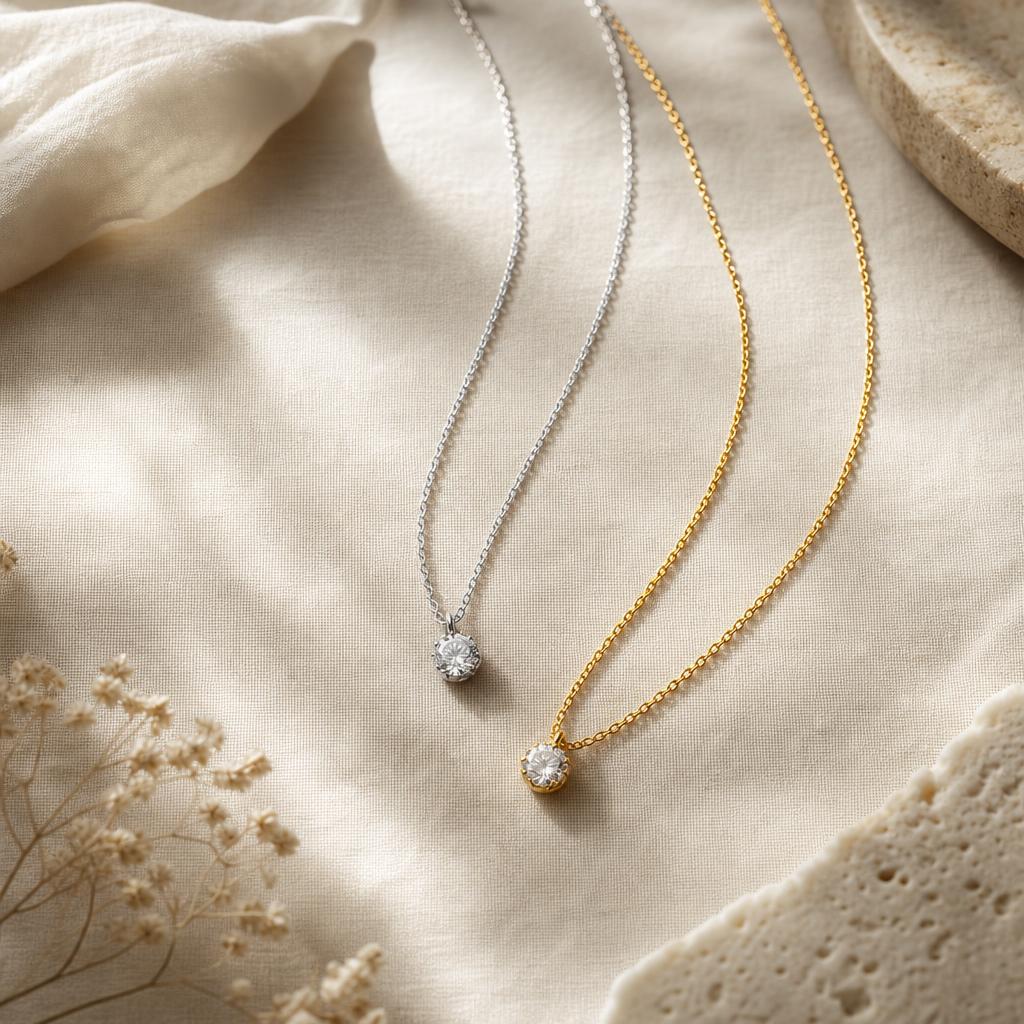
The 18k gold plating on a Gemiros piece isn't a lighter, cheaper version of the silver design — it's the same setting, same stone, same construction, finished in a completely different metal for a completely different undertone. Neither one is the "upgrade." They're built for different skin.

The Éclat Moissanite Necklace
A round-cut moissanite in a clean 6-prong solitaire, set in sterling silver — the kind of everyday brilliance that reads brighter against cool undertones.
Shop The Éclat Necklace →
The Éclat Moissanite Necklace — Gold
The same 6-prong moissanite solitaire, finished in 18k gold plating instead of silver — built to pick up warmth rather than fight it.
Shop The Éclat Necklace — Gold →Neutral Undertones: The Lucky Draw
If your vein test came back genuinely mixed and neither metal won the jawline test, you have a neutral undertone — meaning both silver and gold sit comfortably against your skin without either one looking off. This isn't indecision on your skin's part. It's the one undertone category with no wrong answer, which makes the decision a matter of what the specific piece calls for rather than what you're limited to.
If you fall here, resist the urge to feel like you're missing out on a rule everyone else gets to follow. You're not choosing a metal by default — you're choosing it on purpose, every time, which is arguably the more deliberate position to shop from.
The Jewelry Skin Tone Chart, Simplified
| Undertone | How to Spot It | Metals That Flatter |
|---|---|---|
| Cool | Blue/purple veins, burns before tanning | Sterling silver, platinum, white gold |
| Warm | Green/olive veins, tans before burning | Yellow gold, rose gold |
| Neutral | Mixed veins, no clear winner in the jewelry test | Both — silver and gold equally |
What About Mixing Metals?
Mixed-metal stacking has been quietly normalized for long enough that it no longer needs a permission slip — but the undertone logic still applies underneath it. A cool-toned woman mixing silver and gold usually leads with silver as the dominant metal and lets gold appear only in small accents, and a warm-toned woman does the reverse. The mix reads intentional when one metal is clearly in charge; it reads accidental when both are fighting for the lead.
✦ Pro tip: If you're neutral, mixed-metal pieces are the easiest category in your entire jewelry box — nothing to calculate, no dominant metal required.
Quick Takeaways
- Cool undertones (blue/purple veins) are flattered by silver, platinum, and white gold
- Warm undertones (green/olive veins) are flattered by yellow gold and rose gold
- Neutral undertones can wear both — no dominant metal required
- The fastest undertone jewelry test: hold silver and gold against your jaw in natural light and see which brightens you
- Undertone is fixed — figure it out once and every future purchase gets easier
Frequently Asked Questions
Is my skin tone better suited to gold or silver?
It depends on undertone, not skin depth — a fair, medium, or deep complexion can be warm, cool, or neutral. Cool undertones (blue or purple wrist veins) are generally flattered by silver, platinum, and white gold. Warm undertones (green or olive veins) are flattered by yellow gold and rose gold.
What color jewelry goes with my skin tone?
Match the metal's temperature to your undertone's temperature. Cool undertones look brightest in silver-toned metals; warm undertones look richest in gold-toned metals; neutral undertones can wear either without any visible mismatch.
Can I wear gold jewelry if I have cool undertones?
Yes — undertone is a guide, not a rule. Cool-toned skin can absolutely wear gold; it will simply read as a slightly bolder, warmer contrast rather than a seamless match. Some of the strongest editorial looks come from working against the "rule" on purpose.
What's the fastest way to check whether I'm warm or cool toned?
The quickest version of a gold vs silver skin tone test: hold one piece of each metal against your jawline in natural daylight, one at a time, and watch which one makes your skin look brighter rather than washed out. Pair it with the wrist-vein check for a faster, more confident answer.
Do neutral undertones really look good in everything?
Close to it. Neutral undertones sit at the midpoint between warm and cool, so both silver and gold read as flattering rather than mismatched — the only jewelry decision left is which piece actually fits the moment.
None of this is about narrowing your options. It's the opposite — once you know your undertone, you stop buying pieces that quietly disappoint you in photos and start buying the ones that were built for your exact skin from the start. That's not a smaller jewelry box. It's a smarter one.


