

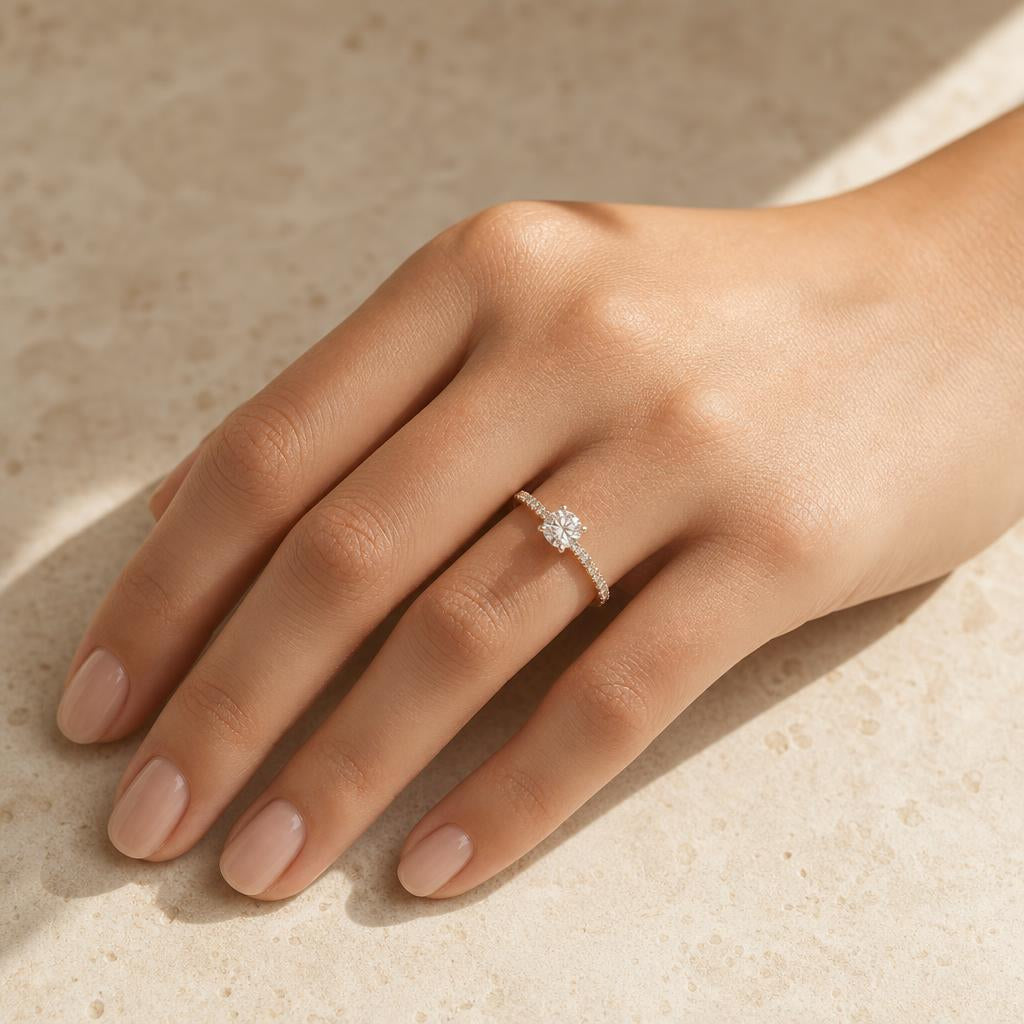
Right Hand Ring Meaning: How Small Choices Build Real Confidence
There is a specific kind of confidence that comes from a ring you bought yourself — not the one that arrived in a box with someone else's speech attached, but the one you chose on a random Tuesday because you wanted it. It sits differently on the hand. You notice it more. And there is a reason for that: what you wear on your hands has quietly signaled something about you for a hundred years, long before anyone called it a "confidence piece."
Right-hand rings, cocktail rings, statement rings — the vocabulary has shifted over the decades, but the idea underneath it hasn't. A ring on your own terms says something a ring you're waiting for never can. Before we get into what that history actually is, here are a few pieces built for exactly that kind of everyday, no-permission-needed sparkle.


Right hand ring meaning: where this actually comes from
If you search right hand ring meaning, you'll find the same answer everywhere, because it happens to be true: a ring on the right hand has never been about romance. It traces back to the 1920s, when women started buying bold, oversized rings for themselves — not to mark an engagement, but to mark financial independence. They wore them into speakeasies during Prohibition, deliberately, on the hand that raised the glass. The gesture was the point. Nobody needed to explain what it meant. Everyone already knew.
A century later, the symbolism has held up better than most trends do. A ring on the right hand still reads as something you decided for yourself — a personal milestone, a small act of independence, a piece that answers to no one's timeline but yours. The left hand still carries the old associations. The right hand carries the new ones.
Worth knowing: Cocktail rings and statement rings get used interchangeably, but they're not identical. Cocktail rings are the original, bolder, evening-leaning version born from that 1920s history. Statement ring is the broader modern term — it covers everything from a sculptural gold band to a full three-stone piece, worn any time of day you feel like wearing it.
Why a ring changes how you carry your hands
There's a reason stylists and photographers pay close attention to hands — they move constantly, they're rarely out of frame, and they're one of the first things people notice mid-conversation. A ring that actually catches light does something subtle: it gives your hands a reason to be looked at on purpose, instead of just incidentally. That's not vanity. That's just how attention works.
This is where the Gemiros stones do real work. A 4.5ct oval in a hidden halo, a cushion cut framed in pavé — these aren't subtle pieces, and they aren't meant to be. They're indistinguishable from a diamond and pass diamond testers, which means the confidence isn't borrowed from an idea of what a "real" ring should look like. It's earned from wearing something that genuinely holds up under a closer look, every single time someone asks.
The self love ring: an old idea with a newer name
The self love ring is really just the modern packaging for something women have been doing for a hundred years without a label for it. The idea is simple: a ring you buy for yourself, worn as a daily, physical reminder that you don't need an occasion or another person's approval to own something beautiful. It's not a placeholder for anything. It's not "practice" for a different ring later. It's the actual thing.
The Ophelia is one of the pieces we hear about most in exactly this context — women who describe it less like a purchase and more like a decision they made about themselves. It's a hidden halo oval set in 925 sterling silver, with the kind of sparkle that gets noticed without anyone realizing it wasn't a five-figure purchase. Nobody clocks the difference. That's rather the point.

The Camilla Ring
A round halo set in pavé — quiet enough for a Tuesday, sparkling enough that you'll catch yourself glancing down at it mid-meeting.
Shop The Camilla Ring →Everyday luxury jewelry: the case against saving it for "someday"
There's an old habit worth retiring: the good jewelry stays in the box until the occasion is important enough. Everyday luxury jewelry pushes back on that logic directly — the idea that a beautifully made piece belongs on your hand on a Wednesday, not just at the one event a year that supposedly justifies it. Waiting for permission that never comes is its own kind of cost.
This only works, though, if the piece can actually survive an everyday life. That's a materials question, not a styling one. Gemiros rings are set in 925 sterling silver with rhodium or 18k gold plating — hypoallergenic, nickel-free, and built to be worn daily rather than saved for special occasions. You're not choosing between "the nice ring" and "the ring you can actually wear." With the right materials, that's the same ring.
✦ Pro tip: If a piece can't handle daily wear — washing your hands, typing, getting in and out of the car twenty times a day — it was never going to become a real habit. Durability isn't the boring part of buying jewelry for yourself. It's what makes the habit stick.
What actually holds up (and what to check before you buy)
A ring you intend to wear constantly needs to clear a higher bar than one that comes out twice a year. A few things worth checking before you commit to any piece, Gemiros or otherwise:
- The base metal. 925 sterling silver with rhodium or gold plating resists everyday wear far better than thin costume plating, and it won't discolor skin the way lower-grade metals can.
- The stone. Moissanite and lab-created stones aren't a compromise — they're indistinguishable from a diamond to the naked eye, and they'll pass a diamond tester without hesitation.
- The setting. A hidden halo or pavé setting protects the stone from daily knocks better than an exposed prong does, which matters if this ring is going on your hand and staying there.
- The fit. A ring that's slightly loose will spin and catch on things constantly. Get sized properly before committing to daily wear.

The Beatrice Ring
A round pavé solitaire built for the woman who wants the confidence without the fuss — understated enough to wear with anything, sturdy enough to actually live on your hand.
Shop The Beatrice Ring →Choosing a piece that actually feels like you
The easiest way to pick the wrong ring for this purpose is to shop for what looks good on someone else's hand in a photo. The right piece is the one you'd reach for without thinking about it — bold if that's genuinely your instinct, quiet if it isn't. A three-stone piece like the Statement Ring makes a very different case for itself than a slim solitaire does, and neither is more "correct." The only real test is whether you'd still want to be wearing it a year from now, on an ordinary day, for no reason at all.
Quick Takeaways
- Right-hand rings trace back to the 1920s, when women wore them as a deliberate symbol of financial independence — not romance.
- Buying yourself a ring has a fashionable new name now, but the habit itself is a century old — no occasion required.
- 925 sterling silver, rhodium or gold plating, and moissanite or lab-created stones hold up to daily wear without the price tag of mined diamonds.
- The right piece is the one you'd still reach for on an ordinary Tuesday, not just for a photo.
Frequently Asked Questions
What does a ring on your right hand actually mean?
Historically and today, it signals independence and personal achievement rather than a romantic commitment. It's a ring you chose for yourself, on your own terms — no proposal, no waiting required.
Is a self-love ring the same thing as a promise ring?
Not quite. A promise ring traditionally signals a commitment to another person. This one is different — it's a commitment to yourself, a daily reminder to choose your own happiness first, with no one else involved in the decision.
Which finger should a statement ring go on?
There's no strict rule. The right ring finger or index finger are the most common choices for a bolder piece, but plenty of women wear statement rings on the middle finger or stacked with other pieces — whatever feels most natural on your hand.
Will a ring I wear every single day actually hold up?
If it's set in 925 sterling silver with rhodium or gold plating and a securely set moissanite or lab-created stone, yes — that combination is built for daily wear, not just special occasions. Loose costume plating and unsecured settings are what actually fail under everyday use, not the concept of wearing a ring often.
A ring doesn't need a special occasion to mean something. Sometimes the only occasion is deciding you're done waiting for one — and that decision looks better on your hand than almost anything else you could buy.


