

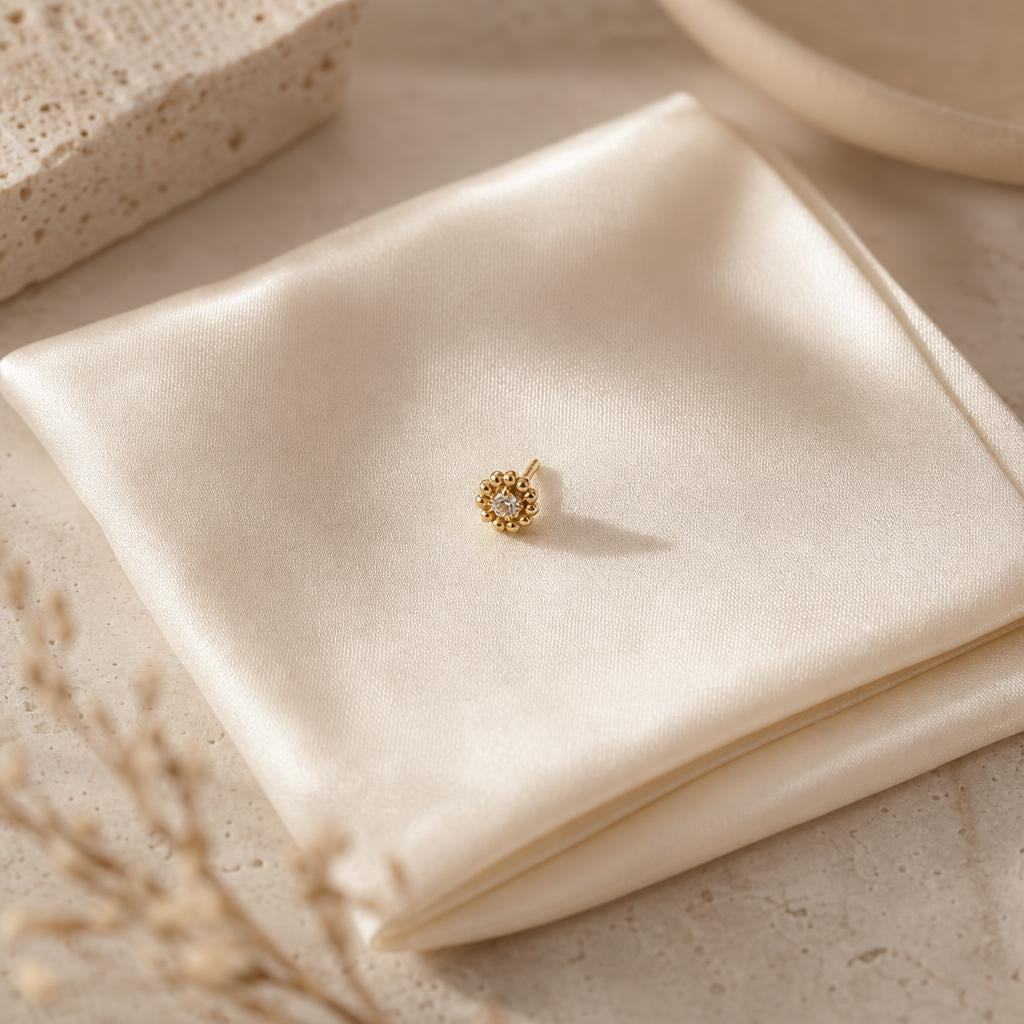
Old Money Earrings: The Stud-Only Rule and Why It Exists
There is a version of expensive that doesn't announce itself. No logo, no stack of six mismatched hoops, no earring that needs an explanation. Just one considered pair, worn the same way tomorrow as today — and somehow, that reads as more money than anything louder ever could.
That is the old money earrings rule, and it is stricter than it looks: one pair of studs, chosen well, worn on repeat. Before we get into why that restraint works, here are four studs built entirely around it.


What "Old Money" Actually Means in Jewelry
Strip away the aesthetic's internet shorthand — the tennis whites, the trench coats, the muted color palettes — and the jewelry version of old money comes down to one habit: buying fewer, better things and wearing them until they are simply part of you. It is less a style than a filter. Before something goes near your ear, it has to survive the question "will I still reach for this in five years," not "does this look expensive in a photo right now."
That is what separates the old money jewelry aesthetic from most jewelry trends. It is not about spending the most. It is about spending on purpose, and then stopping.
The Stud-Only Rule, Explained
Here is the actual rule, stripped of the aesthetic language: at any given moment, the earring doing the most talking on you should be a single, well-made stud — not a cluster of climbers, not six cartilage hoops, not a chandelier that catches the light before your face does. One pair. Chosen with intention. Worn without needing to think about it.
This is not a rule against personality. It is a rule against noise. A woman who has quietly decided the diamond markup is irrational and the trend cycle is exhausting doesn't need eight pairs of statement earrings to prove she has taste — she needs one pair good enough that she stops looking for the next one.
Worth knowing: The reason a single stud reads as "more" rather than "less" is contrast. When everything else about the look is quiet — skin, hair, a plain sweater — one small, precise point of light does more visual work than five competing ones. Restraint is what makes the sparkle legible.
Why Simplicity Reads as Wealth
There is an old idea, never actually written down anywhere but absorbed by almost everyone, that more jewelry equals more money. It is the same idea that convinces people a diamond has to cost five figures to be worth wearing. It is not true, and the old money aesthetic — for all its internet-trend packaging — is built on having quietly figured that out already. A single, excellent stud says "I don't need to prove anything" in a way that a full ear of mismatched hardware never can.
The Case for Wearing the Same Studs Every Day
There's a particular kind of confidence in owning one pair of earrings good enough that you stop shopping for a replacement. It removes a decision from your morning. It means the photo from your best friend's wedding and the one from a random Tuesday show the same woman, wearing the same considered thing, because she already decided what she liked and didn't need to keep relitigating it.
That's a different posture than most jewelry marketing wants you to have. Most of it is built on the idea that you need the next piece, the seasonal drop, the trend before it's over. The old money approach — buy once, wear constantly, stop looking — is quietly the more expensive-feeling choice, even when the price tag says otherwise.

The Stella Stud Earrings
Sometimes the simplest design makes the biggest statement. A brilliant round-cut center stone, set clean and close to the ear — the kind of stud you put in once and never think about again.
Shop The Stella Stud Earrings →What to Look For in a Stud That Holds Up to Scrutiny
Because the stud-only rule puts all the weight on one pair, that pair has to actually earn it. A few things worth checking before you buy:
- The setting sits close to the ear. Old money earrings are rarely showy in silhouette — a low, close-set solitaire or a small halo reads considered, not theatrical.
- The metal won't discolor your skin. Gemiros studs are set in 925 sterling silver — hypoallergenic and nickel-free, so sensitive ears are a non-issue.
- The stone is genuinely convincing. This isn't a ring you can second-guess across a room. Gemiros' simulated diamonds and moissanite are indistinguishable from a mined diamond to the naked eye and pass diamond testers — no one is checking, but if they did, nothing would give it away.
- It's a size you'll actually wear daily. The whole premise of the rule collapses if the stud is too dramatic for a Tuesday.

The Ophelia Stud Earrings
An elegant oval-cut stone set low against the ear — small, bright, and genuinely hard to place a number on. Exactly the kind of quiet confidence the stud-only rule is built around.
Shop The Ophelia Stud Earrings →Building a Minimalist Ear Without It Looking Empty
Minimalist jewelry has a branding problem: done badly, it just looks like you forgot to get dressed. Done well, it looks like you already own everything you need. The difference is almost entirely in the quality of the one piece you're wearing, not the quantity.
If you're moving toward a quieter jewelry collection, start by retiring anything that only works with one specific outfit. What's left — the studs that go with a blazer and a swimsuit and a wedding, equally — is your actual foundation. That's the ear the old money rule is describing.
This is also, practically, an easier way to travel and pack. A single pair of studs that works everywhere means one less decision at 6 a.m. and one less thing to lose in a hotel bathroom. The women who've fully adopted this approach tend to describe it less as a style choice and more as a relief — one part of getting dressed that no longer takes any thought at all.
✦ Pro tip: If you're used to wearing multiple pairs at once, don't go cold turkey. Drop to two — one small stud in the lobe, one slightly bolder piece above it — for a week before you commit to a single pair. Most women find they don't miss the extra hardware nearly as much as they expected to.
The Halo Middle Ground
Not every day calls for the barest possible stud. A halo setting — a small circle of pavé stones framing the center — gives you more presence for evenings out without breaking the rule, because it's still one earring doing one job well, not a cluster competing for attention.

The Leighton Stud Earrings
A brilliant round-cut center stone framed in a delicate halo — more light, same restraint. The evening version of the stud-only rule.
Shop The Leighton Stud Earrings →Quick Takeaways
- The stud-only rule: one considered pair at a time, worn on repeat — not a rotation of statement pieces
- Restraint is what makes a single stud read as expensive, not the size of the stone
- Check setting height, metal safety, and stone quality before committing to your one pair
- 925 sterling silver, hypoallergenic and nickel-free — built for daily wear, not just photos
- A halo stud is the evening-appropriate version of the same principle, not an exception to it
Frequently Asked Questions
What is the old money aesthetic, in jewelry terms?
It's a preference for fewer, better pieces over visible logos or trend-driven statement jewelry — quality and restraint signal more than quantity does. In practice, that usually means one excellent stud earring, a thin chain, and not much else.
What jewelry does old money actually wear?
Small, well-made pieces worn consistently: a single pair of stud earrings, a delicate chain, maybe one ring that isn't trying to be the whole outfit. The pieces tend to be quiet enough that you notice the person before you notice the jewelry.
What earrings make you look classy?
Size and setting matter more than sparkle. A close-set solitaire or small halo in a size you'd wear on an ordinary day reads as considered. Anything so large or elaborate it needs an explanation tends to read the opposite way, regardless of what it's made of.
What is the 2:1:1 rule in jewelry?
It's a common styling shorthand — two delicate everyday pieces, one medium piece, one statement piece, worn in that proportion rather than all at once. The stud-only rule is essentially the earring-specific version of the same idea: let one piece do the work instead of stacking several that compete.
Do simulated diamond studs actually hold up to close inspection?
Yes. Gemiros studs are indistinguishable from a mined diamond to the naked eye and pass diamond testers — nobody is going to clock the difference across a dinner table, or across a jeweler's loupe either.
The stud-only rule isn't really about earrings. It's about deciding, once, what you actually want to be known for wearing — and then not reopening that decision every time a new trend shows up in your feed. One pair, chosen well, is a quieter kind of confident than most jewelry ever manages to be.


