

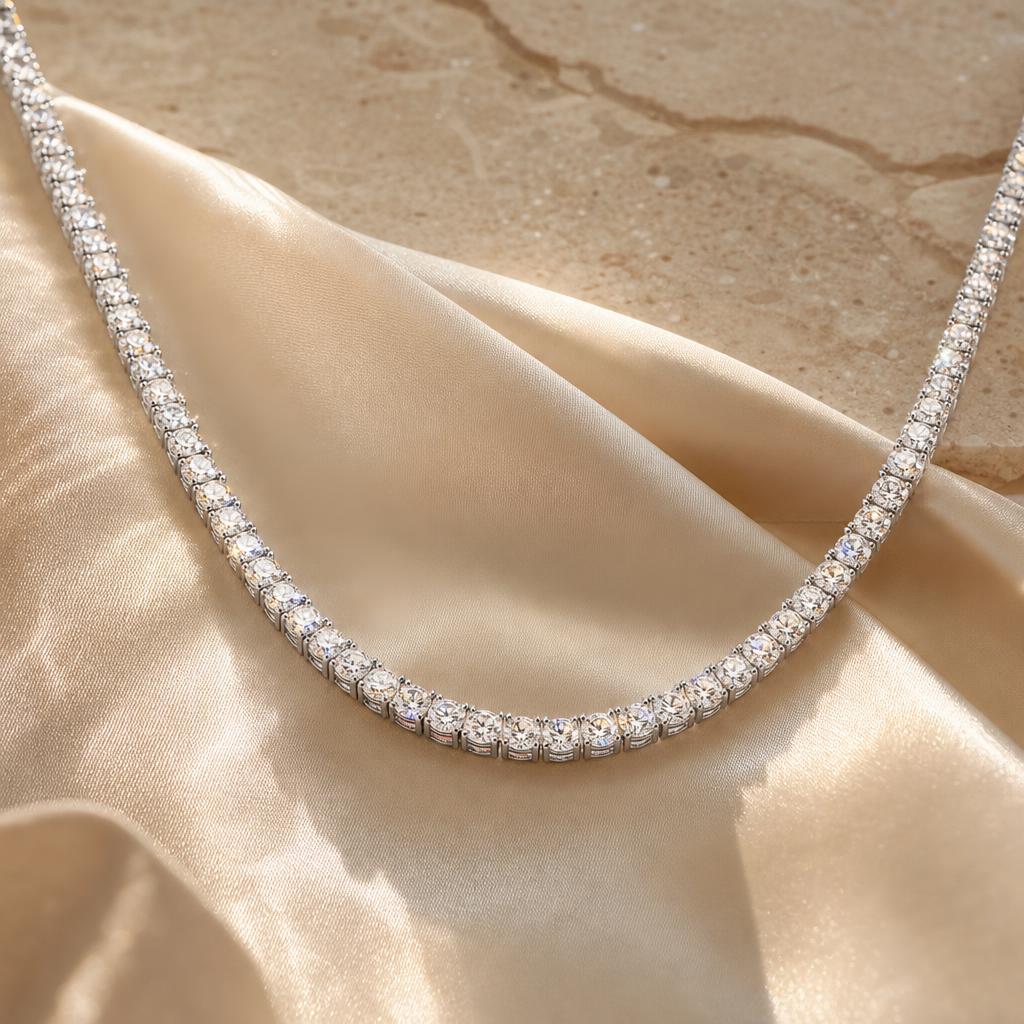
Moissanite Tennis Necklaces: What to Know Before You Buy One
A tennis necklace is supposed to look like a decision you don't have to explain — one continuous line of stones, catching every bit of light in a room. In moissanite, that effect isn't a smaller version of the real thing; it's the same brilliance, built on the same logic you already applied the moment you stopped overpaying for a ring. Before you buy one, here's exactly what changes, what doesn't, and what actually matters on the listing.
Whether you already wear moissanite or you're shopping your first piece, the questions are the same: does it genuinely catch light the way a mined-diamond version does, does it hold up to daily wear, and which setting is actually worth the money. Gemiros builds that same brilliance into necklaces you can wear today — start here, then read on for the full buying guide.


What a Moissanite Tennis Necklace Actually Is
A tennis necklace is a continuous line of same-size stones set edge to edge along a chain, with no visible metal breaking the sparkle. The name comes from a 1987 U.S. Open moment when Chris Evert stopped play to find a diamond bracelet that had slipped off her wrist mid-match — the press ran with "tennis bracelet," and the name stuck to the whole category, necklaces included. The construction has stayed almost identical for decades: identical stones, a shared-prong or channel setting, and a clasp that has to hold real weight in a straight line.
What's changed is the stone itself. This version uses a lab-created gem instead of a mined or lab-grown diamond, cut to the same round brilliant proportions. Moissanite actually bends light more than diamond does, which is why a well-cut piece can look, if anything, slightly more alive under indoor lighting — not a toned-down version of the sparkle, a different and arguably more generous one.
Worth knowing: Moissanite passes handheld diamond testers that check for thermal conductivity, because moissanite conducts heat almost as efficiently as diamond does. It isn't standing in for something else — it's a distinct gemstone with its own name, its own grading, and its own reasons to exist.
Moissanite vs. Cubic Zirconia: Reading the Listing Correctly
These two terms get mixed up constantly, but they're describing different tiers of the same idea. Both are lab-created stones cut to mimic a diamond's brilliance, and both can be set into a necklace made from sterling silver, gold-plated silver, or solid gold — the stone and the metal are two separate decisions, and a listing should specify both clearly.
| Moissanite | Cubic Zirconia | |
|---|---|---|
| Hardness | 9.25 on the Mohs scale | 8 to 8.5 on the Mohs scale |
| Sparkle over years of wear | Holds brilliance | Can dull and fog |
| Passes a diamond tester | Yes | No |
| Typical setting metal | Sterling silver, gold plating, solid gold | Sterling silver, base metal, gold plating |
Cubic zirconia isn't a lesser purchase on its own — it has a place, particularly for a piece worn only occasionally. A cubic zirconia tennis necklace is usually the least expensive way into the look, but it's also the version most likely to visibly dull within a year or two of regular wear, since the stone itself is softer and scratches more easily. That single hardness gap is the entire reason moissanite has become the default upgrade for anyone planning to wear the piece often.
What to Check Before You Buy
Setting and Stone Count
A true tennis necklace holds every stone in shared or individual prongs along its entire length — that's what gives it the unbroken line. Some listings use the word loosely for a necklace with only a few stones and long stretches of plain chain in between. Neither is wrong, but they're different pieces with different intentions, so check the product photos closely, not just the title, before deciding which one you actually want.
Metal and Plating
If you already know you want a sterling silver tennis necklace, this is the detail that matters most: whether that silver core has a rhodium finish. Rhodium is what keeps sterling silver looking bright and resists tarnish far longer than bare silver on its own, and it's worth confirming on the listing rather than assuming every silver piece includes it.

The Aria Moissanite Necklace
A round-cut moissanite set into a sleek bezel, with no exposed prongs to catch on clothing or hair. It's the setting we'd point to first for anyone who wants sparkle that survives an actual daily routine.
Shop The Aria Moissanite Necklace →Chain Length
Tennis necklaces are almost always rigid or semi-rigid along their sparkling section, which means length matters more here than on a pendant chain — there's no sliding a too-long tennis necklace into a shorter-looking drape the way you can adjust a pendant. Most sit between 14 and 18 inches; measure a necklace you already own and like against a mirror before ordering, rather than guessing from a size chart alone.
Who a Tennis Necklace Actually Suits
A full-length tennis necklace reads as a statement piece — worn alone, at the collarbone, with nothing else competing for attention. If your everyday style already leans toward layering multiple thinner chains, a shorter tennis-style choker or a single-stone pendant like a floating solitaire will sit more naturally in that stack than a wide, continuous line of stones. Neither approach is more correct; it's a question of how you actually get dressed most mornings, not which piece photographs better on someone else.
Living With It: Durability, Cleaning, and Everyday Wear
Moissanite doesn't require special handling beyond what any fine jewelry needs. Warm water, a drop of mild soap, and a soft brush around the setting will clear the everyday buildup — lotion, sunscreen, the fine dust that dulls any stone's sparkle within a few days of wear. Sterling silver can tarnish with air exposure over time; storing the necklace in the pouch or box it arrived in, away from direct humidity, slows that process considerably.
✦ Pro tip: Take it off before applying perfume, lotion, or hairspray, and put it on last when you're getting dressed. Chemical buildup on the surface of a stone dulls sparkle far faster than the stone itself wearing out.
Because a tennis necklace has more individual settings than a solitaire pendant, it's worth an occasional check that no prong has loosened — the same way you'd check a ring's prongs after months of wear. It's a five-second glance in good light, not a maintenance chore, but it's the difference between catching a loose stone at home and losing one on a night out.
Is a Moissanite Necklace Worth It?
The honest answer depends on what you're comparing it to. Against a mined-diamond tennis necklace, moissanite gets you a comparable — in some lighting more generous — sparkle for a fraction of the layout, set in a stone that's conflict-free by nature since it's lab-created rather than mined. Against cubic zirconia, moissanite gets you a harder stone that won't visibly dull after a year of real wear. There isn't a version of this comparison where moissanite is the compromise option; it's simply the better-informed one.
Quick Takeaways
- Moissanite is a distinct, lab-created gemstone — not a diamond substitute — and it passes standard handheld diamond testers.
- Sterling silver with a rhodium finish and moissanite stones gives you a durable metal and a hard, long-wearing stone in one piece.
- Check stone count, setting type, and metal plating on the listing before buying, not just the product photo.
- Bezel settings hold up best for daily wear; shared-prong settings show off the most brilliance.
- Clean with mild soap and a soft brush, and take the piece off before applying perfume or lotion.
Frequently Asked Questions
Is a moissanite necklace worth buying?
Yes, for anyone who wants diamond-level brilliance without the diamond-level cost or the mining supply chain. Moissanite is harder than cubic zirconia, holds its sparkle for years, and passes diamond testers — it holds up to genuine daily wear rather than sitting in a drawer for special occasions only.
Is moissanite a real diamond?
No, and it isn't trying to be. Moissanite is its own gemstone, with its own hardness rating and its own way of catching light — in some cases more brilliantly than a diamond does. It's graded and sold on its own terms, not as a stand-in for something else.
What's the real downside of a moissanite tennis necklace?
The most honest one: moissanite disperses light differently than diamond, throwing slightly more visible color flash in direct sunlight. Most people read this as extra sparkle rather than a flaw, but it's the one genuine optical difference worth knowing before you buy.
How much should a moissanite tennis necklace cost?
It depends heavily on stone size, stone count, and metal — a short, dainty piece in sterling silver costs meaningfully less than a full-length necklace in solid gold. What matters more than any single number is that the listing discloses metal, stone type, and stone size clearly, so you know exactly what you're paying for.
Does a tennis necklace actually look real up close?
Yes — under normal viewing distance and lighting, moissanite is convincing enough to pass a handheld diamond tester, and it reads as fine jewelry in photographs and in person. The only way to tell the difference is a gemological loupe in the hands of someone specifically trained to look for it.
A tennis necklace was always meant to look effortless — proof that you know exactly what you're doing, worn as a straight, uninterrupted line of light. Moissanite doesn't change what the piece is meant to say. It just means you got there without paying the old markup for the privilege.


