

Matching Jewelry for Couples: What to Buy Each Person (Not the Same Piece Twice)
Somewhere between "let's get matching rings" and actually standing in front of two very different jewelry boxes, most couples hit the same wall: matching jewelry for couples almost never means the same piece worn twice. One of you wants something quiet. The other wants something that catches light across a room. Buying two identical rings, two identical necklaces, solves nothing — it just means one of you is wearing a compromise.
The smarter approach is coordination, not duplication: two pieces that clearly belong to the same idea without being carbon copies of each other. Here's what that actually looks like, and six Gemiros pieces that pair well without ever repeating themselves.


Why Matching Doesn't Mean Identical
The identical-piece instinct comes from somewhere reasonable: you want proof, visible and wearable, that you're a unit. But two people rarely have the same hand, the same neckline, the same taste in how much sparkle is "enough." A ring sized for her will sit differently on him. A pendant she'd wear daily might be a piece he never reaches for. Buying the exact same design for both of you optimizes for symmetry over the thing that actually matters — whether either of you wants to wear it in six months.
Coordinated jewelry solves this by matching on one variable instead of all of them. Same metal tone, different silhouette. Same stone, different setting. Same story, told two ways. That's the difference between a set that looks thoughtful and one that looks like it came shrink-wrapped from a mall kiosk.
The Case for Two Different Pieces, One Shared Idea
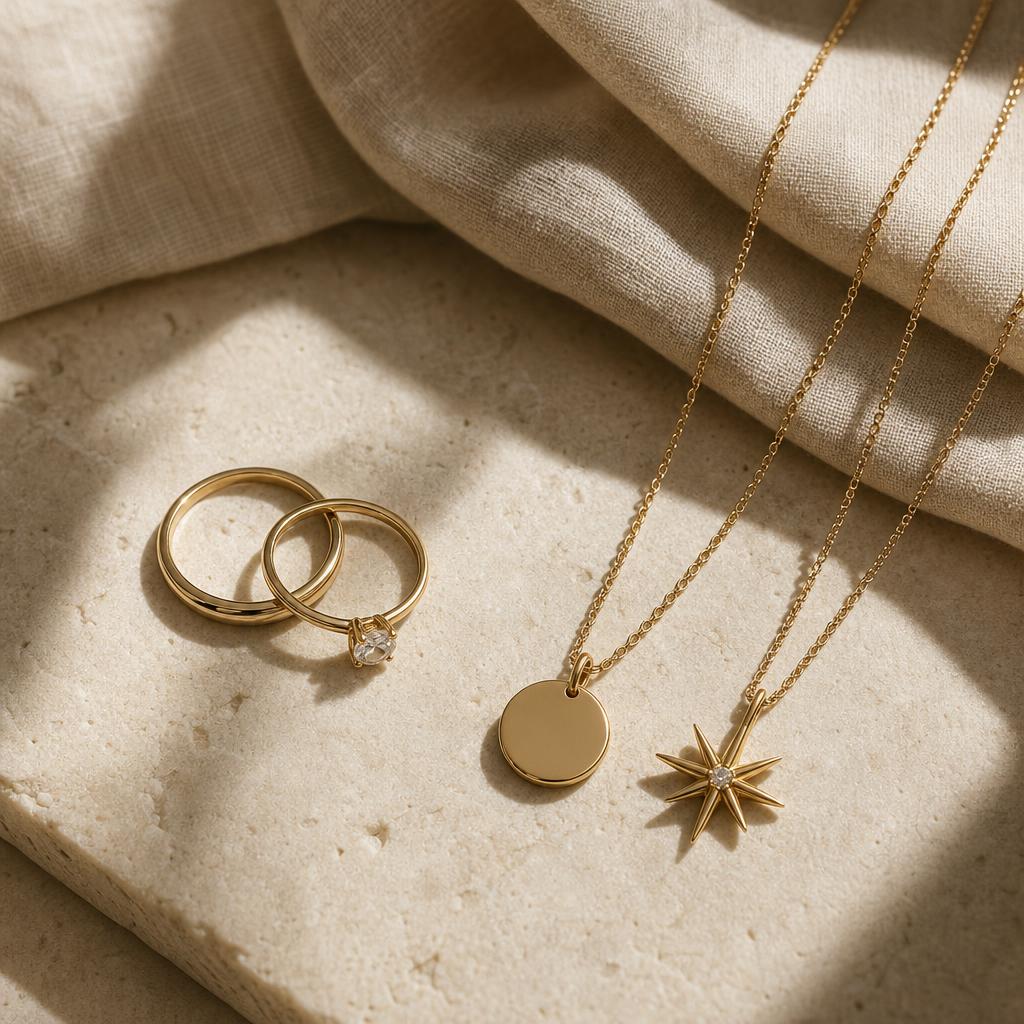
Start with the one detail you actually want to share — a metal color, a stone, an era of style — and let everything else diverge. If you're drawn to moissanite specifically, both of you can wear it without wearing the same cut: a round bezel solitaire for the person who wants something low-profile, a celestial-shaped pendant for the person who wants a piece with more personality. The stone connects you. The silhouette lets you each keep your own style intact.
This is where a lot of matching necklaces for couples fall short — they're designed as a single product sold in pairs, which means one half is always the compromise. Building your own pairing from two separate, fully-realized pieces avoids that entirely. Nobody's wearing the "other" half of something; you're both wearing something that was actually designed for you.
Who Is Actually Doing the Buying Here
Most of the time, this isn't a joint decision made in a store together — it's one person doing the research, picking two pieces, and either gifting one or keeping both to wear as a set. If that's you, the framework doesn't change, but the order does: choose your own piece first, based on what you'd genuinely wear every day, then look for the second piece that shares a detail with it rather than trying to reverse-engineer a "matched" feeling from scratch. It's a lot easier to coordinate toward a piece you already love than to design two pieces from nothing and hope they read as a pair.
If you've already worked through a piece for yourself — a ring you wear daily, a necklace that's become part of how you get dressed — that's your starting reference. Everything else just needs to agree with it on one axis: the metal, the stone, or the general weight of the design. That's a far more forgiving standard than "identical," and it's the one that actually produces jewelry either of you keeps wearing past the first month.

The Octavia Ring
An oval center stone wrapped in a halo, set on a pavé band — this is the ring for the partner who wants sparkle to feel effortless rather than loud. It's proof, not compromise: indistinguishable from a diamond, and it passes diamond testers.
Shop The Octavia Ring →Necklaces Read as Coordinated More Easily Than Rings
If rings feel like too big a commitment to coordinate — sizing, daily wear, the fact that one of you might already have a ring you love — necklaces are the easier entry point. A pendant necklace does a lot of the coordination work on its own: two chains in the same metal, worn at similar (not identical) lengths, already read as a pair even before anyone notices the pendants are different shapes.
This is also where unique couples jewelry tends to actually get worn long after the occasion that prompted the purchase. A necklace chosen because it suits the person wearing it — not because it's half of a matched set — survives the honeymoon phase of a new purchase. It becomes part of how you each get dressed, not a prop you both put on for the same photo and then quietly stop wearing.

The Belle Pendant Necklace
A round-cut simulated diamond set in a halo, on a fine chain that layers as easily as it wears alone. It's the piece that makes the case louder than a matched set could — 925 sterling silver and a stone that reads as fine jewelry, not a matching-set placeholder.
Shop The Belle Pendant Necklace →Coordinating Beyond Just the Two of You
The same logic that works for a partner works for anyone you're building a matching moment with — a mother and daughter choosing pieces that echo without matching outright, or a small group standing up in a wedding party who all need something cohesive without wearing five of the exact same necklace. The underlying rule doesn't move: pick the one shared detail, then let each person's piece fit them specifically. It's why coordinated jewelry tends to age better than a literal matched set — a matched set stops making sense the moment the occasion that justified it passes, while coordinated pieces just keep being jewelry each person actually likes.
It also means the two pieces you choose don't have to be bought in the same transaction, on the same day, for the same reason. One of you might already own a piece that quietly does the "quiet half" job; you're just filling in the other half whenever the right piece shows up — for an anniversary, or simply because you saw it and it fit the story you'd already started.
A Simple Framework for Choosing Without Overthinking It
You don't need a stylist to pull this off. Pick one connecting thread and build outward from it:
- Metal first. If you only align on one thing, make it the metal tone. Two silver pieces will always look intentional together, even in completely different shapes.
- Stone second. Sharing a gemstone — moissanite, a lab-grown ruby, a particular cut — gives you a story to point to without forcing identical settings.
- Let intensity differ. One of you gets to be the quiet half. One of you gets to be the statement half. That's not an imbalance — it's just accurate to how two people actually wear jewelry.
- Buy for daily wear, not the occasion. If a piece only works for the anniversary dinner that prompted the purchase, it's the wrong piece. Choose what you'd both reach for on an ordinary Tuesday.
✦ Pro tip: If you're shopping for the same reason people search for engagement ring dupes — wanting the visual weight of fine jewelry without the fine-jewelry price — apply that same logic here. The Ophelia's oval hidden halo reads like a piece that costs $15,000 or higher. Gemiros' version costs a fraction of that, in the same 925 sterling silver the rest of this pairing is built from — indistinguishable from a diamond, not a placeholder for one.
Quick Takeaways
- Coordinate on one shared detail — metal, stone, or era — rather than buying the identical piece twice.
- Necklaces are the easier place to start coordinating than rings, since chain length and metal tone already do half the work.
- Let one piece be quieter and one be more of a statement; that's realistic, not mismatched.
- Choose pieces you'd each wear on an ordinary day, not just for the occasion that sent you shopping.
Frequently Asked Questions
What are some good matching jewelry ideas for couples who don't want the obvious matched set?
Anchor the pairing on one shared detail instead of an identical design — the same metal tone or the same stone, worn in two different silhouettes. A round bezel necklace and a celestial pendant in the same moissanite tell the same story without either person wearing a "his and hers" placeholder.
Do matching necklaces for couples have to be the exact same pendant?
No — and they generally shouldn't be. Two necklaces in the same metal and similar chain length already read as coordinated. Different pendant shapes let each person's necklace actually suit their neckline, wardrobe, and taste, rather than forcing one shape to work for two different people.
Is it better to coordinate rings or necklaces first?
Necklaces are the lower-commitment starting point. Rings involve sizing and daily-wear considerations that make a mismatched purchase more costly to fix, while a necklace pairing can be adjusted or added to over time without either piece feeling wasted.
What's a tasteful way to do matching couple jewelry ideas without it looking cheesy?
Keep the connection subtle enough that it reads as coincidence to anyone who doesn't already know: same metal, same stone family, quieter versus bolder silhouettes. The moment a matching set announces itself as a set, it stops looking like two people with good taste and starts looking like a costume.
None of this requires buying two of the same thing, and it shouldn't. The point was never to prove you match — it's to choose pieces that happen to agree with each other while still being unmistakably yours. Start with the metal, add the stone, and let the rest of it be exactly as different as the two of you actually are.


