

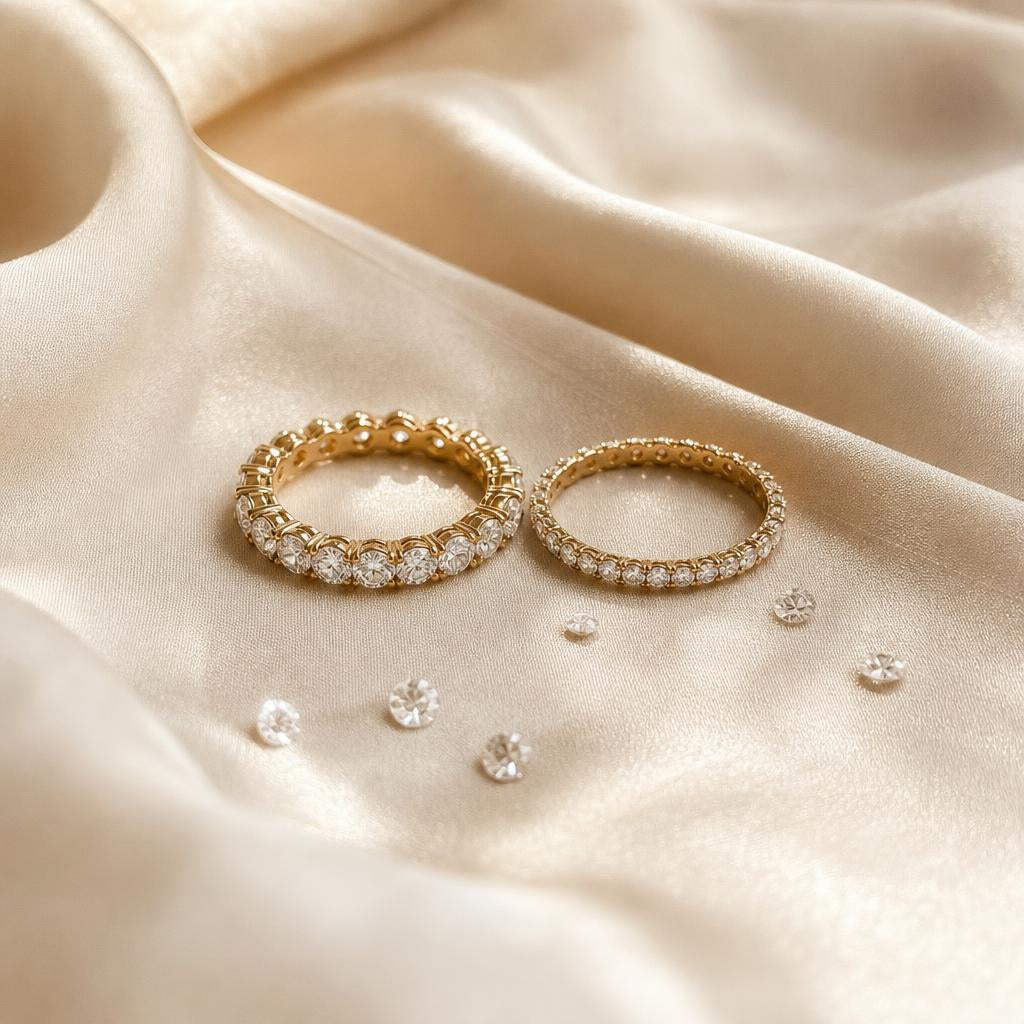
Do You Need a Stacking Band Ring If Your Eternity Ring Is Already Full?
Your eternity ring is already a full circle of stone. Every millimeter of the band catches light. So when someone tells you the next move is buying a plain wedding band to go underneath it, it's worth asking a genuinely intelligent question first: underneath it, doing what, exactly?
Stacking got popular because it let a ring say more than one thing at once. But a stacking band ring only earns its place next to an eternity ring if it's adding something the eternity ring doesn't already have — texture, a second metal tone, a shape the eye hasn't caught yet. Otherwise it's just more metal on the same finger. Here's how to tell the difference before you buy anything.


What "Full Eternity" Actually Means
An eternity ring is a band where stones run the entire way around — no gap, no plain metal underneath your finger, no break in the line. That's a deliberate design choice, not an accident: it's meant to read as complete on its own. When a jeweler describes a ring as a full circle of stone, they're telling you it was built to be the whole statement, not the first layer of one.
That matters, because most of the pressure to add a wedding band comes from habit, not logic. The traditional sequence — engagement ring, then wedding band, then eventually an anniversary band — was built around solitaires with plain shanks that genuinely needed something else to look finished. A ring that's already covered in stone from every angle isn't in that position. It doesn't have a gap to fill.
Worth knowing: An eternity wedding band is often chosen specifically because it doesn't need a second piece — the continuous line of stone already reads as a complete, considered ring on its own.
The Honest Case for Stopping at One Ring
If your eternity ring already wraps in stone, adding a second band next to it can start working against the design instead of with it. Three things tend to happen: the extra band competes with the eternity ring's own line instead of framing it, the two pieces shift and gap against each other because a fully stoned band doesn't have the flat, predictable shank a solitaire has, and — the one nobody mentions — the whole hand starts to look busy instead of considered. A ring built to be the entire statement doesn't need reinforcements to prove the point.
There's also a comfort argument that's easy to underrate until you've lived with it. Two textured bands sitting flush against each other, both catching on gloves, sleeves, and each other's prongs, is a genuinely different daily experience than wearing one ring that already does the job. If the appeal of your eternity ring was simplicity with maximum sparkle, stacking can quietly undo exactly what you bought it for.
When a Second Band Genuinely Adds Something
None of that means stacking is off the table — it means the second piece needs a reason to exist beyond "that's what you do." A second band earns its spot when it introduces something the eternity ring doesn't already have on its own.
A different cut, not more of the same
Pairing a round pavé eternity ring with a baguette-cut band, like The Devotion, gives the hand two distinct shapes instead of one continuous sparkle. The contrast reads as intentional in a way that matching cuts rarely do.
A setting with a different personality
A bezel-set band next to a pavé eternity ring — think The Cherish — brings in a smoother, more architectural line. It's the difference between a ring that only sparkles and a stack that has a quiet moment built into it.
A second metal tone, done on purpose
This is where a rose gold wedding band stack earns its keep. A silver eternity ring paired with a warmer rose gold band, like The Beloved or The Infinity, creates deliberate contrast instead of a mismatch. The key word is deliberate — pick one accent tone and commit to it, rather than layering three different metal colors and hoping they resolve themselves.

The Everlasting Ring
A continuous line of simulated diamonds set in sterling silver — built to sit as a clean second layer against a bolder eternity ring rather than competing with it.
Shop The Everlasting →Full Eternity vs. Half Eternity: Why It Changes the Math
Not every eternity-style ring is built the same way, and the distinction changes whether stacking makes sense. A full eternity ring carries stone in a complete circle, including underneath the finger. A half eternity wedding band carries stone across the top half only, with plain metal along the base. That plain underside is exactly where a second, thinner band can sit flush without a fight — which is why half eternity styles stack more naturally than full ones.
If your ring is a true full circle, like The Eternity or The Everlasting, there's no plain metal for a second band to tuck against. Anything you add will sit on top of stone, not beside it, and the two pieces will compete for the same visual space. That's not a reason to avoid stacking — it's a reason to choose the second piece deliberately, with a different cut, setting, or tone, rather than reaching for the first plain band you find.

The Infinity Ring
Delicate crossing lines of simulated diamonds in rose gold, designed to sit as an accent piece rather than a competing centerpiece next to a silver eternity band.
Shop The Infinity →What Actually Makes Something a "Stacking Band Ring"
The term gets used loosely, but a true stacking piece is designed to be worn as part of a set — thinner, lower-profile, built to sit flush against a neighboring ring rather than stand alone as a solitary statement. That's a different design brief than an eternity ring, which is engineered to be complete by itself. Knowing which one you're actually buying matters more than the name on the listing.
✦ Pro tip: Before adding a second ring, try wearing your eternity ring alone for a week. If you keep reaching for something else, you have a real reason to stack. If you don't, you have your answer.
A Simple Way to Decide
Ask three questions. Does the eternity ring already read as finished on its own — or does it genuinely look like it's missing something? Would the second piece add a new shape, setting, or metal tone, or would it just repeat what's already there? And would you still choose to wear both rings together on a plain Tuesday, not just for a photo? If the answer to all three points toward "yes, add it," adding a second ring is a genuine upgrade. If it doesn't, wearing the eternity ring alone isn't a compromise — it's the ring doing exactly what it was designed to do.
Quick Takeaways
- A full eternity ring is designed to be a complete statement on its own — it doesn't need a second band to look finished.
- Stacking works best when the added piece brings something new: a different cut, a different setting, or a deliberate second metal tone.
- Half eternity styles leave room underneath for a band to sit flush; full eternity styles don't, so choose the second piece with more intention.
- Mixing metals in a stack should use one deliberate accent tone, not several colors layered without a plan.
- If you're not sure, wear the eternity ring alone first — the answer usually becomes obvious within a week.
Frequently Asked Questions
Can you wear an eternity ring as a wedding band on its own?
Yes. An eternity ring's continuous line of stone was designed to function as a complete ring, not a placeholder for something else. Plenty of women wear one alone permanently, with no second band added at any point.
Is a full eternity band or a half eternity band better for stacking?
Half eternity styles stack more easily, since the plain metal underneath gives a second band somewhere to sit flush. A full eternity ring can still be stacked, but the second piece should be chosen for contrast — a different cut, setting, or metal tone — rather than picked at random.
What actually makes a ring a stacking band ring instead of just a ring?
Design intent. A true stacking piece is built thinner and lower-profile on purpose, meant to sit flush against a neighboring ring. An eternity ring is built to be complete on its own — the two serve different jobs, even when they're worn together.
Are stacking rings still in style, or is the trend fading?
Stacking hasn't faded — it's become more deliberate. The current direction favors two or three considered pieces with a clear reason for each one, over five or six rings added without a plan. A single eternity ring, worn alone, is just as current as a curated stack.
Do rose gold and silver stacking bands actually work together?
They do, when it's a deliberate choice rather than an accident. One warm rose gold accent against a silver eternity ring reads as considered. Mixing several different metal tones without a plan is what makes a stack look unintentional.
Whichever way you land, the point of an eternity ring was never to leave you needing more. Whether you wear it alone or build a considered stack around it, the ring was designed to hold its own — and it still does.


