

Your Ring Stopped Fitting — Here's Why, and What to Wear in the Meantime
Your ring fits on Monday. By Friday, it won't slide past your knuckle. Or worse — it squeezes your finger all the way through a long day, and you spend the commute home wondering if it's stuck. Finger size changes more than most people realise, and when those changes are significant enough, your ring simply stops being wearable. You don't have to go without — you just need to know what's going on, and what to reach for in the meantime.
Whether the cause is pregnancy, summer heat, hormonal shifts, or gradual body changes that crept up without announcement, the answer is the same: have something beautiful that fits you today. These are some of our favourites to wear while you wait it out.


Why fingers change size — and why it's almost never your fault
The first thing worth saying: if your ring stopped fitting, it almost certainly isn't because of something you did wrong. Fingers are one of the most fluid parts of the body — they swell and shrink in response to dozens of factors, most of them completely outside your control.
Heat and humidity
Hot weather is one of the most common culprits, and one of the most overlooked. When you're warm, blood vessels near the surface of the skin dilate — your body's way of releasing heat. That dilation causes a small but noticeable increase in the volume of your fingers, and a ring that fit perfectly in February can feel uncomfortably tight in August. This resolves as soon as the temperature drops, but if you're spending extended time somewhere warm — a holiday, a hot summer, a job in a heated environment — it can persist for weeks.
Sodium and fluid retention
Salt pulls water into your cells. Eat a particularly salty meal — or spend a few days eating out, where sodium levels are often far higher than home cooking — and you'll often notice your fingers feeling puffier the following morning. This is simple fluid retention: your body holding onto water to dilute the excess sodium. It typically resolves within a day or two of drinking more water and cutting back on salt, but it can be enough to make a ring that usually fits feel like it's cutting off your circulation.
Time of day
Fingers are often smallest in the morning and largest in the evening. After a full day of activity — holding bags, typing, gripping things — blood tends to pool slightly in the lower extremities, including your hands. If your ring fits when you put it on at 7am but feels tight by 7pm, this is almost certainly why. It isn't a sign your ring has changed size; it's a sign that sizing is more variable than most jewellery retailers ever mention.
Hormonal fluctuations
The menstrual cycle causes measurable changes in water retention throughout the month. In the days before a period, progesterone and oestrogen shifts prompt the body to hold more fluid — and that fluid distributes everywhere, including the hands. Some women notice their rings are noticeably tighter in the week before their period and looser again once it starts. If you've noticed this pattern but assumed it was in your head, it isn't.
Pregnancy
Pregnancy is the single most significant cause of finger swelling for most women, and the one that causes the most anxiety around rings. During pregnancy, blood volume increases by around 40–50%, and the body retains significantly more water to support the developing baby and placenta. The result is swelling throughout the body — in the hands, feet, and ankles — that tends to be most pronounced in the second and third trimesters.
Most women find swelling peaks in the third trimester, particularly in hot weather or after a long day on their feet. For some it's manageable. For others, rings become impossible to wear well before their due date, and forcing them on and off creates unnecessary risk — both of damaging the ring and of getting it stuck on a finger that swells further overnight.
Worth knowing: Many women remove their rings somewhere between 25 and 32 weeks as a precaution. This isn't a sign of a problem — it's just sensible. Finger swelling during pregnancy is normal, extremely common, and temporary.
After birth, most women's fingers return to close to their pre-pregnancy size within two to six weeks, though the timeline varies. Some notice the change almost immediately; for others it takes longer, particularly while breastfeeding (which affects hormone levels and fluid retention in its own ways). A small number find that their ring size has shifted permanently once everything settles — usually by half a size to one full size.
Weight changes
Gradual weight gain or loss over time is one of the less discussed causes of rings no longer fitting — partly because it happens slowly enough that it can catch you off guard. You haven't changed anything specific, but suddenly the ring you've worn for years is either squeezing your finger or slipping off when you shake your hand, and you can't pin the change to a single moment. Body composition shifts can permanently alter your ring size, often by half a size to a full size in either direction.
The standard advice here is to wait until your weight has been stable for a few months before resizing a ring you care about, since resizing has limits depending on the metal and setting style. In the meantime, wearing a different ring in the right size is the most practical solution.
Medications and medical conditions
Certain medications — including some blood pressure drugs, corticosteroids, antidepressants, and hormonal contraceptives — can cause fluid retention as a side effect. Conditions like hypothyroidism, kidney disease, and lymphoedema can also cause persistent swelling in the hands. If your rings have stopped fitting and none of the above explanations feel relevant, it's worth mentioning to a doctor.
What to actually do when your ring won't fit
Don't force it
This sounds obvious, but it bears repeating: forcing a ring over a swollen finger causes more problems than it solves. The ring compresses the already-swollen tissue, which can worsen the swelling and make removal harder. If your ring won't slide on without effort, leave it off — especially during pregnancy, when fingers can swell quickly and unpredictably.
Wear it on a necklace
A classic solution: thread your ring onto a fine chain and wear it as a pendant. It stays close, it stays meaningful, and it removes the worry of getting it stuck. For an engagement ring with sentimental value, this is often the most emotionally satisfying answer for a shorter pause.
Try a silicone ring adjuster
Silicone ring adjusters — small plastic or silicone wraps that attach to the inside of the band — are inexpensive and effective for a ring that's become slightly too loose rather than too tight. They don't work in reverse (you can't make a too-tight ring fit a larger finger), but if your weight has dropped and a ring you love is now slipping off, they're a useful and near-invisible fix.
Order a ring you love in a size that fits right now
This is the practical choice — and usually the most satisfying one. If your ring won't fit for the foreseeable future, whether that's the remaining months of pregnancy, an extended warm-climate trip, or a more permanent body change, buying a ring you genuinely love in your current size means you're not spending that time bare-fingered. A well-made simulated diamond ring is ideal here: the look is virtually indistinguishable at normal viewing distance, modern stone quality is genuinely impressive, and you're not leaving a meaningful ring stuck in a drawer.

The Destiny Ring
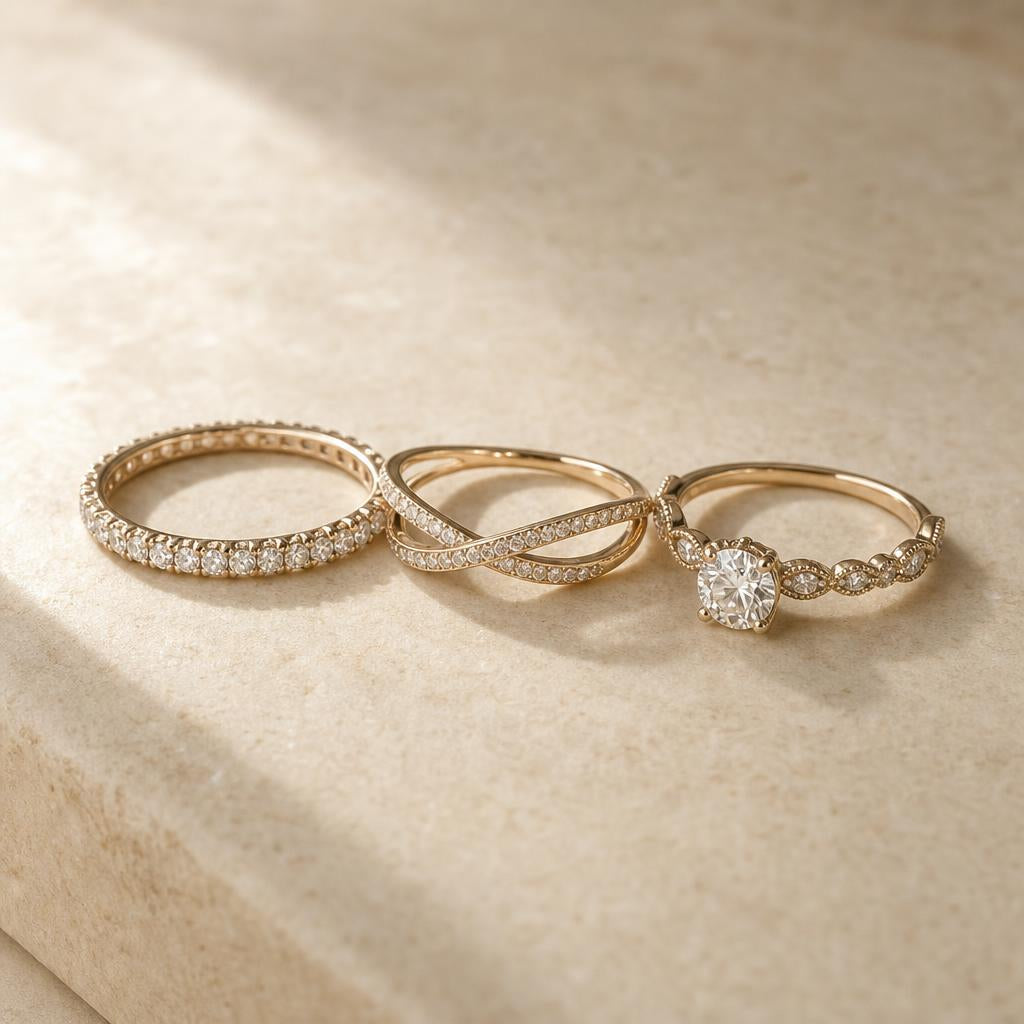
Two delicate pavé bands intersecting at the centre — light enough to feel effortless, sparkly enough to look intentional. This is the kind of ring that reads as an elegant choice, not a stand-in. A beautiful thing to wear every day while your usual ring waits.
Shop The Destiny Ring →How to measure your finger size at home
Before ordering, it's worth measuring your current size properly — particularly if you're buying during pregnancy, when your size may be changing week by week. A few methods worth knowing:
- String method: Wrap a thin strip of paper around the base of the finger you want to wear the ring on. Mark where it overlaps, then measure the length in millimetres. Divide by 3.14 to get the internal diameter, then compare to a standard ring size chart.
- Existing ring: If you have a ring that already fits the target finger comfortably, measure its internal diameter in millimetres and match it to a size chart. This is the most accurate method for an online order.
- Measure at the right time: Take your measurement in the evening, or when your hands are slightly warm — this gives you the larger end of your natural size range, which is more useful when buying a ring that should be comfortable throughout the whole day.
- Size up if in doubt: A ring that's fractionally loose is far easier to manage than one that's tight. You can always use a silicone adjuster to fill a small gap.
✦ Tip for pregnancy: Order based on your current finger size at the time of ordering, not your pre-pregnancy size. If you're in the second trimester, size up by at least one whole size to account for further swelling in the third. A ring that's slightly loose is easy to manage — a ring that's stuck on a swollen finger is not. When in doubt, go bigger.

The Beatrice Ring
A round-cut simulated diamond on an intricately detailed pavé band — the kind of ring that looks considered and wears beautifully every day. If you're going to wear something while your usual ring waits in a box, The Beatrice makes the pause feel like a deliberate choice, not a compromise.
Shop The Beatrice Ring →When will things go back to normal?
For most temporary causes — heat, sodium, the menstrual cycle — swelling resolves within a day or two of removing the trigger. For pregnancy, the timeline is longer: most women see their fingers return to close to their pre-pregnancy size within two to six weeks postpartum, though it can take a little longer if breastfeeding continues. A small number find their ring size has shifted permanently once everything settles, usually by half a size to one full size in either direction.
For weight-related changes, the equation is simpler: your ring size will roughly stabilise when your weight does. If you've experienced a significant change — more than a dress size or two — it's worth having your original ring professionally measured before committing to a resize, since different metals and settings have different limits.
What's true across all of these situations is that going without a ring for an extended period is entirely unnecessary. The range of beautiful, well-made rings available at a sensible price point means there's no reason to spend months bare-fingered — and a ring that fits you properly right now might turn out to be something you reach for long after the original is back on your hand.
Quick Takeaways
- Fingers change size in response to heat, sodium, hormones, pregnancy, and body composition — often by a full ring size or more
- Swelling during pregnancy typically peaks in the third trimester and resolves within weeks of birth
- Don't force a ring onto a swollen finger — remove it early and keep it safe
- Wearing a ring on a necklace is a practical and emotionally meaningful option for shorter pauses
- For longer periods, order a ring you love in your current size — you'll be glad you did
- Measure in the evening and always size up if you're between sizes or your fingers are still changing
Frequently asked questions
Will my ring fit again after pregnancy?
For most women, yes — fingers return to pre-pregnancy size within two to six weeks of giving birth, sometimes sooner. A small number of women find their size has permanently shifted, usually by half a size to one full size. If your ring still doesn't fit eight weeks postpartum, it may be worth having it professionally measured for resizing.
How much can fingers swell during pregnancy?
It varies considerably. Some women barely notice a change; others go up two or three full ring sizes, particularly in the third trimester. Swelling is typically worse in hot weather, after standing for long periods, and later in the day. Staying well hydrated and avoiding excess salt can help manage it.
Is it safe to wear my ring during pregnancy?
As long as it fits comfortably and can be removed without difficulty, yes. The risk comes when a ring becomes tight — swelling can worsen quickly in heat or during labour, making a tight ring very difficult to remove. Many doctors recommend removing rings by the third trimester, or earlier if you notice any tightness or discomfort.
What size should I order if I'm not sure?
If you're between sizes — or ordering during pregnancy when your size is still changing — always size up rather than down. A slightly loose ring is easy to manage with a silicone adjuster; a too-tight ring during pregnancy is uncomfortable and potentially difficult to remove safely. When in doubt, go bigger.
Can I resize my ring later if my size changes permanently?
Most rings can be resized by a professional jeweller, though the extent depends on the metal and setting. Solid sterling silver and gold can usually be sized up or down by one to two sizes. Eternity bands and rings with stones running all the way around are harder to resize without affecting the stones. Check with your jeweller before assuming it's straightforward.
Your ring not fitting right now is not a problem — it's one of the most ordinary things about wearing jewellery for years. The practical response is simply to have something beautiful that does fit, and to stop worrying about the rest. Keep your original ring somewhere safe. And when the time comes, put it back on.


