

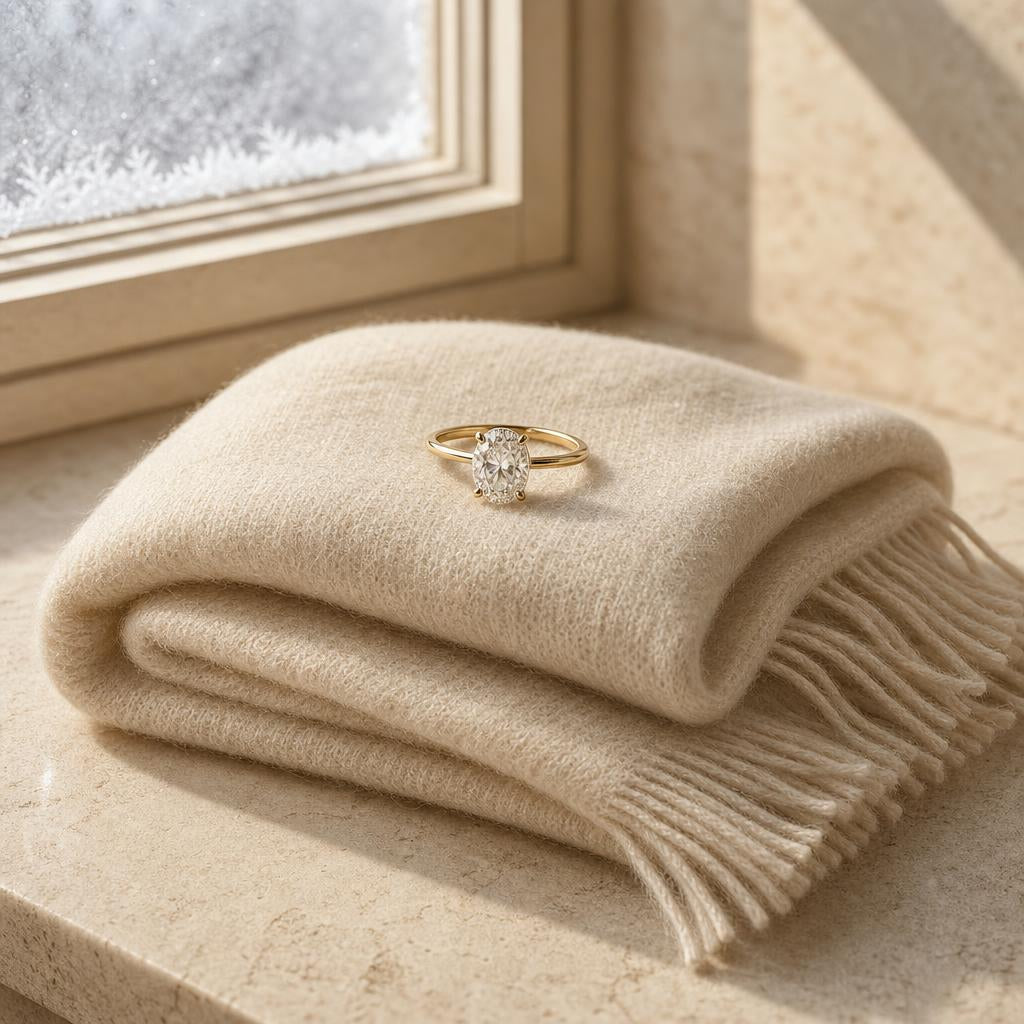
Winter Travel Ring Guide: What Actually Holds Up in Snow, Salt & Dry Heat
Winter is the season that quietly wrecks jewelry. Not through one dramatic accident — through a hundred small ones. Dry cabin air pulls moisture out of everything, including the finish on a ring. Sidewalk salt gets tracked into gloves. Radiators and hotel heating run hot and constant. And a ring that fits perfectly in October can feel like a vice by the time your flight lands somewhere colder. If you're packing for a winter trip, the ring on your hand deserves the same planning as everything else in your suitcase.
That's exactly what a travel ring is built for: a piece that looks like the ring you'd never want to risk, without the risk. Before we get into what actually holds up through a season of snow, salt, and dry heat, here are four Gemiros styles built for exactly this kind of trip.


Why winter is uniquely hard on a ring
Every season has its own jewelry hazards, but winter stacks several of them at once. Indoor heating systems drop humidity to levels closer to a desert than a home, which is part of why skin, hair, and metal finishes all look a little duller by February. Sidewalk and road salt is corrosive by design — it's built to break down ice, and it isn't gentle on metal it touches along the way. Gloves mean constant friction against a ring's surface, all day, every day you're wearing them. And temperature swings — freezing outside air, then a blast of dry heat the second you walk indoors — cause metal to contract and expand slightly, which is exactly the kind of repeated stress that loosens a setting over years of wear.
None of this is a reason to leave every ring at home for the winter. It's a reason to be specific about which one goes with you.
Worth knowing: Choosing moissanite or a simulated diamond for winter conditions isn't a downgrade — it's the more rational choice. Indistinguishable from a diamond and passes diamond testers, without the anxiety of exposing a piece you can't easily replace to salt, gloves, and hotel radiators for two weeks straight.
What actually holds up: the material question
The base metal underneath the plating matters more in winter than almost any other season, because dry air and temperature swings are hardest on finishes. Gemiros rings are built on a 925 sterling silver base with rhodium, 18k gold, or rose gold plating — hypoallergenic and nickel-free, which matters when you're layering gloves over sensitive skin for hours at a time. The stones themselves are moissanite and cubic zirconia: lab-created, conflict-free, and set to the same standard whether the ring is headed to a boardroom or a ski chalet.
Solid gold reacts to temperature and humidity swings differently than a well-plated sterling silver base does, and it comes with a price tag that makes "what if I lose a glove with the ring still in it" a genuinely stressful thought. A travel engagement ring exists precisely to remove that calculation from your trip.
The settings that survive a winter trip best
Setting matters as much as material. A few structural choices make a real difference once gloves, scarves, and suitcase zippers enter the picture:
Bezel settings
A bezel wraps a rim of metal fully around the stone instead of holding it up with prongs. That means no snagging on wool, no catching on a glove lining, and no prong to bend if the ring gets knocked against a hard suitcase edge. The Cherish Ring is a strong example — low, smooth, and built to disappear into a stack rather than announce itself.
Solitaire settings
A clean four-prong or six-prong solitaire has fewer places for salt residue, moisturizer, or lint to collect than a heavily pavéd design. Fewer surfaces means less upkeep on a trip where you don't have your usual routine — or your usual jewelry cloth — on hand. The Stella Ring and The Odette Ring both keep the structure simple without reading as plain.
Architectural cuts
Step cuts like asscher and emerald sit lower and more evenly against the finger than many brilliant cuts of the same size, which means less surface catching on a glove edge as you pull it on and off all day. The Échelon Ring makes the case for a shape that's as practical as it is striking.

The Lumière Ring
A round-cut solitaire in a plain polished band — no pavé to trap salt, no halo to catch a glove seam. Built for a season where simplicity is the practical choice.
Shop The Lumière Ring →
The Verge Ring
A pavé split-shank band that still keeps its round-cut center stone in a secure, low-fuss setting — a good middle ground between plain and statement for a trip where you want a little sparkle without extra upkeep.
Shop The Verge Ring →Packing and care, once you're actually on the trip
A few habits do more for a ring's winter survival than any single material choice:
- Take it off before you moisturize. Hand cream and heavy winter lotions are the single biggest cause of a dulled-looking stone by the end of a trip — the residue builds up in the setting faster than you'd expect.
- Wipe down after outdoor exposure. If you've been walking through salted sidewalks or slush, a quick wipe with a soft cloth before you put your ring away for the night keeps residue from sitting against the metal overnight.
- Store it somewhere it can't roll. Hotel nightstands and ski lodge cubbies are exactly where rings go missing. A small pouch in a zipped inner pocket beats a bare nightstand every time.
- Size for gloves, not bare hands. Cold weather constricts fingers slightly, but gloves on and off all day means more friction on the band than usual — a ring that's already snug can start to feel tight by the second week of a trip.
✦ Pro tip: If you're flying, a ring on your hand is one less thing to think about at security — most travelers can simply wear it through the checkpoint without removing it, the same as any other ring.
Why a dedicated travel ring makes more sense in winter than any other season
Summer travel risk is mostly about water — pools, oceans, sunscreen. Winter risk is about chemistry and friction: salt, dry heat, constant glove contact, and temperature swings that stress a setting over the course of a trip. A travel engagement ring sidesteps all of it by design — it's not a lesser version of the ring you love, it's built to survive the exact conditions winter throws at it.
It's also worth saying plainly: choosing a moissanite or simulated diamond ring for a winter trip isn't a consolation prize. It's 925 sterling silver and lab-created stones, indistinguishable from a diamond to the eye and to a diamond tester — the kind of ring you can wear through an airport, a ski trip, or a week of below-freezing sightseeing without spending the whole trip thinking about it.
Quick Takeaways
- Dry indoor heat, road salt, glove friction, and temperature swings make winter uniquely hard on jewelry
- 925 sterling silver with rhodium or gold plating holds up better through winter conditions than most people expect
- Bezel and solitaire settings shed less residue and snag less on gloves than heavily pavéd designs
- Take rings off before moisturizing, and store them somewhere they can't roll away in an unfamiliar room
- Choosing a dedicated piece for winter isn't a downgrade — it's the more rational choice for the conditions
Frequently Asked Questions
What is the point of a travel ring?
It lets you wear something that looks like your real ring — or your engagement ring — without carrying the financial or emotional risk of exposing it to hotel safes, salted sidewalks, gloves, and unfamiliar hands for the length of a trip. It's a practical swap, not a compromise on how it looks.
Do you have to take a ring off when traveling in cold weather?
No — most people wear a ring through security and through the entire trip without issue. The bigger consideration in winter is fit: cold weather and constant glove use can make a ring feel tighter than usual, so make sure it's sized comfortably before you leave.
Will a ring set off airport security or get flagged at TSA?
A ring is small enough that it typically doesn't need to come off for standard walk-through metal detectors, and it won't read as a concern in carry-on jewelry bags. If you're wearing a larger statement piece, some travelers choose to remove it before the body scanner simply to avoid a pat-down, but it isn't a requirement.
Does cold, dry winter air actually damage sterling silver or moissanite?
Moissanite itself is extremely hard and unaffected by cold or dry air. Sterling silver can be more sensitive to humidity swings and salt exposure than solid gold, which is why a good rhodium or gold plating layer — and wiping the ring down after exposure to salted streets or slush — makes a real difference over a multi-week trip.
What's the smartest ring to bring on a winter trip?
Look for a low-profile setting — bezel or a clean solitaire — over anything heavily pavéd, since fewer surfaces means less salt and lotion residue to manage without your usual cleaning routine on hand. Simplicity of structure matters more in winter than in almost any other season.
That's the whole idea behind travel rings as a category — not a downgrade, a smarter tool for a specific job. The best one isn't the piece you have to think about the least while you're packing — it's the one you don't have to think about at all once you're wearing it. Pack accordingly.


