

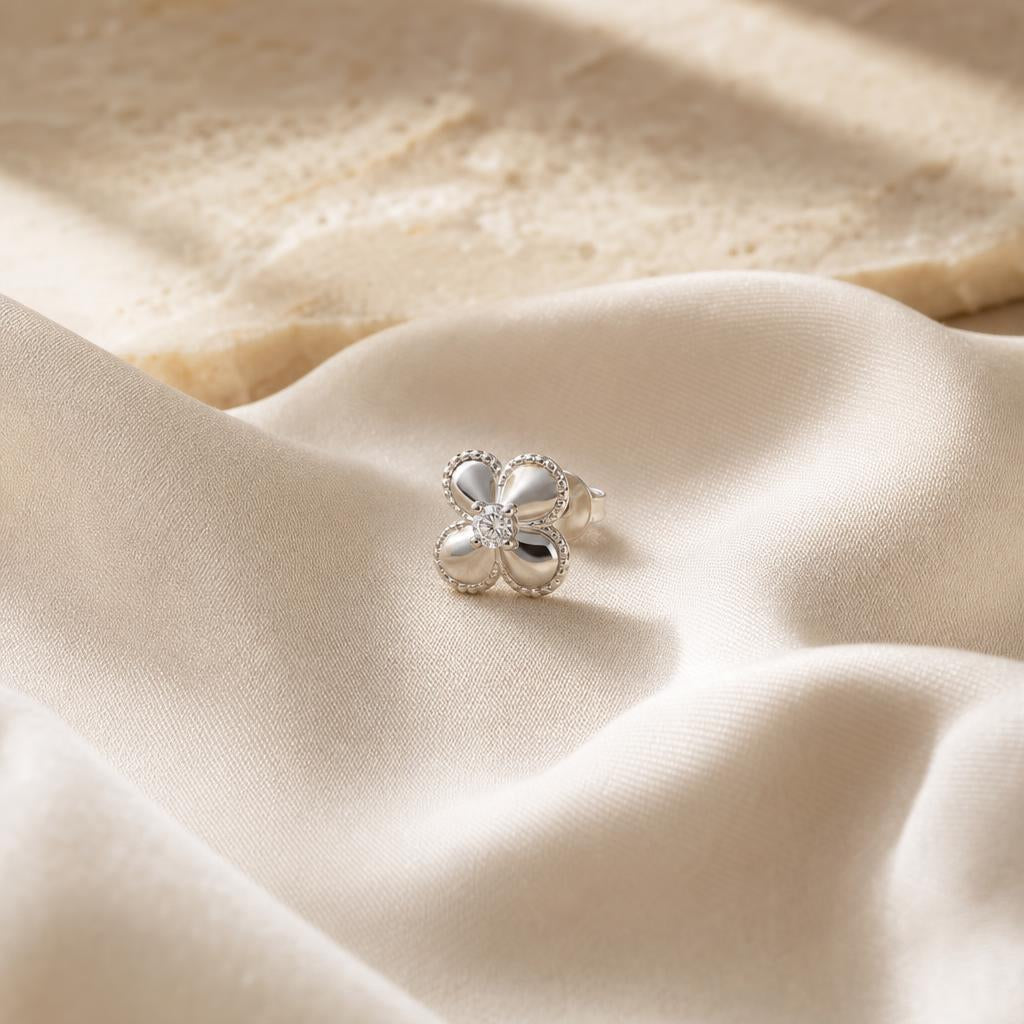
What Does 925 Mean on Jewelry? Decoding a Sterling Silver Earring Listing
You flip the earring over, hold it up to the light, and there it is — a tiny stamp reading "925." No one ever tells you what that actually means, so most women either shrug it off or quietly assume it's the polite way of saying "not real."
It's neither. It's a fact, and once you know how to read it, an earring listing stops being a guessing game and starts being information you can actually use. Here's what's currently catching the light in the Gemiros collection while we get into it.


So, What Does 925 Mean on Jewelry, Exactly?
Sterling silver is never 100% pure silver — pure silver, on its own, is soft enough to bend with a firm handshake, let alone survive a full day on your ears. So jewelers alloy it: 92.5% fine silver, 7.5% another metal, almost always copper, added purely for structure. That ratio is where "925" comes from. It is not a code, a grade, or a marketing term. It's a purity standard, set internationally, and it's stamped directly into the metal so anyone — a jeweler, an appraiser, you — can verify it at a glance.
That's the answer to the question most listings never bother to spell out. The number tells you what the piece is made of, not how nice it looks or what it's worth to sell — those are separate questions with separate answers, and conflating them is exactly how so many buyers end up more confused after reading a listing than before.
Worth knowing: "925," "Sterling," and "S925" all mean the exact same thing — 92.5% pure silver, 7.5% copper. Different manufacturers just prefer different stamps. None of them is a lesser version of the others.
The Difference Between "925," "Sterling," and Everything Else on the Tag
Where listings get genuinely confusing isn't the 925 itself — it's everything stacked on top of it. A gold-colored earring stamped "925" hasn't lied to you; it means the piece is built on a sterling silver base and then plated in gold, usually rhodium, 18k gold, or rose gold, for color and shine. The base metal and the finish are two different specs, and a well-written listing tells you both. Every Gemiros earring works this way: 925 sterling silver underneath, a plating layer for color, nickel-free throughout so it won't irritate sensitive ears.

The Éclat Moissanite Stud Earrings - Gold
Same 925 sterling silver base and six-prong moissanite solitaire as the original Éclat, finished in warm 18k gold plating for a completely different look on the same foundation.
Shop The Éclat Gold →The stone is its own separate line item, too, and this is where the smart reading pays off. A 925 stamp tells you nothing about what's set into the metal — it could hold a moissanite, a cubic zirconia, a lab-grown gemstone, or nothing at all. Gemiros pairs its sterling silver settings with moissanite and simulated diamonds engineered to be indistinguishable from a mined stone to the eye and to pass diamond testers. That's not a hedge or a workaround — it's the actual, defensible spec, and reading the listing correctly is how you confirm it rather than take it on faith.
What a "925 Stamp on Jewelry" Actually Confirms
The stamp itself is a small thing to look for, but it's doing a lot of work. A genuine 925 stamp on jewelry is usually pressed directly into the metal at manufacture — on the post of a stud, the inner edge of a hoop's band, or the back of a huggie's hinge — and it's meant to be permanent, not printed on a tag that gets thrown away. That's part of why it matters more than a listing's marketing copy: the metal is making a claim about itself that you can go check with a loupe or a jeweler's eye at any point after you buy, long after the original listing is gone. It's a small detail, but it's the difference between trusting a brand's word and trusting a physical fact stamped into what you're actually wearing.
Is 925 Sterling Silver Real Silver?
Yes, unambiguously. The confusion usually comes from somewhere else: silver-plated base metal, which is a thin layer of silver over something cheaper, often brass or nickel, and which will wear through with normal use. Genuine 925 sterling silver is solid all the way through — the alloy itself, not a coating on top of it. If a listing says "silver-plated" or "silver-tone" instead of 925 or sterling, that's the tell, and it's worth reading for specifically before you buy.
✦ Pro tip: Look for the stamp itself, usually on the post or the inside of a hoop's band. If a listing shows a clear photo of the "925" mark, that's a jeweler confident enough in the piece to let you verify it yourself.
What "925" Doesn't Tell You — And Why That's Useful to Know
Once you know what 925 confirms, it's just as useful to know what it leaves out. It doesn't tell you the setting style, the prong count, the closure type, or how the piece is likely to wear over years of use. Those details live in the rest of the listing — carat weight, stone shape, plating — and reading them together is what separates an earring you'll wear for a decade from one that quietly disappoints after a few months.

The Vivara Moissanite Huggie Hoop Earrings
A 925 sterling silver huggie set with brilliant round moissanite along a sleek pavé band — the kind of listing that's worth reading in full before it goes in your cart.
Shop The Vivara →Closures matter more than most listings let on, too. A post-and-butterfly-back stud sits differently against sensitive skin than a lever-back hoop, and if an earring has ever irritated your ear, the culprit is usually the alloy touching your skin directly at the post — which is exactly why nickel-free construction matters as much as the 925 stamp itself. Sterling silver is naturally hypoallergenic in a way many base-metal alternatives simply aren't, and reading for "nickel-free" alongside "925" is how you buy once instead of learning the hard way.
This is also where a lot of women get stuck on a fear worth naming directly: will this actually hold up, or will it look tarnished and sad in six months? Sterling silver can tarnish when it reacts with air and sulfur compounds — that's chemistry, not a defect — and it wipes off in seconds with a polishing cloth. It doesn't mean the piece is cheap, and it doesn't mean you bought wrong. A 925 stamp is a hallmark of quality construction built to be maintained, not a warning sign.
| Marking | What It Means | Should You Worry? |
|---|---|---|
| 925 / .925 | 92.5% pure silver, 7.5% alloy metal | No — this is the standard |
| S925 / STERLING | Same alloy, different manufacturer stamp | No — identical meaning |
| 999 | 99.9% fine silver, rarely used in wearable jewelry | No — just a different (softer) grade |
| "Silver-plated" / "silver-tone" | A thin silver coating over a different base metal | Yes — read the full spec before buying |
Why This Is Worth Actually Reading, Not Skimming
None of this is trivia for its own sake. Knowing how to read a listing is the difference between buying on a gut feeling and buying because you understand exactly what's arriving at your door — the metal, the plating, the stone, all confirmed before you spend a dollar. That's not a smaller way to shop. It's a smarter one, and it's the entire reason a 925 stamp exists in the first place: so you don't have to guess.
Quick Takeaways
- 925 means 92.5% pure silver alloyed with 7.5% copper for strength — it's a purity standard, not a quality downgrade.
- "S925" and "STERLING" mean the exact same thing as 925.
- A gold-colored 925 piece is sterling silver plated in gold — two separate specs, both worth knowing.
- "Silver-plated" or "silver-tone" is a different, thinner product than 925 sterling silver.
- Tarnish is a normal chemical reaction, not a sign of poor quality, and it polishes off easily.
Frequently Asked Questions
Do they put real diamonds in 925 silver?
Sometimes, though it's uncommon at accessible price points because mined diamonds are expensive regardless of the metal they're set in. What you'll find far more often — and what Gemiros uses throughout — is 925 sterling silver set with moissanite or a simulated diamond engineered to be visually indistinguishable from a mined stone and to pass standard diamond testers.
Can 925 be gold?
Not on its own — 925 always refers to the silver alloy underneath. A gold-colored piece stamped 925 is sterling silver that's been plated in rhodium, 18k gold, or rose gold for color. The plating changes the finish; it doesn't change what the base metal is.
Is 925 silver good quality?
Yes. It's the international standard for silver jewelry meant to actually be worn, not just displayed — durable enough for daily wear, workable enough for detailed settings, and easy to maintain with basic care. Pure silver alone would be too soft for any of that.
How do I know if a 925 stamp is genuine?
Look for the stamp itself — usually on the post, clasp, or inner band — and read the rest of the listing for consistency. A jeweler confident in their metal will show the stamp clearly and describe the plating and stones as separate, specific details rather than vague marketing language.
Is 925 sterling silver good quality for earrings you wear every day?
Yes — that's precisely what the standard was built for. 925 sterling silver holds a setting securely, resists everyday wear far better than pure silver would, and, with the light care described above, stays looking the way it did on day one for years of regular use.
The next time a listing says "925 sterling silver," you'll know it's not softening anything — it's telling you precisely what you're buying, in a language that was designed to be checked, not taken on faith.


